Every major war forces nations to discover what they are truly prepared for.
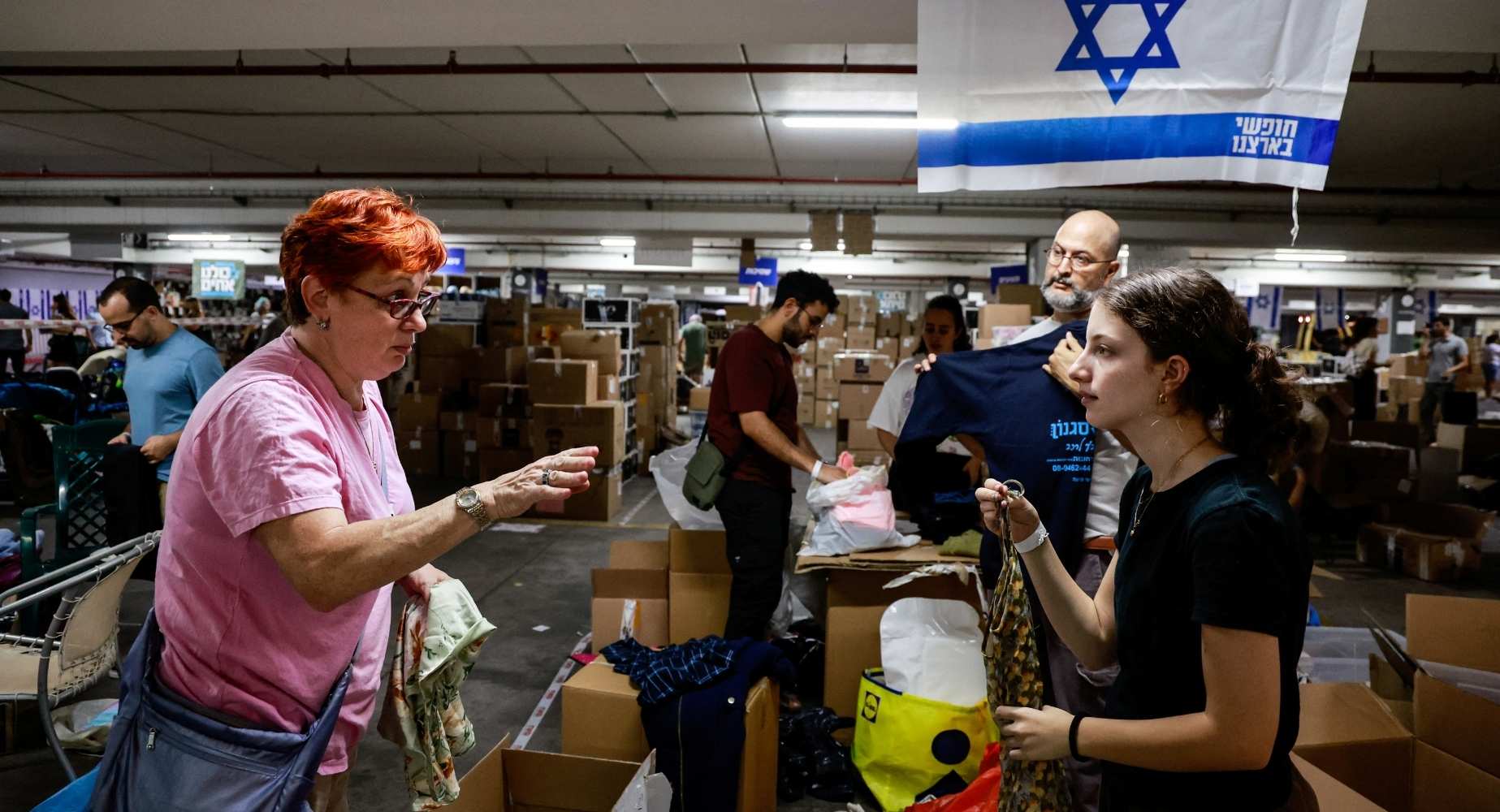
In the days following Hamas’s attack on October 7, Israelis witnessed something extraordinary. Before the government had fully organized its response, thousands of ordinary citizens already had. Volunteers transformed WhatsApp groups into nationwide logistics networks. Technology companies built emergency databases for missing persons. Families opened their homes to complete strangers. Local communities organized transportation, childcare, temporary housing, and mental health support. Businesses redirected production lines. Reserve units received food, medical supplies, and essential equipment through civilian initiatives before formal systems had fully adapted.
Faced with catastrophe, Israeli society did what it has done repeatedly throughout its history. It refused to wait.
Like millions of Israelis, I was deeply moved by those first weeks. They revealed something profoundly admirable about Israeli society: an instinctive sense of mutual responsibility that emerges whenever the country faces existential danger. For a time, I believed that was the story.
Looking back, I have come to think it was only half the story.
The volunteers did more than reveal the strength of Israeli society. They also exposed the limits of the institutions expected to organize the national response. The more extraordinary the civic mobilization became, the harder it was to ignore a simple but unsettling question: why did so many ordinary citizens have to improvise solutions that public institutions should have been prepared to deliver?
Much of the discussion that followed October 7 focused, understandably, on intelligence failures, military preparedness, political leadership, and the conduct of the war itself. Those debates remain essential, and historians will continue to revisit them for years. Yet another question has received far less attention: what happens when a democracy discovers that one of its greatest vulnerabilities lies not only in its ability to defend itself, but in its ability to organize itself?
Israel confronted that question under the most dramatic circumstances imaginable. But the question itself is not uniquely Israeli.
Over the past two decades, democratic societies have been confronted by crises that seemed unrelated: the global financial crisis, COVID-19, supply-chain disruptions, climate shocks, cyber threats, and now the rapid rise of artificial intelligence. Each crisis differed in cause and character. Yet each demanded something similar from democratic societies: the ability to coordinate complex systems, mobilize expertise, adapt quickly, and translate public decisions into effective action.
These crises rarely reveal a lack of intelligence, innovation, technology, or even financial resources. More often, they expose something less visible: the difficulty of turning those strengths into collective capability.
For much of the late twentieth century, democratic politics revolved around a familiar debate. How much should governments do? How much should markets do better? Those questions shaped elections, economic reforms, and ideological divisions across much of the democratic world. They remain important. But recent experience suggests they are no longer sufficient.
Increasingly, one of the defining questions facing democracies is not simply how large government should be, but whether democratic institutions retain the ability to govern effectively under conditions of growing complexity.
Political scientists have a name for this capability: state capacity. The phrase is technical. The underlying idea is not. It describes something citizens recognize instinctively when crisis strikes: whether public institutions can transform democratic decisions into effective action.
Seen through that lens, October 7 looks different. It was not only a military test. It was also a test of democratic resilience.
Thinking about October 7 led me to a broader question: how do we measure national strength?
For generations, the answer appeared self-evident. Nations were judged by the size of their economies, the strength of their armed forces, the sophistication of their technology, and the productivity of their industries. Those measures remain indispensable. Military power still deters aggression. Economic dynamism still creates prosperity. Technological leadership still shapes geopolitical influence.
But recent experience suggests they are no longer sufficient on their own.
This is not because public institutions suddenly matter. They always have. What has changed is the environment in which they operate, and therefore their strategic importance.
The twenty-first century is defined by interconnected risks. Pandemics spread across borders in weeks. Cyberattacks can disrupt essential services without a shot being fired. Climate events cascade through infrastructure, agriculture, public health, and housing. Artificial intelligence transforms labor markets faster than education systems can adapt. Supply chains that once symbolized efficiency can quickly become sources of strategic vulnerability.
These challenges differ in their origins, but they share one defining characteristic: they place extraordinary pressure on a society’s ability to coordinate.
That ability is becoming one of the most valuable strategic assets a democracy possesses. Increasingly, national resilience depends not only on the resources available to a country, but on its capacity to organize those resources when circumstances demand it.
This is where the discussion often becomes unnecessarily ideological. Some hear an argument for a larger state. Others hear an argument against markets. Neither interpretation captures what recent experience actually suggests.
The remarkable resilience displayed by Israeli society after October 7 depended on three different sources of strength.
The private sector adapted with speed and creativity. Technology companies built platforms, manufacturers redirected production, and businesses solved logistical problems that had not existed the week before.
Civil society mobilized on an extraordinary scale. Volunteers reached isolated communities, supported displaced families, cared for the wounded, and created networks of mutual assistance that no government could have assembled overnight.
Public institutions, where they functioned effectively, performed tasks that neither markets nor volunteers could perform alone: coordinating national logistics, maintaining critical infrastructure, managing public health, ensuring continuity across sectors, and acting with the legitimacy that only democratic institutions possess.
Each pillar contributed something unique.
Markets create innovation and prosperity. Civil society creates solidarity and trust. Public institutions create the capacity for collective action at scale. Healthy democracies depend on all three. The mistake is not to value one over another. The mistake is to assume that any one of them can permanently substitute for the others.
This distinction matters because democratic societies have spent decades becoming very good at improving efficiency. Supply chains became leaner. Organizations reduced redundancy. Public services adopted performance metrics borrowed from private management. Technological innovation accelerated decision-making across almost every field. Many of these developments produced enormous benefits.
But they also reflected an implicit assumption: that the future would largely resemble the past.
Efficiency works best when conditions are predictable. Resilience becomes indispensable when they are not. The distinction is subtle during periods of stability. Crisis is what makes it visible.
The lesson is not that democracies placed too much emphasis on efficiency. It is that efficiency and resilience answer different questions. Efficient systems maximize today’s performance. Resilient institutions preserve tomorrow’s capacity. Modern democracies need both.
This shift has profound implications for how we think about national security.
For much of modern history, military policy, economic policy, and social policy occupied separate intellectual worlds. Military planners thought about deterrence, intelligence, force structure, and logistics. Economists focused on productivity, investment, trade, and growth. Social policy dealt with education, healthcare, welfare, and local government.
Increasingly, those boundaries have become harder to sustain.
A resilient healthcare system is not only a social asset. It is part of national preparedness. Reliable infrastructure is not only an economic concern. It is strategic infrastructure. Education is not only about opportunity. It is about a country’s long-term capacity to adapt to technological and geopolitical change. Public trust is not only a democratic value. It is operational capacity during crisis.
This does not mean that everything has become national security. Quite the opposite. It means that national security itself has become inseparable from the broader capacity of democratic societies to function effectively.
Military strength remains indispensable. No country can substitute institutional competence for credible defense. But the relationship increasingly runs in both directions. Modern militaries depend upon functioning civilian systems far more than they once did. Armies rely on transportation networks, healthcare systems, digital infrastructure, energy grids, industrial production, local authorities, scientific research, and public confidence.
The battlefield no longer begins where civilian life ends. It extends through it.
Israel’s own history offers an important reminder of this principle. Long before it became known as the Start-Up Nation, Israel was, above all, an institution-building project. Its founders understood that political independence alone would never be enough. They invested in universities before there was a knowledge economy to sustain them. They built healthcare systems before the country was prosperous. They developed water infrastructure before scarcity became an existential emergency. They created institutions capable of absorbing mass immigration, establishing new communities, educating citizens, and governing a state under extraordinary conditions.
None of these institutions was perfect. Nor should they be romanticized. The point is not nostalgia. The point is that Israel’s founders understood something democracies often forget when times are stable: resilience is built long before it is tested.
That insight is worth recovering today, not because democracies should recreate the institutions of the past, but because they face a similar challenge in a very different world. Institution-building is never finished. Like democracy itself, it is a continuous process of adaptation.
The institutions needed for the coming decades will not look like those of the mid-twentieth century. They will need to be more agile, more transparent, more technologically capable, and better able to work across traditional boundaries between government, business, academia, and civil society. But the underlying principle remains the same. Strong societies do not merely rely on spontaneous resilience when crisis arrives. They invest in the structures that make resilience possible.
Looking back, I no longer see the volunteers of October 7 only as a story of extraordinary civic solidarity. They were certainly that. But they were also something else. They reminded us that resilience does not begin when citizens step forward in moments of crisis. It begins years earlier, in the patient work of building institutions capable of turning civic energy into national capacity.
This is not a lesson for Israel alone. Across the democratic world, societies are becoming more innovative, more interconnected, and more exposed to shocks that ignore traditional boundaries between war and peace, domestic policy and national security, economics and geopolitics.
In that world, resilience cannot be measured only by the strength of an economy or the sophistication of a military. It also depends on whether public institutions retain the capacity to anticipate, coordinate, adapt, and act when societies need them most.
For decades, democracies focused largely on making economies more productive and markets more efficient. Those achievements should not be underestimated. But the defining challenge of the decades ahead may be different. It may be learning how to build institutions that are as resilient as the societies they are meant to serve.
Efficient systems maximize today’s performance.
Resilient institutions preserve tomorrow’s capacity.
That may prove to be one of the enduring lessons of October 7.
