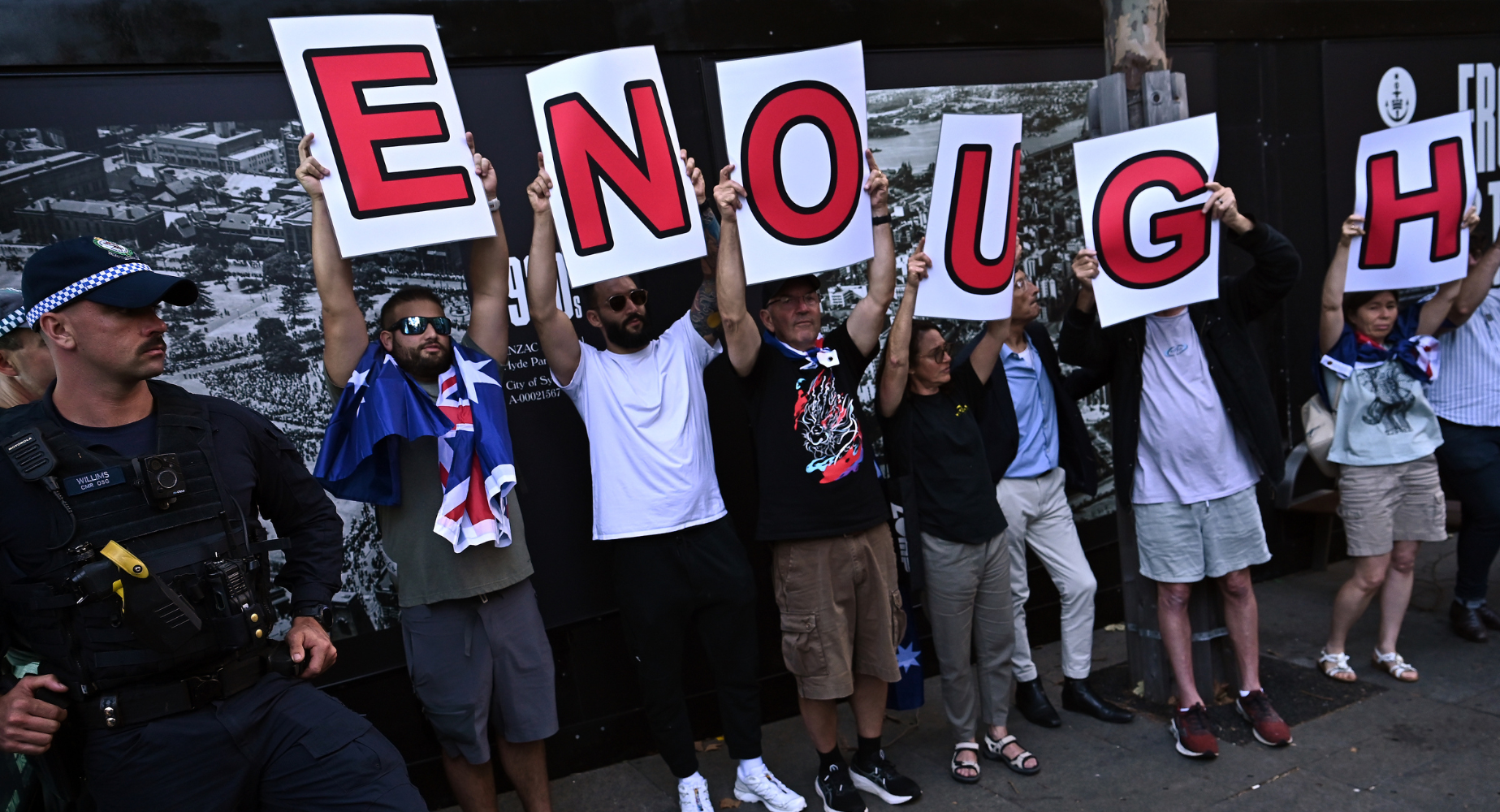
For more than two years now, a small number of Australians have warned that the country was drifting into dangerous territory: not through sudden radicalization but through a steady normalization of hate speech, blurring of moral boundaries and tolerance of rhetoric that often precedes violence.
Those warnings were not abstract. They were made repeatedly across Australia’s major media outlets. And they were largely dismissed as alarmist.
Australia is now paying the price.
In recent months Australia has experienced the largest escalation of antisemitic violence of any liberal democracy: a synagogue firebombed, another narrowly escaped the same fate, an attempted arson and physical attack on the head of the Executive Council of Australian Jewry, hundreds of Jewish creatives doxed, dozens of Jewish businesses vandalized, school children abused in public and Jewish schools and institutions defaced with explicitly pro-Nazi and anti-Jewish graffiti. All this culminated in the Bondi Beach attack on a Hanukkah celebration on December 14, 2025, in which 15 people were murdered.
This is a strategic failure, arguably the most profound in Australia’s history outside its historical treatment of Aboriginal and Torres Strait Islander peoples.
On January 8, the Prime Minister announced the establishment of a Royal Commission into antisemitism and social cohesion. Its proposed terms of reference recognize failures in law enforcement, education systems and regulatory frameworks. They explicitly connect antisemitism to the broader erosion of social cohesion and democratic norms.
Royal Commissions are not convened lightly. They are instruments of last resort, used when governments accept that existing systems have failed, trust has been broken and that incremental reform is not sufficient.
Prior to Christmas, the Prime Minister had already announced a five-point reform package aimed at antisemitism and radicalization, including higher penalties for incitement, enhanced visa cancellation provisions and a national effort to address antisemitism in schools and universities.
The announcement of a Royal Commission also represents an implicit admission that Australia did not arrive at this moment suddenly. Multiple governments at the local, state and federal levels failed to act earlier when the risks were visible, measurable and manageable.
For years the Commonwealth had options. It could have moved to list extremist organisations such as Hizb ut-Tahrir and Islamist movements like the Muslim Brotherhood. It could have acted decisively against hate preachers whose rhetoric glorifies terrorist violence including individuals who have openly praised ISIS and the murder of Jews. Existing legal and migration powers were available, they simply were not used.
Meanwhile, Islamist activists learned how to cloak antisemitism in the language of anti-Zionism and how to exploit liberal democracies’ discomfort with drawing hard lines. What followed was entirely predictable: rising rhetoric, escalating intimidation and ultimately the arrival of violence.
Much of the current political blame is being directed at the Federal Government even though the vast majority of operational failures occurred at state level. Policing decisions not taken, prosecutions not pursued, phrases such as “globalize the intifada” left unchallenged in public spaces and a reluctance to test existing public-order and incitement laws for fear of controversy or “inflaming” the situation.
The state-federal distinction matters. But it does not absolve Canberra. Federal governments set the tone and determine whether extremism is treated as a marginal issue or as a core security concern. When the Commonwealth hesitates, state jurisdictions take their cues accordingly.
Nowhere was this clearer than in the aftermath of Hamas’s attack of October 7, 2023. Australian Foreign Minister Penny Wong’s initial statement acknowledged Israel’s right to defend itself while immediately urging restraint.
On October 9, 2023, before Israel had mounted a military response, protesters gathered on the steps of the Sydney Opera House celebrating the murder of Jews and calling for further jihad and violence. Flares were lit and the images travelled the world. The New South Wales police response was negligible and no meaningful legal consequences followed. In fact the local police debated whether the chants included “Gas the Jews” or “Where’s the Jews” before settling on the latter. Either would have been abhorrent and went unchecked regardless.
It can never be proven that prosecuting those responsible for hate speech on October 9, 2023 would have prevented the tragic events of Bondi on December 14, 2025. But it is reasonable and strategically sound to argue that accountability deters escalation. Democracies that fail to enforce boundaries teach extremists exactly how far they can go.
One of the most corrosive elements of Australia’s experience has been the deliberate conflation of Zionism with uncritical support of the policies of Israel. I have been publicly critical of Israeli government policy for years. I oppose settlement expansion. I oppose settler violence. Two months after October 7 I called for Prime Minister Benjamin Netanyahu’s resignation in an interview on Sky News Australia, arguing that the attack occurred under his Prime Ministership and that his reliance on extremists such as Itamar Ben Gvir and Bezalel Smotrich to maintain power represented a failure of leadership, not strength.
That is political criticism. It is legitimate and certainly not inconsistent with Zionism.
Zionism was a political movement 150 years ago. With the establishment of Israel nearly 80 years ago, it became something simpler and more fundamental: belief in the Jewish people’s right to a state and to live within safe and secure borders. That so few Australian political leaders are prepared to state publicly that they are Zionists speaks volumes. When governments refuse to call out attacks on Jews masquerading as anti-Zionist rhetoric, extremists are allowed to hide in plain sight.
The Royal Commission’s success will depend on whether it is prepared to confront uncomfortable truths, including how language, ideology and institutional timidity interacted to produce the conditions we now face.
There is a risk that process will replace urgency. Royal Commissions, task forces and consultation frameworks have value only if they lead quickly to visible enforcement and durable change. Communities do not measure seriousness by the calibre of commissioners or the elegance of drafting. They will measure it by prosecutions, listings, and deportations where appropriate.
Australia’s Jewish community is angry not because it seeks special treatment, but because it warned repeatedly where this would end: that anti-Zionism was being used as cover for antisemitism, that slogans with a long history of bloodshed were being laundered into respectable discourse, that failure to act early would lead to escalation.
This moment therefore extends beyond antisemitism. It goes to whether Australia understands that social cohesion is not self-sustaining and that liberal democracies must actively defend their values or watch them hollow out.
The Prime Minister’s decision to establish a Royal Commission is a start. It is not redemption.
Australia’s credibility will be judged by whether people feel safe walking to synagogue, sending their children to school or wearing a kippah or a Magen David without fear. It will be judged by whether leaders are prepared to confront hate consistently, clearly and early even when it is politically inconvenient.
Strategic failure does not begin with violence. It begins with hesitation. Australia has hesitated long enough.
