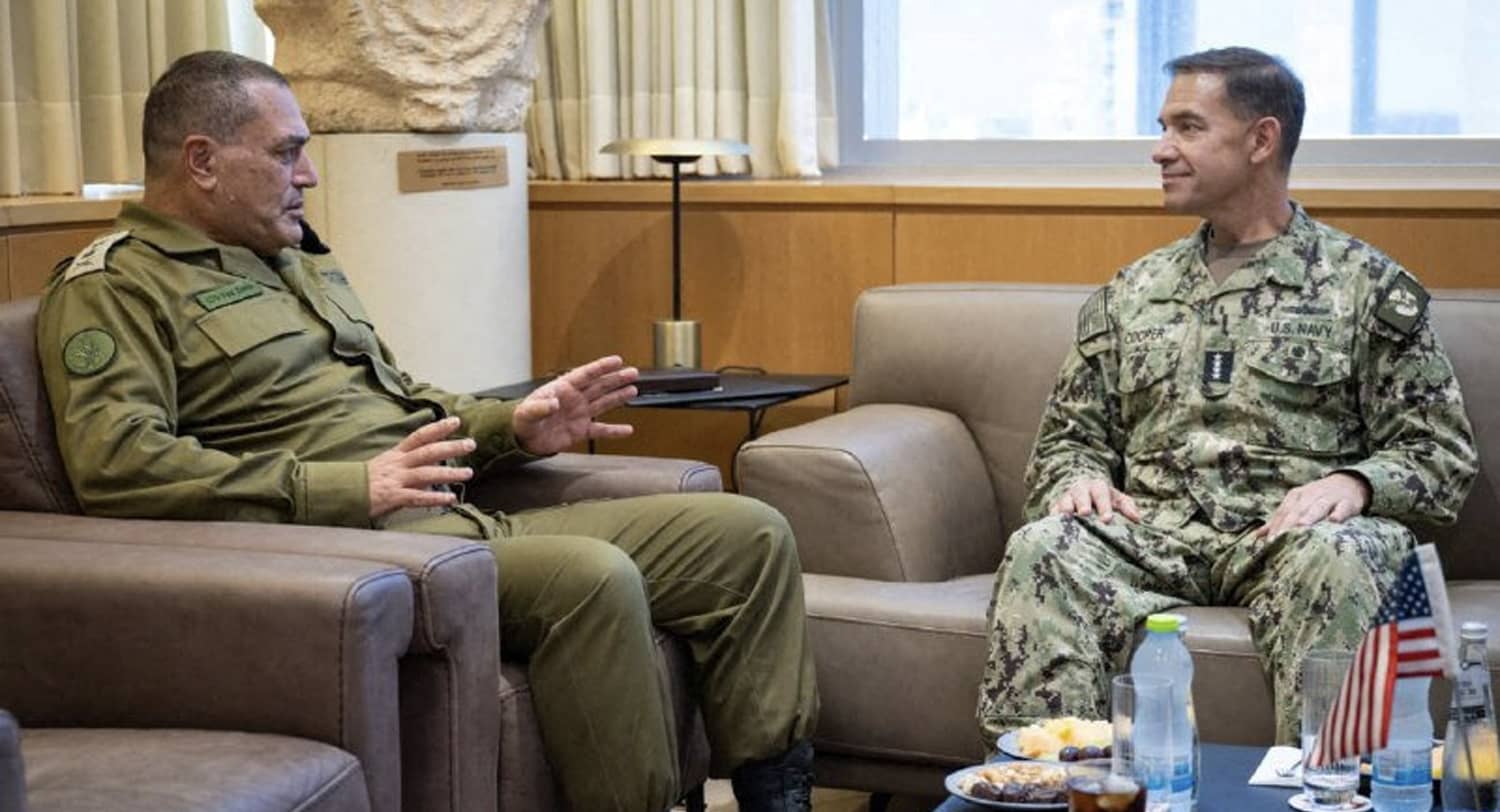
Israel’s 2022 integration into the US regional military command for the Middle East, CENTCOM, is a game changer. It is not a formal alliance, yet provides many of the advantages of a defense treaty: stronger deterrence, coordinated defense with other US allies in the region, deeper strategic depth, and the capacity for joint action, while maintaining Israel’s freedom of action.
Some voices in Israel are arguing that the country has “lost control” of the situation in postwar Gaza to the United States. But this view misses a broader regional transformation that began in 2022, a shift whose significance most Israelis are only now beginning to understand.
One must start with how the US military is structured overseas. The United States operates six global geographic Combatant Commands, each responsible for an enormous region: Europe, Africa, South America, the Indo-Pacific, North America, and the Middle East. Each is headed by a four-star general who reports directly to the Secretary of Defense and the President. These regional commands are not mere administrative divisions but are strategic frameworks through which the U.S. organizes alliances, coordinates multinational training, conducts combined operations, and integrates intelligence at a global scale.

Geographically, Israel naturally belongs under the Central Command, CENTCOM, with an area of responsibility covering the broader Middle East. But for decades Israel was placed under the European Command, EUCOM for political reasons since Arab states opposed normalization with Israel and refused to be grouped with it under the same command. Allocating Israel to EUCOM allowed Washington to maintain deep military cooperation with Israel without jeopardizing relations with key Arab allies.
The Abraham Accords of September 2020 fundamentally altered this arrangement. Once the UAE, Bahrain, and later Morocco agreed to open security and diplomatic cooperation with Israel, the long-standing Arab veto effectively collapsed. The US announced Israel’s move to CENTCOM in 2021, and by 2022 it was fully implemented. Israel thus became an official component of the regional security architecture that the United States had been building in the Middle East, designed to counter Iran through shared intelligence, integrated air defense, maritime cooperation, and coordinated operational planning.
Israel began participating in CENTCOM joint exercises with Arab militaries: IMX-2022, a massive naval drill led by the US Fifth Fleet; and Juniper Oak 2023, the largest US–Israeli military exercise ever conducted, involving strategic bombers, fighter jets, naval forces, special operations units, and advanced intelligence platforms. Operationally, it marked the institutionalization of deep, routine, high-tempo military cooperation.
Still, it was only after Hamas’s surprise attack of October 7, 2023 that the full meaning of Israel’s integration into CENTCOM became clear. The US responded with a rapid, large-scale deployment: aircraft carriers, missile defense ships, electronic warfare aircraft, and enhanced intelligence assets. In effect, the US provided Israel with a strategic umbrella that reduced the likelihood of a northern escalation and signaled unmistakable deterrence toward Iran and Hezbollah.
The most dramatic development took place in the context of Iran’s missile and drone attacks on Israel in 2024 and 2025. For the first time, CENTCOM activated the emerging regional defensive network. US aircraft intercepted dozens of drones over Iraq and the Red Sea; American, British, and French ships shot down cruise missiles; Jordan, Saudi Arabia, and the UAE provided air corridors and shared tactical intelligence; Israel synchronized its Iron Dome, David’s Sling, and Arrow systems with US command elements. The result was an unprecedented multinational defensive effort that largely neutralized what could have been devastating strikes. A long-discussed concept became a functioning regional defense mechanism.
After a ceasefire was reached under the Trump 20-point plan of October 2025, the U.S. and Israel set up a joint command center in the Israeli town of Kiryat Gat near Gaza. It facilitates real-time intelligence sharing, access to American reconnaissance capabilities, humanitarian coordination with international actors, and continuous operational deconfliction in a highly complex arena. The physical presence of American officers alongside Israeli commanders has also heightened US understanding of Hamas’s methods: use of human shields, diversion of humanitarian aid, and the impossibility of managing the Gaza arena without intense intelligence work.
Israeli critics often focus on potential drawbacks: the concern that U.S. political leaders will overlook Hamas maintaining its arms or that American expectations may not align with Israel’s interests regarding the end state in Gaza. These risks are not imaginary. However, Israeli defense officials repeatedly emphasize that no attempt has been made thus far to impose decisions contrary to Israel’s security interests.
For decades, Israel grappled with the question of whether or not to pursue a formal defense treaty with the United States. A treaty would codify America’s commitment to Israel’s security, bolster deterrence against regional adversaries, and guarantee large-scale military assistance in times of crisis. Yet successive Israeli governments hesitated. The central concern was the potential loss of autonomy and fear that a treaty would restrict Israel’s freedom of action, requiring American approval for sensitive military operations that often require quick responses.
The current arrangement, while not a formal defense pact, effectively delivers many of its benefits: operational coordination, shared real-time intelligence, integrated regional air defense, and the ability to conduct joint action when necessary. Crucially, it does so without formally limiting Israel’s sovereignty or imposing rigid treaty obligations. In practice, it creates a “hybrid model” in which Israel enjoys the strategic advantages of quasi-alliance integration while retaining independent decision-making.
For years Israel feared that the United States was withdrawing from the Middle East. Successive US administrations in their strategic planning talked of reprioritizing away from the Middle East, including in the recently released National Security Strategy.
But the strategic reality is different: the US is re-engaging, strengthening allies, escalating pressure on Iran, and signaling a renewed commitment to the regional balance of power. This shift results from new opportunities following the “12-Day War” of June 2025. In practice, this shift represents a dramatic enhancement of Israel’s strategic position; Israel is embedded within a regional defense architecture that magnifies its strengths and compensates for its vulnerabilities.
Israel has not “lost control.” Rather it has entered into new relationships by joining CENTCOM, operating shoulder-to-shoulder with the United States and, increasingly, with key Arab partners. This emerging de-facto regional alliance provides Israel with strategic depth, intelligence and logistical support, operational coordination, and an improved international posture. In the long term, the advantages of this integration far outweigh its limitations.
