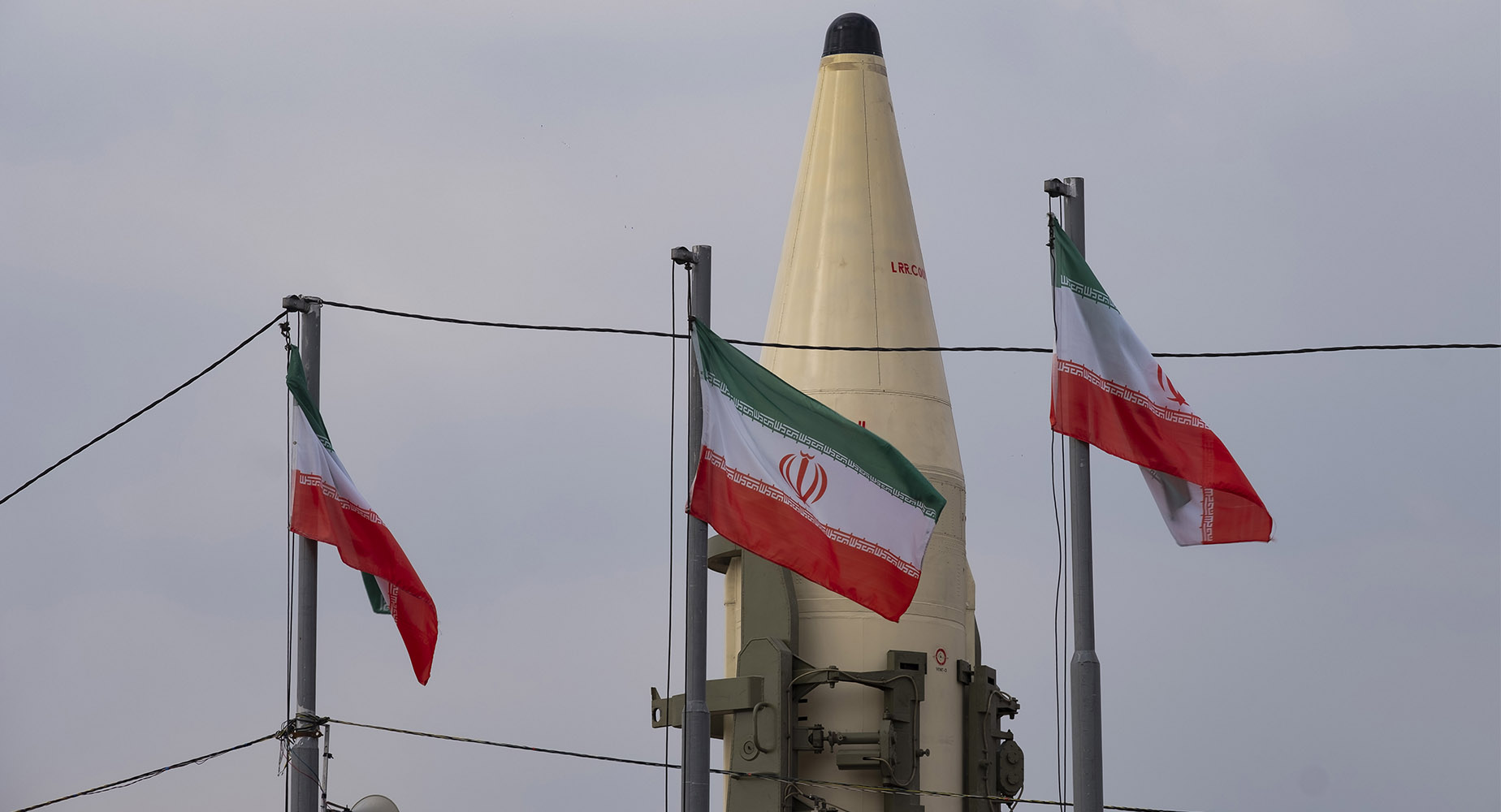
As Israel and the United States undertake operations of unprecedented scale against Iran, with a regional war now underway and global implications mounting, many critics are asking why this is necessary.
Some pundits and academics have sought to play down the threat of a nuclear Iran, claiming that the logic of nuclear deterrence would apply to it just as in the Cold War, and that despite the regime’s belligerent rhetoric toward Israel, in practice it would act with restraint under threat of mutually assured destruction.
In reality, however, even a minimal nuclear arsenal in the hands of this regime would have grave implications for Israel, the region, and the world. So grave that the price of preventing it by force—with all the regional escalation and disruption in energy flows that this entails—is almost negligible compared to the alternative: life in the shadow of a nuclear Iran, which until last week was on a swift path to becoming a reality.
The Threat of Nuclear Escalation as a Tool for Iranian Regional Hegemony
Since the revolution, Iran has been a revisionist power seeking to remake the Middle East in its image by establishing a sphere of regional dominance extending from the Zagros Mountains to the Mediterranean and Red Sea on its western flank and through Pakistan and Afghanistan to its east. Iran has pursued this vision through a three-pronged strategy of building nuclear capacity, amassing a vast ballistic missile arsenal and nurturing terror proxies.
Iranian hegemony would place a large share of the world’s energy resources under its influence, alongside critical waterways for international shipping, and make it an invaluable strategic partner for China and Russia in their bid to upend the US-led world order.
A nuclear Iran would certainly use the threat of nuclear escalation to gain leverage in its regional struggles and would intensify efforts to assert hegemony over the broader Middle East. It would leverage its nuclear capability to deter Israel from escalating during a conventional conflict with Hizballah. It could launch missile and drone attacks on Israel and then threaten that any Israeli retaliation might provoke nuclear escalation.
Tehran would also likely adopt a more aggressive posture in the Persian Gulf and beyond, working to destabilize regimes across the region. It would severely constrain US freedom of action in the region, as any use of force would raise the specter of nuclear war.
This strategic shift would place intense pressure on regional states to align with Iran or, at the very least, adopt conciliatory policies toward it. Gulf states might cease resisting Iranian influence and even consider expelling US military bases or denying overflight rights.
Achieving a nuclear bomb would significantly bolster the Iranian regime’s long-term survivability by functioning as an insurance policy against efforts to undermine or militarily intervene against the regime.
Undermining of US Credibility Worldwide
The emergence of a nuclear Iran would greatly damage US credibility worldwide, given that every US administration has declared for decades that a nuclear Iran is unacceptable and that all options are on the table.
While it is possible that Saudi Arabia and other Gulf states may respond by strengthening their security ties with the US to balance against Iran, it is more likely that America’s failure to uphold its longstanding pledge to prevent a nuclear Iran would undermine confidence in such guarantees and they may prefer looking to Beijing to rein in its partner in Tehran.
A nuclear Iran would significantly strengthen the anti-Western axis of China-Russia-North Korea-Iran and China and Russia would have an interest in deepening cooperation with a now-invincible Iran.
The resulting instability in the Middle East would itself likely raise energy prices globally, as well as the prices of commodities passing through the region, as all would be held hostage to Iran and its terror proxies.
Regional Proliferation and Weakening of the NPT
A nuclear Iran would serve as a strong incentive for other regional powers to pursue nuclear weapons of their own, chief among these Turkey, Saudi Arabia, and Egypt. Israel, too, would likely no longer be willing to rely on a policy of nuclear ambiguity when faced with an explicitly nuclear-armed enemy. Any American offers of a nuclear umbrella to these states would be unsatisfactory given Washington’s loss of credibility having failed to act to prevent a nuclear Iran.
Such a scenario would severely undermine the Nuclear Non-Proliferation Treaty (NPT), demonstrating that it is possible to acquire nuclear weapons despite prolonged opposition from the international community.
Similarly, it is likely that a nuclear Iran would export its nuclear expertise to like-minded countries seeking similar capabilities.
Even a Rational Iran might Start a Nuclear War
Despite the insistence of academics who imagine the world as a virtual computer model, deterrence in real life is never perfect, and even during the Cold War there were numerous cases in which the delicate balance nearly collapsed into nuclear war. There is always the risk of miscalculation due to a misreading of the adversary’s intentions—an error that could stem from the deep mutual distrust between two countries and result in a nuclear launch that neither side actually intended.
As Iran’s ballistic missile capabilities are vast and constantly improving, a nuclear Iran would be able to threaten Europe, and eventually the US mainland. But even focusing only on Iran and Israel, a balance of terror would be highly unstable. The distance between the US and the Soviet Union allowed both sides thirty minutes of missile flight time to confirm that alerts were not false alarms. In contrast, the distance between Iran and Israel allows for only a few minutes. This becomes exponentially more unstable with multiple nuclear actors.
There remains the possibility that the regime might transfer an operational nuclear bomb to a terror proxy to use against Israel with Iran denying any connection. Control over the warheads could also fall into the hands of an unaccountable terror group.
Finally, in a scenario where the regime is on the verge of collapse, there is a real possibility that it would launch a nuclear attack on Israel, as the regime’s survival would no longer be a relevant constraint.
The Threat of Deliberate Nuclear War
The possibility of a surprise nuclear attack on Israel cannot be dismissed. The ideology of the regime is, above all, Islamist revolutionary, and profound hatred of Israel is one of its core tenets. The veneration of the figure of the martyr (shahid) is deeply embedded in Iran’s Shiite culture, and the same assumptions of rationality that applied to the Soviet Union during the Cold War cannot be relied upon in this case. In 1979, Khomeini stated: “We do not worship Iran; we worship Allah. For patriotism is another name for paganism. I say, let this land burn. I say, let this land go up in flames, as long as Islam emerges victorious in the rest of the world.” In 2001, President Rafsanjani stated: “The use of a nuclear bomb against Israel would destroy Israel completely, while the use of it against the Islamic world would only cause damage… Such a scenario is not inconceivable.”
These statements illustrate the potential of the Iranian regime to act in ways not necessarily bound by Western notions of rationality, including the acceptance of mass Iranian casualties.
Preventing these outcomes is why Israel had to act—and why the United States ultimately chose to act as well. The costs of confronting Iran today are serious. The costs of living with a nuclear Iran would be far worse.
