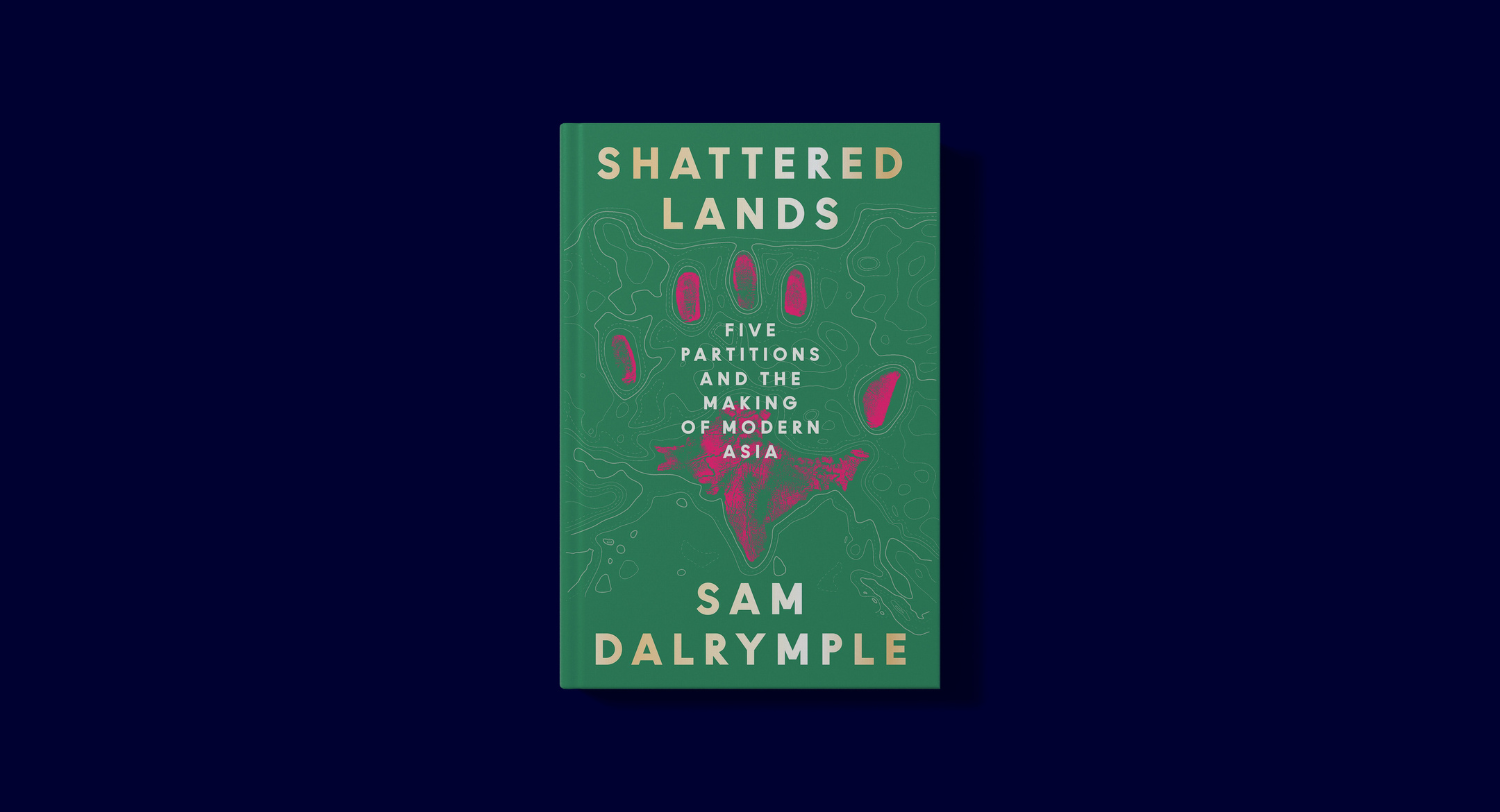
Sam Dalrymple, Shattered Lands: Five Partitions and the Making of Modern India, William Collins, 2025
The most sweeping revision of the world’s political map in all of history took place in the twentieth century, when the great Europe-based multinational empires that had dominated the planet dissolved and their constituent parts became independent states. The most expansive of these empires belonged to Great Britain, and the core of that empire – the jewel in the imperial crown – was British India, which encompassed the Asian subcontinent and some territories beyond it as well.
The central event in the end of what was known as the British Raj in Asia occurred on August 15, 1947, when it was partitioned along religious lines into two large countries: Hindu-majority India and predominantly Muslim Pakistan. In Shattered Lands, a political history of the region from the 1930s to the early 1970s, Sam Dalrymple, an Oxford-educated Scotsman who grew up in India, notes that that epochal event was only one of five partitions of what was once British India. Together they created the South Asia of today.
In 1937, Burma, which had become part of British India in 1887 due in no small part to the efforts of Randolph Churchill, Winston Churchill’s father, was separated from it, while remaining under British rule until 1948. Also in 1937, the small hereditary monarchies along the southern rim of the Arabian Peninsula underwent a similar administrative separation. They stretched from Aden on the Indian Ocean – then a thriving port but today part of impoverished, war-torn Yemen – to Kuwait on the Persian Gulf. They, too, later achieved independence from Britain, most of them in the 1960s.
In the immediate wake of the 1947 partition that created India and Pakistan came yet another, almost equally momentous, political change. The British had not governed all of South Asia directly. About forty percent of its territory came under the rule, albeit with British supervision, of a multiplicity of hereditary monarchs, who presided over what were called princely states. After gaining independence, the governments of India and, on a smaller scale, Pakistan, folded virtually all of these states into their new countries – generally peacefully but not without the threat of coercion. The fifth and final partition came in 1971. The Pakistan of 1947 had two non-contiguous parts, separated by 1,000 miles of Indian territory. The western part dominated the more populous east, which comprised the Muslim part of what had been the Raj’s province of Bengal. The Bengalis became increasingly dissatisfied with the arrangement and, in 1971, managed to secede and form independent Bangladesh after a brutal crackdown in East Pakistan by the West-Pakistan-dominated Pakistani army and then the defeat of that army by the armed forces of India.
From the author’s lively and instructive account of these twentieth-century events, enhanced by an interesting collection of photographs, two themes emerge. One is violence. The disassembling of British India caused massacres on a large scale. The second theme is the indeterminacy of history. As Dalrymple shows, the twentieth-century history of South Asia did not have to take the course that, in the end, it followed. Alternative outcomes were available, were plausible, and had support. They just happened not to happen.
The disjoining of Burma from India did not lead to large-scale violence; and the removal of the Arabian monarchies from the responsibility of the government of India, and later in the century their independence from Great Britain, passed off relatively peacefully, although what became Yemen has consistently been a site of civil strife. Similarly, the princely states surrendered the internal autonomy they had enjoyed under the British without large-scale disruption – with the conspicuous exception of Kashmir, over which independent India and Pakistan have fought several wars, the first of them in 1947.
The partitions that created those two countries, and then the one that gave birth to Bangladesh, by contrast, count as among the bloodiest episodes in a very bloody century. The anti-Muslim and anti-Hindu rampages in the months leading up to August 1947, and the massive violence that the partition itself unleashed, accounted for as many as 1 million deaths, and caused perhaps 14 or 15 million more to flee their homes in India and Pakistan for the other country. The vast majority of the refugees fled based on all too well-founded fears that they would be killed if they didn’t. The creation of Bangladesh repeated this pattern on a smaller but still horrifying scale. The estimates of the number of people killed vary widely, from several hundred thousand to 1 million, and 10 million fled into India from what was then East Pakistan, although the vast majority returned once independent Bangladesh, freed by the Indian Army from the control of West Pakistan, came into existence.
The violence demonstrates that multinational empires, whatever their shortcomings – and shortcomings they plainly had, inasmuch as they have disappeared – did offer at least one benefit: safety. With major exceptions – the great Indian Mutiny of 1857, for example – the British Empire kept the peace. It did so by using its monopoly of force to suppress violence by individuals or groups, as all governments do. It also brought tranquility in another way. It gave the different national, religious, and ethnic groups under its control confidence that other groups would not abuse, attack, or dispossess them. When imperial rule ended, that confidence vanished; and the ensuing uncertainty all too easily led to fear and then, often through the instigation of local entrepreneurs of aggression, attacks on people who had been peaceful neighbors but suddenly loomed as mortal threats. The violence of 1947 unfolded in just that way. The same dynamic was at work in the last decade of the same century when the multinational Yugoslav state collapsed. In its most heterogeneous province, Bosnia, Serbs, Croats, and Muslims, who had coexisted more or less peacefully under communist rule, began to attack one another.
Twenty-first-century South Asia is the product of these five partitions, but it did not have to become precisely what it is. Its present-day political configuration was not predetermined. Its history could have played out differently and, conceivably, more peacefully. A significant slice of informed opinion in Burma, for example, opposed separating it from greater India. Had the separation not taken place, what is now Myanmar might have become one of the states of independent India. In that case, the ethnic and tribal violence that has plagued the country, which, in combination with the long-lasting military dominance of its government, transformed it from the richest province in British India to the poorest country in twenty-first-century Asia, might have been averted. Similarly, before East Pakistan descended into violence, the most prominent Muslim Bengali leader, Mujiber Rahman, who subsequently became Bangladesh’s first president, presented a six-point plan for turning the country into a loose but still united federation. Had his counterparts in the country’s western wing accepted the plan, Pakistan might conceivably have remained intact, and the carnage that attended the birth of Bangladesh avoided.
The most important, and most poignant, “what if” about South Asian history in the last century involves the partition of 1947. On the one hand, the Raj could have broken into more than two pieces. An independent Bengal, encompassing both its Hindu and Muslim populations, had local support. A distinctive people known as the Nagas in the northeast, their population spread over what became independent India, Pakistan, and Burma, wanted a state of their own, and had a good case for it – although they did not have the political strength or good fortune to achieve it. Several of the princely states had the size – Hyderabad in the south of the subcontinent – or the location – Travancore on the southwestern coast – to aspire realistically to independence. The small, poor Himalayan kingdoms of Nepal, Bhutan, and Sikkim in fact did become independent, sovereign states.
On the other hand, the subcontinent need not have been divided at all. The idea of a separate Pakistan was born only in the 1930s and had few adherents at the time. As late as 1940 and even, arguably, at the end of World War II, an independent India that included its large Hindu and Muslim populations seemed the most likely political fate of the Raj. The Hindu leaders of the independence movement did not want it divided and accepted partition reluctantly — in the case of the foremost of them, Mohandas Gandhi, despairingly.
Pakistan owes its existence, to a very great extent, to the preferences and the efforts of the paramount Muslim leader in the Raj, Mohammed Ali Jinnah. Until almost the moment of partition itself, it was unclear, perhaps even to him, precisely what post-British arrangements he desired. Only a year after independence, in September 1948, Jinnah died, leading the last British viceroy, Lord Louis Mountbatten, to say that if he had known the seriousness of the tuberculosis and lung cancer that eventually killed Jinnah, “he [Mountbatten] might have delayed independence and there may have been no partition.”
Had the partition of 1947 not taken place, it seems entirely possible that much of the bloodshed that surrounded it would not have taken place. Moreover, a united India might have avoided some of the problems that have afflicted the two countries since 1947: periodic wars between them; communal violence, with the majority community targeting minorities, within them; religious extremism; departures from democratic governance; and a nuclear arms race on the subcontinent.
Of course, a united post-Raj India would not have been free of problems. It might have suffered some of the same dysfunctions that have marked the region’s post-partition history, and even from others just as damaging. Continuing unity would not have guaranteed civil peace. Had the other enduringly consequential division of a British imperial possession, the United-Nations approved partition of Palestine in 1948, not taken place and an independent Israel capable of defending itself not come into being, the result would not have been religious harmony but rather the persecution, expulsion, and murder of the Jewish population, not unlike vicious the massacre of Israelis by Palestinians on October 7, 2023.
The consequences of following the road not taken can never be known, and so cannot be assumed to be benign. Still, the alternatives to partition that were plausibly available in the years and even months leading up to August 15, 1947, call to mind some lines from the nineteenth century American poet John Greenleaf Whitter (1807-1892):
Of all sad words,
Of tongue or pen,
The saddest are these:
It might have been.
