Pressure alone will not produce a regime that can keep a deal. It needs an Iranian alternative ready to take over.
The central question facing Washington is whether Iran’s surviving rulers can deliver the changes the United States demands. Military pressure can destroy infrastructure, eliminate commanders, and bring representatives to the negotiating table. It cannot automatically create an authority capable of binding the entire regime to an agreement.
The removal of Supreme Leader Ali Khamenei exposed this problem. His position extended beyond ideological leadership. He maintained a balance among competing factions, institutions, and networks whose interests frequently diverged. Removing that arbiter disrupted the mechanism through which the Islamic Republic managed its internal contradictions.
The resulting paralysis makes a durable settlement based on behavioral reform increasingly unlikely. The strategic alternative is a guided fall: the end of the ruling system through Iranian political mobilization, accompanied by an organized transition that preserves the state.
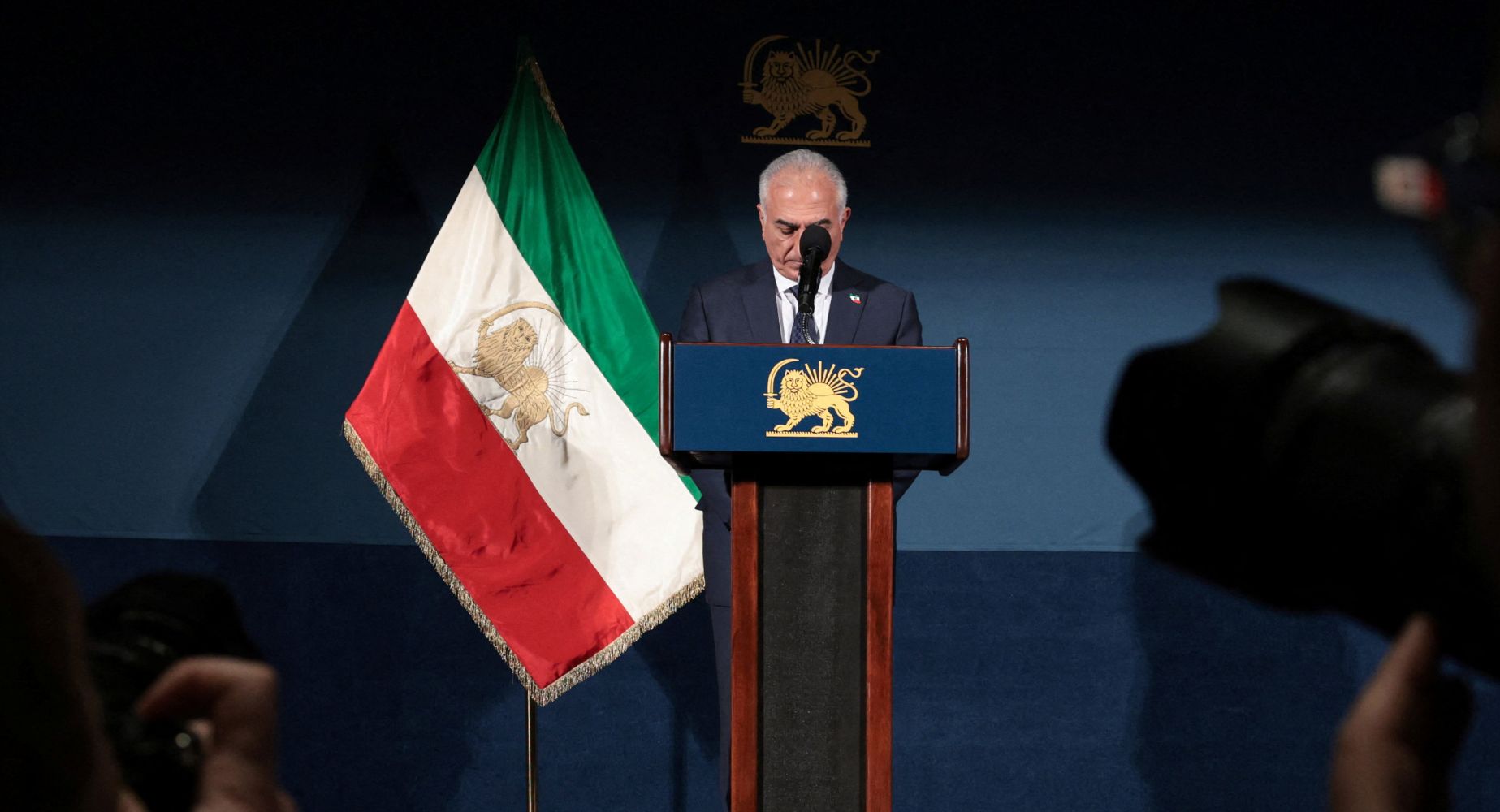
Recognition of Prince Reza Pahlavi as a coordinating leader of that process should become a serious priority for Washington and its partners.
The Missing Arbiter
My theory of Iran as an “Onion State” describes power operating through overlapping layers: clerical institutions, military and intelligence organizations, economic interests, political factions, and administrative networks. These layers protect the system while competing over its resources and direction.
The supreme leader regulated those rivalries. Figures described as reformists, pragmatists, and hardliners operated within a structure in which his authority helped determine the boundaries of acceptable competition.
This arrangement created a paradox. The supreme leader obstructed fundamental political change while also providing the authority through which limited adjustments could be enforced. His removal therefore did not necessarily open a path toward reform. It could leave surviving factions with enough power to prevent concessions, but insufficient authority to impose an alternative.
Mojtaba Khamenei has been named to the position, yet no verified image, video, or voice recording of him has been released, and even reformist figures inside Iran have demanded proof that he is alive. Even if he is, he has neither his father’s experience nor his standing over the armed institutions. A title does not make the generals and the Guards obey. Formal succession cannot by itself resolve a deeper fragmentation of power.
The question is consequently larger than who occupies the leadership position. It concerns whether the system can make and execute a collective decision under extraordinary pressure.
Negotiation Without Binding Authority
Washington’s approach appears to rest partly on the expectation that sufficient pressure can compel surviving Iranian officials to change the regime’s behavior. That strategy assumes a negotiating counterpart capable of accepting terms and enforcing them.
Iran’s power structure challenges that assumption.
Ghalibaf’s appearance at the Pakistan-mediated negotiations exposed the difference between representing the regime and possessing the authority to commit it. The delegations met with U.S. Vice President JD Vance, yet no photograph of a handshake was released.
In the Islamic Republic’s political system, a public handshake with a senior American official can carry consequences far beyond diplomatic protocol. Its absence raises the question of whether Ghalibaf possessed the authority to make such a gesture—and, more importantly, to enforce the substantive concessions contained in a memorandum of understanding.
The absence of a handshake does not, by itself, establish the limits of his power. But it brings the unresolved question into focus: who in Tehran possesses the authority to make a commitment and compel the competing institutions of the regime to honor it?
The evidence is not limited to a gesture. While the negotiators talked, missiles and drones were fired. Tehran denied responsibility, and no one has established who was behind the attacks. That uncertainty is itself significant. Either a force inside the system acted against its own negotiators, or the state cannot say who acts in its name. In both cases, no single center controls the use of force.
Under the Onion State structure, a representative can occupy the negotiating chair without exercising the effective authority of a head of state. Following the removal of the supreme arbiter, Washington faces interlocutors whose ability to negotiate may exceed their ability to deliver.
An agreement can consequently become another arena for factional competition. Its provisions may be resisted, selectively implemented, or portrayed as betrayal by institutions seeking to protect their position.
This is the danger identified by the Onion State framework: pressure can weaken the center while leaving multiple layers capable of obstructing adaptation. Leadership losses may produce a more fragmented and defensive system rather than a more negotiable one.
Pressure Requires a Political Destination
Military action, sanctions, and restrictions on trade can reduce the regime’s resources. They cannot determine the political order that follows.
Economic exhaustion also imposes enormous costs on civilians. A strategy that assumes hardship will automatically generate a coherent democratic alternative overlooks the leadership, organization, and institutional preparation that such an outcome requires.
Nor does the survival of the Islamic Republic necessarily preserve regional stability. A weakened ruling system can remain capable of repression and external disruption while becoming progressively less capable of governing.
The United States therefore faces two related dangers: an existing order unable to deliver a durable settlement, and a deteriorating state whose authority could become the subject of an uncontrolled struggle.
My conclusion is that regime change must become the political destination of a strategy that has relied heavily on pressure. Preparing that destination requires an identifiable Iranian alternative.
Revolution and Transition Are Different Tasks
The Islamic Republic will not necessarily disappear because its economy deteriorates or its leaders lose authority. A coercive system can survive political exhaustion by continuing to repress its population.
This is why revolution and transition must be understood as distinct tasks.
The revolution removes the ruling order. The transition establishes legitimate authority, maintains essential services, and creates the conditions for a freely chosen constitutional government. Preparing for the second cannot substitute for organizing the first.
What Prince Pahlavi’s office calls the Sun and Lion Revolution, and what I understand as the Iranian struggle to reclaim national sovereignty from the Islamic Republic, would draw its political strength from popular mobilization, the withdrawal of support from the regime, and an organized alternative capable of assuming responsibility.
External pressure can influence the conditions in which that struggle unfolds. It cannot substitute for Iranian political agency or confer domestic legitimacy on its own.
There can be no honest guarantee that the regime will relinquish power peacefully. Recognizing that danger does not make violence an objective. It makes civilian protection and the prevention of prolonged internal conflict essential responsibilities of leadership.
The revolutionary rupture may be violent; the transition must be designed to prevent that violence from becoming the organizing principle of the next political order.
A peaceful transition is an objective requiring preparation, rather than a prediction that the regime will surrender peacefully.
Five Pillars Connecting Change to Reconstruction
Prince Reza Pahlavi’s published strategy connects the struggle to end the Islamic Republic with preparation for the government that follows.
Its five pillars are maximum support for the Iranian people’s struggle; maximum pressure on the Islamic Republic; maximum defections from the regime; mobilization of Iranians abroad to influence public opinion and policymakers; and a political and economic vision for transition and reconstruction.
His framework distinguishes the first four pillars, principally concerned with achieving political change, from the fifth, concerned with establishing a national government and moving toward democracy after victory.
That distinction gives practical meaning to a guided fall. Political preparation must connect the struggle against the regime to the responsibility of governing afterward.
Iran’s population will need functioning hospitals, water, electricity, public administration, and local security throughout the transition. Ending clerical rule must not mean abandoning those foundations of ordinary life.
The process also requires a distinction between accountability and collective punishment. Individual responsibility for crimes should be established through lawful proceedings. Public employees and military personnel must have a credible path to serving the country without continuing to defend the ruling ideology.
Four Principles for Opposition Cooperation
Pahlavi has identified four foundational principles for cooperation: Iran’s territorial integrity; separation of religion and government; individual rights and equality of citizens; and the people’s right to choose their future democratic system.
These provide a common basis for political forces that disagree about the eventual form of government. Unity need not require agreement on every constitutional question. It requires agreement on the process through which those questions will be resolved.
Pahlavi has specified the proposed mechanism: a referendum in which Iranians would choose between a republic and a parliamentary monarchy. Recognition of his transitional leadership would therefore not itself settle the question of restoring the monarchy. That decision would belong to the Iranian electorate.
His coordinating role should be assessed in relation to this commitment. The purpose of transitional leadership is to carry the country toward an accountable constitutional order whose authority comes from popular choice.
International recognition could help give that process a clearer political counterpart. It would be most valuable if it strengthened cooperation among opposition forces and reinforced the referendum commitment.
My argument for supporting Pahlavi rests on this potential: a recognizable leadership around which a transition can be organized, with the permanent form of government reserved for the people.
A Declared Break with Regional Confrontation
Pahlavi’s proposed foreign policy is explicit. He has committed a free Iran to immediate recognition of Israel and normalization of relations with the United States. He has also proposed expanding the Abraham Accords into the Cyrus Accords, linking Iran, Israel, and Arab states through a broader framework of cooperation.
His declared commitments include ending support for terrorist organizations and terminating Iran’s nuclear military program.
These are concrete proposed departures from the Islamic Republic’s regional posture. For Israel, recognition by an Iranian government would create the possibility of a fundamentally different relationship. For Washington, restored diplomatic relations would establish direct channels for negotiation and cooperation.
Such commitments would still require implementation and reciprocal diplomacy. Their importance is that they identify a political direction beyond the indefinite containment of the existing regime.
A stable Iran engaged in international commerce could also broaden its economic choices and reduce dependence on Russia and China. That outcome would depend on the institutions and agreements built after the rupture.
Guiding the Fall
The removal of the supreme leader has not, in my analysis, resolved the central problem of Iranian power. It has disrupted the arbitration through which competing layers managed their differences, without necessarily creating an authority capable of enforcing a new course.
Washington should therefore stop assuming that pressure alone will produce a leadership able to reform the system and deliver a durable settlement.
A guided fall would connect pressure on the ruling order with Iranian political agency, defections, opposition cooperation, and credible transitional leadership. Recognition of Prince Reza Pahlavi should form part of that preparation.
The Sun and Lion Revolution would end the Islamic Republic’s authority. The transition would preserve essential institutions, establish lawful accountability, and carry the country toward a referendum and democratic government.
The regime’s departure cannot be assumed to be peaceful. The political order that follows must be deliberately organized around peace, constitutional choice, and the freely expressed will of the Iranian people.
The Next War and Iranian Political Agency
If another war occurs, the decisive question will be whether external military pressure is accompanied by an organized Iranian political movement capable of turning the weakening of the regime into a change of government.
Another campaign of strikes could damage the Islamic Republic without ending its rule. Unless a credible political alternative emerges, surviving institutions could regroup, intensify repression, and present their continued survival as a national victory.
The missing element is the political agency of the Iranian people.
In my proposed strategy, Iranians inside the country and across the diaspora would organize around a common political objective: ending the Islamic Republic and establishing a democratic transition under the coordinating leadership of Prince Reza Pahlavi. If Washington and Israel seek a durable resolution rather than another temporary military setback for Tehran, their political objectives would need to converge with that Iranian project.
This alignment must be explicit. Iranians cannot be expected to bear the risks of confronting the regime while foreign governments remain prepared to preserve it through an agreement with whichever faction survives. Nor can foreign governments assume that military action will automatically produce a coherent national alternative.
The necessary convergence is political: a shared understanding of the desired outcome, recognition of a credible transitional counterpart, and commitments to Iran’s territorial integrity and the population’s right to choose its future government.
Inside Iran, political agency would be expressed through popular mobilization, civil resistance, and the withdrawal of support from the ruling system. The participation or neutrality of public administrators and members of the security establishment would be consequential. The country needs an alternative capable of receiving their allegiance without dissolving the institutions essential to public life.
Outside Iran, the diaspora’s responsibility would extend beyond demonstrations of solidarity. Its contribution would include diplomatic advocacy, documenting abuses, supporting access to independent information, humanitarian assistance, and assembling the professional expertise needed for transition and reconstruction.
These complementary roles would connect domestic political action with international support. Iranians inside the country would remain the agents of change; Iranians abroad would help secure the recognition and resources necessary to sustain a national political alternative.
This is where the Sun and Lion Revolution belongs within the strategy of a guided fall. External military pressure, should another war occur, would be one part of the circumstances. The revolution itself would require an Iranian movement capable of challenging the regime’s claim to govern and establishing a credible successor authority.
War does not guarantee a revolutionary opening. It can also strengthen repression, endanger civilians, and fragment the country. The purpose of political preparation is to reduce those dangers and prevent the population from being left between a damaged dictatorship and an unprepared opposition.
My argument is therefore for political alignment among an organized Iranian opposition, the United States, and Israel around a defined outcome: the end of the Islamic Republic, preservation of the Iranian state, and a transition leading to a referendum and democratic government.
The revolution would bring the ruling order to an end. The prepared transition would give that rupture a political destination.
