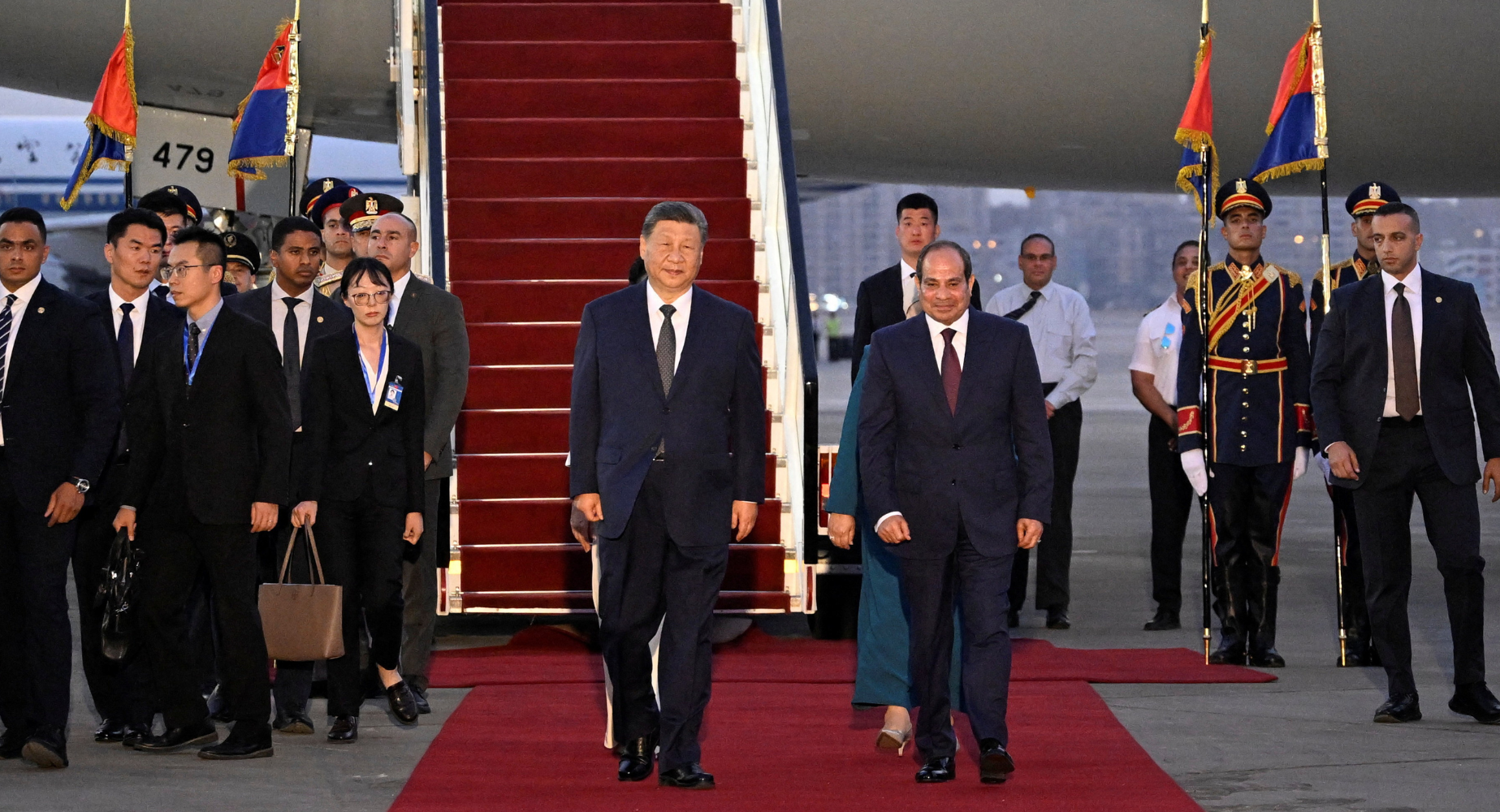
A decade after his previous visit to Egypt, Chinese President Xi Jinping has returned to Cairo at a markedly different moment in both Egyptian-Chinese relations and Middle Eastern geopolitics. His visit, following the Shanghai Cooperation Organization summit in Bishkek and coinciding with the 70th anniversary of diplomatic relations between China and Egypt, is more than ceremonial. It reveals how far the relationship has evolved since Beijing and Cairo declared a “comprehensive strategic partnership” in December 2014.
The most important change is not simply that China has become more economically present, but that its character has changed. Over the past decade, Chinese engagement has shifted from predominantly project-based involvement towards deeper integration into Egypt’s productive and technological infrastructure. What was once associated primarily with trade, infrastructure construction, and project finance is increasingly developing into a more deeply embedded relationship encompassing manufacturing, digital infrastructure, space technology, renewable energy, education, and, increasingly, defense cooperation. China is becoming not merely a provider of capital and infrastructure, but a more enduring participant in sectors central to Egypt’s economic and strategic development.
For Israel, this distinction matters. China does not need to replace the US as Egypt’s principal external partner to alter Egypt’s strategic options. Its growing presence gives Cairo something arguably more valuable: greater room to maneuver among competing powers.
From Building Egypt to Producing in Egypt
Bilateral trade reached roughly $20.8 billion in 2025, while Egyptian imports from China exceeded $10 billion in the first half of 2026 alone. However, the relationship remains highly asymmetric: This imbalance helps explain Cairo’s emphasis on attracting investment and localizing production rather than merely expanding trade. Chinese investment now extends from ports and infrastructure to renewable energy and manufacturing, reflecting Egypt’s growing importance to Beijing not only as a large consumer market but also as a production and logistics hub linking Asia, Africa, Europe, and the Middle East.
Chinese companies are no longer present primarily as contractors building roads, railways, or high-rise developments. They are increasingly involved in local manufacturing, including vehicles, electrical goods, tires, solar-energy equipment, and other industrial products. Local production creates a more durable form of economic embeddedness: unlike discrete infrastructure projects, manufacturing generates continuing relationships across supply chains, employment, training, technology, finance, and export markets.
Egypt’s position astride the Suez Canal reinforces this logic. Amid tariffs, supply-chain fragmentation, and growing pressure on Chinese firms in Western markets, manufacturing in Egypt carries strategic as well as commercial value. For Cairo, Chinese investment offers foreign currency, technology, employment, and diversification beyond Western governments, Gulf capital, and Western-led financial institutions.
Nevertheless, diversification has a paradox. Reducing dependence on one group of partners can generate new dependence on another. Egypt’s enormous trade deficit with China already illustrates this asymmetry. The test for Cairo is whether Chinese investment expands Egyptian productive capacity and exports or entrenches Egypt’s role as a market for Chinese goods.
The Strategic Relationship is Broadening
China’s role in Egypt is increasingly extending to sensitive sectors, including telecommunications, cloud services, artificial intelligence, satellite technology, academic research, and vocational training. EgyptSat-2 and wider space cooperation illustrate Beijing’s ability to combine infrastructure with technology transfer.
More consequential is the emerging military dimension. The second “Eagles of Civilization” joint air exercise began in August and continued through Xi’s visit, including joint sorties, air combat operations, and training involving Chinese J-16 fighters and Egyptian Rafales.
This is not a Chinese-Egyptian military alliance. Washington remains deeply embedded in Egypt’s defense establishment, while Cairo continues to receive approximately $1.3 billion in annual US military assistance. That is precisely what makes the Chinese exercises significant: Egypt can expand military cooperation with Beijing without abandoning Washington. It is not replacing one dependency with another; it is accumulating options.
Diversifying, Not Realigning
The same logic helps explain Egypt’s engagement with non-Western institutions. Cairo became an SCO dialogue partner in 2022 and joined BRICS in 2024. Neither move demonstrates that Egypt has joined a Chinese camp.
Egyptian foreign policy is better understood as strategic diversification. Cairo maintains relationships with Washington, Beijing, Moscow, Europe, and the Gulf, seeking to reduce the costs of relying too heavily on any single partner. China fits this strategy particularly well because Beijing does not require Egypt to sever its US security relationship before expanding economic, technological, or even defense ties.
The familiar question of whether China will “replace America” in Egypt, therefore, misses the point. China does not need to replace America to matter.
Why Israel Should Pay Attention
For Israel, this transformation has implications well beyond China-Egypt relations. The first is strategic geography. Egypt controls the Suez Canal and sits at the intersection of the Mediterranean and the Red Sea. Recent regional conflict has demonstrated how rapidly disruptions around maritime chokepoints such as Bab el-Mandeb can affect Israel, Gulf states, Europe, and Asia simultaneously.
For Beijing, whose economy remains heavily dependent on maritime trade and Middle Eastern energy, Egypt’s strategic value therefore exceeds bilateral trade. For Israel, deeper Chinese economic involvement around Suez and the Red Sea warrants attention because the same maritime system connects Israeli trade routes, Gulf energy flows, and Chinese supply chains. China’s growing presence in Egypt is consequently part of a broader transformation of the strategic environment surrounding Israel’s maritime access.
The second issue is Egyptian strategic autonomy. Israel has benefited for decades from a regional architecture in which Washington is central to both Israeli and Egyptian security. Egyptian diversification will not overturn the peace treaty with Israel or displace the Egyptian-American relationship. It could, however, gradually reduce Washington’s leverage over Cairo by providing alternative sources of investment, technology, diplomatic backing, and selected military capabilities.
For Israel, the relevant development is therefore not the emergence of a “pro-China Egypt”, which remains unlikely, but an Egypt with greater freedom to resist pressure from any single external power. This matters because Washington’s influence over Cairo has historically been part of the broader strategic environment underpinning Israeli-Egyptian stability.
The third issue is technology and infrastructure. Chinese involvement in Egyptian telecommunications, cloud services, artificial intelligence, space technology, and logistics brings Beijing closer to sectors that Israel and the US increasingly define in national-security terms. Not every Chinese investment poses a security threat, but neither can involvement in neighboring strategic infrastructure be treated purely as a commercial matter.
Israel itself has confronted this dilemma: how to preserve the benefits of economic engagement with China while managing American pressure and national-security vulnerabilities. Egypt is now confronting a similar balancing act, but with potentially greater room for maneuver. There is an important irony here: Chinese engagement may provide Egypt with some of the strategic flexibility that Israel increasingly lacks as US-China technological competition intensifies.
The fourth implication concerns regional diplomacy. Egypt remains central to the Palestinian issue, Gaza diplomacy, and Arab politics, while China has sought a larger diplomatic role without assuming the security commitments traditionally borne by Washington. Beijing now maintains a dense regional portfolio encompassing Egypt, Saudi Arabia, the UAE, Qatar, Iran, and Israel.
However, a greater presence should not be confused with a greater security commitment. Recent crises have demonstrated Beijing’s preference for diplomacy, economic risk management, and the preservation of relations with competing regional actors rather than assuming America’s role as a security provider. Israel should therefore distinguish between China’s expanding regional influence and its willingness to bear the costs of regional security.
Not China, Instead of America
Xi’s return to Cairo, therefore, marks something subtler than an eastward realignment of Egypt. China has moved from being primarily a source of trade, finance, and construction to becoming embedded in a broader range of Egyptian economic, technological, and increasingly security relationships. Cairo is using that partnership not to abandon Washington but to increase its strategic and bargaining space.
For Israel, the lesson is not that a Chinese-aligned Egypt is emerging on its southern border, nor that the US-led regional order is disappearing. The more consequential development is a Middle East in which American partners increasingly maintain their security relationships with Washington while simultaneously developing substantial economic, technological, and diplomatic ties with Beijing. Egypt is becoming one of the clearest examples of this model.
Xi’s visit, therefore, illustrates a wider transformation that Israel cannot afford to overlook. China does not need to replace the US to reshape the Middle East. By giving Washington’s regional partners additional economic, technological, diplomatic, and increasingly military options, Beijing can expand its room for maneuver without asking them to choose sides. For Israel, understanding this shift may be more important than asking which great power is “winning” Egypt.
