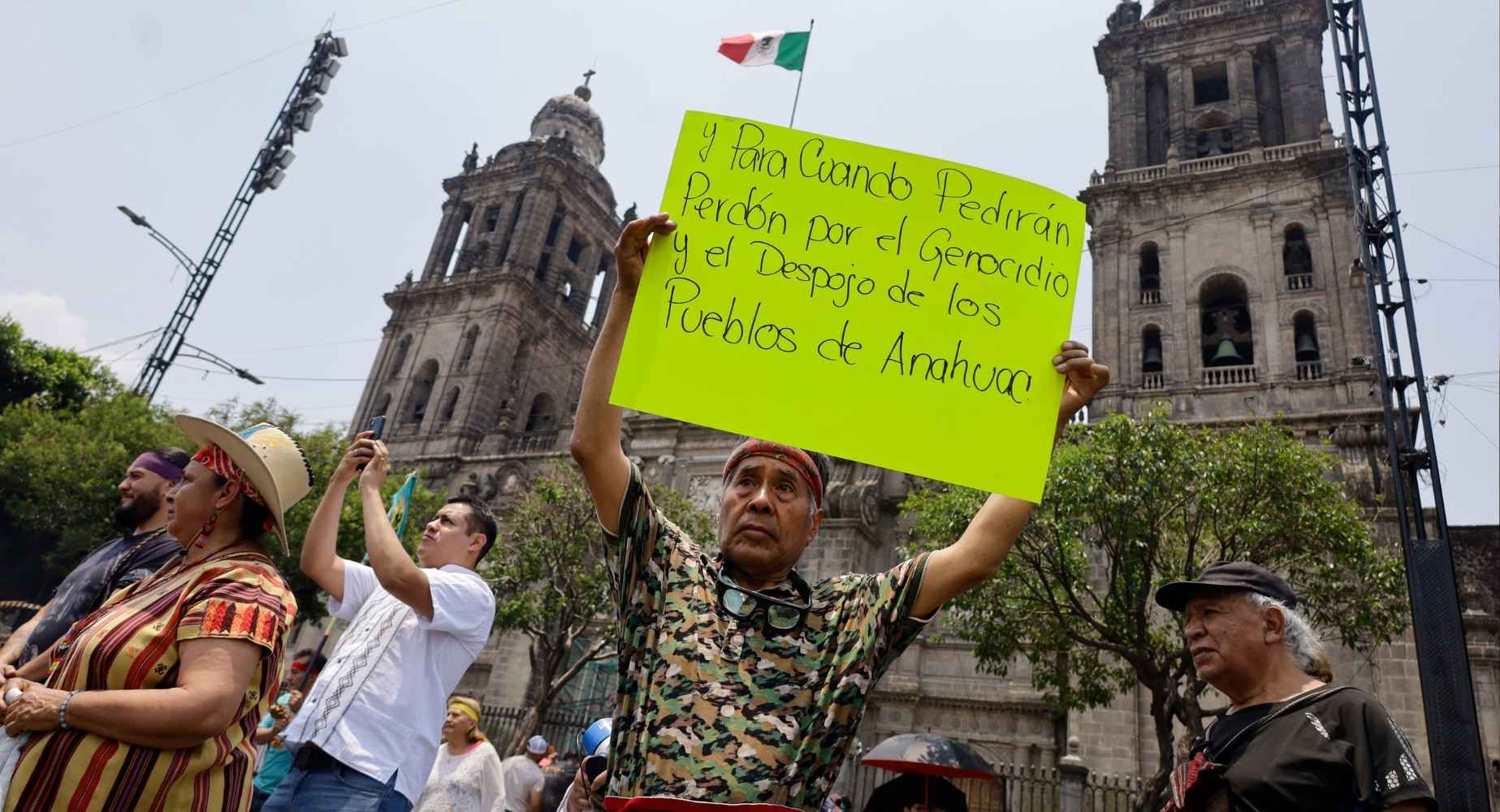
During her recent visit to Mexico, Isabel Díaz Ayuso, the fiercely conservative head of Madrid’s regional government, paid public homage to Hernán Cortés, the conquistador who overthrew the Aztec empire and brought Mexico under Spanish rule by 1521. This provoked a harsh response from Mexican President Claudia Sheinbaum, who emphasized the accepted view of Cortés within her country that stresses his brutality and gives short shrift to the perspective found on the Spanish right that hails him as a bringer of western civilization and Christianity.
Mexico’s former President Andrés Manuel López Obrador had repeatedly demanded apologies from Spain’s leaders for its conduct during the colonial period and taken offense when none were forthcoming. Sheinbaum, his successor, initially followed his line, but when conciliatory statements from Spain’s foreign minister and king were forthcoming, she expressed satisfaction and let the controversy die down.
Díaz Ayuso likely chose to revive it as a way to strengthen her position within Spain’s center-right Partido Popular (People’s Party), the largest formation opposing the governing Socialists, by appealing to voters who may be inclined to support Vox, a new hard right party which has become a force in Spanish politics.
But the question of how Spain’s history in Mexico should be viewed transcends this particular dust-up. While in Spain a belief in a pan-Hispanic identity centered on Madrid persists in some quarters, the prevailing ideology in Mexico underscores the country’s mixed racial roots and unique culture, while casting Cortés as a villain in an ongoing nationalist drama of resistance to imperialism.
A Trip with Political Baggage
On May 3, Isabel Díaz Ayuso, President of the regional government of Madrid and a major figure in Spain’s conservative opposition Partido Popular, began an official visit to Mexico. But while the normal goals of such visits—strengthening trade and tourism—formed part of her agenda, it also had a strong political element.
Having already criticized the leftist governments of López Obrador and Sheinbaum as corrupt, linked to narcotics trafficking, and dictatorial, she made it clear that her trip would also be about forging links with Mexico’s conservative opposition National Action Party (Spanish initials PAN) and that it would include a tribute to Cortés which would take place at Mexico City’s Metropolitan Cathedral. However, after religious authorities decided that this was an inappropriate venue, the tribute was shifted to an events space for Mexico’s Basque community.
In her remarks, Díaz Ayuso asserted that Cortés was an “indispensable architect of Mexico’s existence” and that the relationship between Spain and Mexico was a “five-century-long story of love” rather than of hate. She condemned the “revisionism” which has demanded that Spain apologize for the excesses of the conquest, which she viewed as a “civilizing” process which resulted in Spanish becoming a “universal language.”
Reaction was swift. President Sheinbaum sharply criticized Díaz Ayuso’s “ignorance,” asserting that those who defend the conquest or Cortés himself are “destined for defeat.” She also published a copy of an edict of Spanish King Charles I which, she said, alluded to atrocities committed by Cortés. She went on to say that “the indigenous people are the true reserve of the values of the Mexico of yesterday and today.”
Díaz Ayuso had planned also to attend a gala event honoring Ibero-American cinema. However, threats by participants to boycott the event should she appear left her with little choice except to return home early. She did receive some support from members of the PAN who accused Sheinbaum of “intolerance,” but generally the party appears to have found her engagement on the issue of Cortés’ historical role to be embarrassing.
Back in Spain, the governing Socialists wasted no time in criticizing her for trying to provoke an international incident, claiming that she had subjected herself to ridicule. She defended herself, asserting that Sheinbaum was “attacking Spain” and had tried to “expel” her from Mexico. It remains to be seen whether her Mexican excursion is net plus or minus for her, but in any event, it was consistent with the space which she has been carving out for herself in Spanish political life.
Positioned on the Right
She is a member of the Partido Popular, which governed Spain for two periods following the country’s return to democracy—first from 1996 to 2004 under José Maria Aznar and then from 2011 to 2018 under Mariano Rajoy. During both its periods in power it governed from the center-right, committed to rule of law and accepting of Spain’s welfare state. However, in recent years Spanish politics has become more polarized. The Partido Popular has faced pressure as a new hard right party, Vox, which had split off from it, has gained prominence.
Vox takes a strong position on social issues, principally immigration and abortion, and celebrates what it sees as the glories of Spain’s past such as the victory over the Turks at Lepanto in 1571 and the colonization and Catholic evangelization of the Americas. While remaining within the Partido Popular, Díaz Ayuso is representative of this political style. She has emphasized her Catholic identity; also, she has participated in events associated with the international Trump-adjacent right such as the “Hispanic Prosperity Gala” held at Mar-a-Lago in February.
No stranger to hot rhetoric, she has accused Prime Minister Pedro Sánchez of seeking to perpetuate himself in power and send the opposition to prison “like in Nicaragua.” She recently condemned his decision to regularize the status of illegal immigrants as leading to the “Islamization” of Spain. She has, however, said that she supports the “ordered” entry of Latin Americans to Spain, as the cultural affinities mean that this is really is “not immigration.” (To vocal criticism she suggested that immigrants were required as “someone needs to clean houses.”)
Díaz Ayuso’s ambitions to play a role on the national stage are evident, and she may one day seek to supplant current Partido Popular leader Alberto Núñez Feijóo who is trying to maintain a balance between the party’s right and its more moderate elements. Thus, her decision to visit Mexico and vindicate the long-dead conquistador seems to have been part of her effort to consolidate a position as leader of the right wing of her political party, positioning it to govern with support from Vox, if necessary, as she had done at one point at the regional level.
The question of Spain’s historic role had already become a hot button issue in Spanish-Mexican relations, and inevitably in Spain’s internal politics as well. Former Mexican President López Obrador, who claims some indigenous ancestry, had repeatedly demanded that Spain apologize to Mexico’s native peoples for the massacres and cultural imposition which the conquest had entailed, including in a 2019 letter to King Felipe VI. The response delivered by Spain’s Foreign Ministry rejected the demand, stating that one could not judge the events of five hundred years ago by contemporary standards.
However, with the succession of the combative López Obrador by the less confrontational Sheinbaum, the Spanish government took a softer approach. King Felipe admitted that there had been “much abuse” during the conquest, while Foreign Minister Albares recognized the “pain and injustice” of the colonial period, statements which Sheinbaum accepted as steps towards reconciliation.
However, these gestures were rejected by Spain’s conservative opposition. Partido Popular leader Núñez Feijóo dismissed the reexamination of these distant events as “nonsense” while saying that the king had only engaged in a “conversation” rather than having issued a formal declaration on the subject. A senior figure in Vox went further, proclaiming himself to be “stunned” by the apology, defending “the colossal and glorious work of Spain”… (with) the end of the Muslim presence and the glorious leap across the Atlantic… a civilizing miracle full of generosity, piety, genius (and) service….” Díaz Ayuso, it seems, took Vox’s rhetoric with her to Mexico.
Dueling Visions of History
But in Mexico Cortés is no hero. His tomb inside a church in Mexico City is seldom visited, while a grand monument to Cuauhtémoc, the last Aztec ruler, whose execution Cortés had ordered, has long stood at the intersection of two of the capital’s principal arteries. And in a more recent slight López Obrador determined in 2023 that the long body of water which separates Baja California from the rest of Mexico should be exclusively known as the Gulf of California, and not by its alternative name, the Sea of Cortés.
The prevailing Mexican view of Cortés emphasizes the brutality and rapacity of his conquest of the Aztecs, and the overthrow of their distinct culture which had produced Tenochtitlan, the largest city in the pre-Colombian Americas, with its huge temples, as well as the bridges, causeways, canals, and aqueducts that served a population of 200,000. (Cortés razed the city and built Mexico’s capital on its site.) And unquestionably the search for gold figured heavily in Cortés’ successful effort to conquer the Aztecs by a mixture of guile and force.
Of course, the Aztecs themselves were imperialists, and Cortés’ ultimate victory was achieved with the support of neighboring tribes and city states who sought to free themselves from Aztec demands for both tribute and prisoners for human sacrifice. And while the Aztecs have been appropriated as symbols of Mexican greatness in nationalist discourse which began in the nineteenth century and continues today, the impact of Spain on the culture that emerged as a result of the conquest is pervasive—language and literature, law and governance, architecture and religion—all bear the Spanish stamp, although partially refracted through the pre-existing societies which left their own mark.
Díaz Ayuso’s homage to Cortés and the reaction to it demonstrated posturing both in Spanish and Mexican politics. She sought to highlight her credentials on the right as a defender of Spain’s historic grandeur, while Sheinbaum led a fervently nationalist Mexican rebuttal. But while this episode has already begun to disappear from the headlines, it highlights the very different ways in which Spain’s role in Mexico is viewed on each side of the Atlantic.
Although it has long since abandoned its transatlantic empire, Spain still struggles to produce a coherent historic and political vision of its relations with its former colonies. During the Franco era the ideological construct was “hispanidad,” (Spanish-ness) an assertion of a common Madrid-centric identity based on Spanish culture and the Catholic religion. This vision was implemented through cultural and political outreach (and included a certain affinity with authoritarian Latin states such as Perón’s Argentina).
With its return to democracy, Spain’s approach shifted towards a rhetoric of more equal relations. Successive governments promoted Spain as a bridge between Latin America and Europe, while encouraging Spanish investment in the region. Support for democracy and a vigorous foreign aid program formed part of Spain’s policies, as did the creation of annual “Ibero-American” summits. But in the world of the new right wing politics, within which Díaz Ayuso is claiming her place, pride in Spain’s history of empire seems to be gaining a new lease on life.
It is likely to be rejected in Mexico where there the emphasis has been historically on its racially mixed (“mestizo”) heritage. Ideologues of this vision such as José Vasconcelos in the 1920s suggested that such fusion would lead to the creation of a “cosmic race” which represented the future of mankind. Without going that far, more recent Mexican intellectuals such as Carlos Fuentes have stressed that Mexico is not merely a country, but a distinct civilization with European, indigenous and African roots.
Such views have their skeptics such as one Spanish journalist who, covering the story of Díaz Ayuso’s praise of Cortés and the sharp Mexican reaction, asserted that “except for its food, which is no small thing, Mexico has more of Cortés than Cuauhtémoc.” Whatever the degree of truth in that stance, and however profitable revisiting the conquest of the Americas may be in Spain’s internal politics, it is unlikely to do it any good in its relations with Mexico. And although Spain’s was the first of the great global empires to fall, and was followed later by its British, French and most recently Russian counterparts, this episode demonstrates that the politics of imperial nostalgia never completely fades away.
