
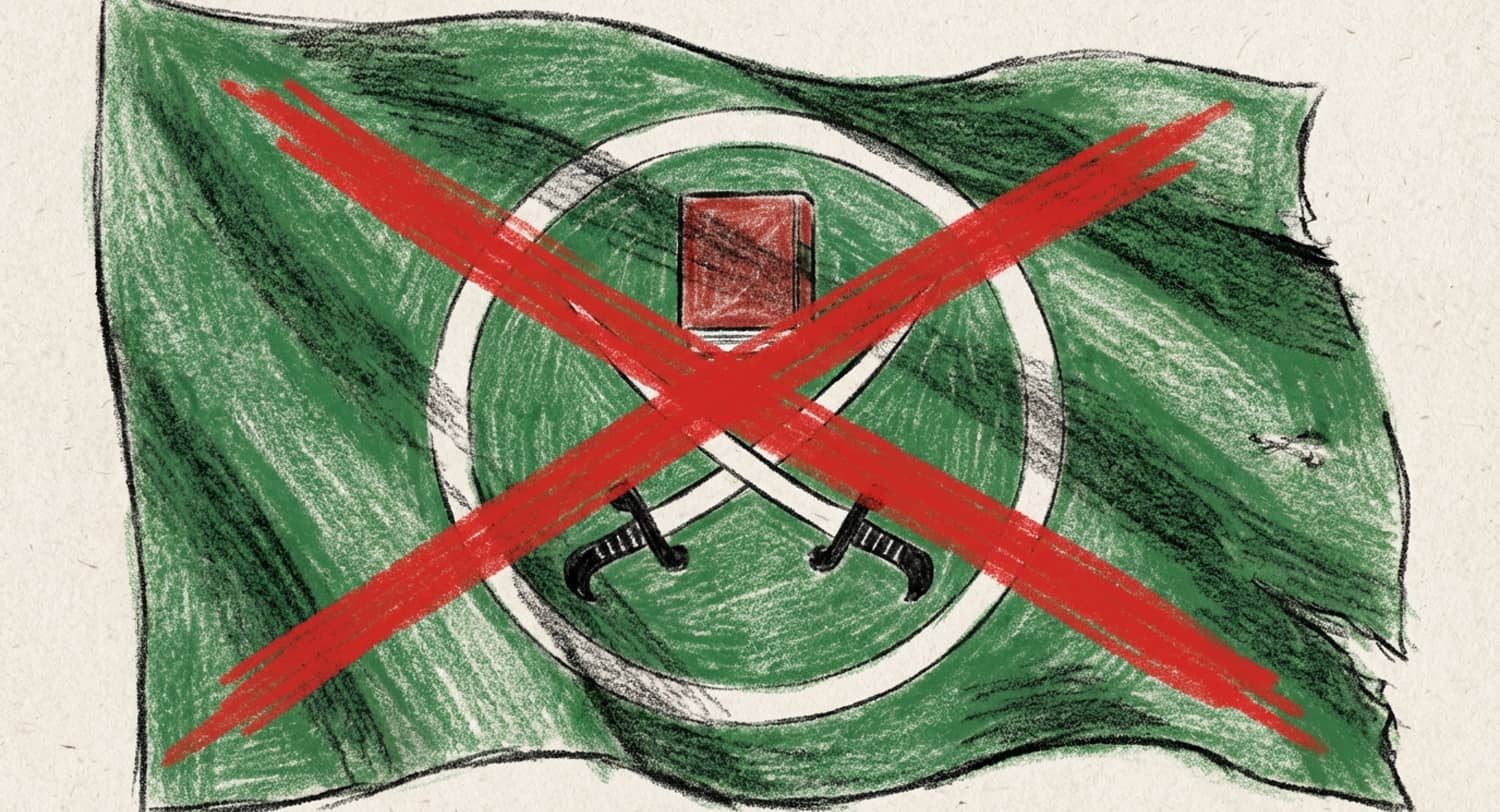
On November 24, President Donald Trump signed an executive order that begins the process of designating three Muslim Brotherhood chapters (in Egypt, Jordan and Lebanon) as “foreign terrorist organizations” and “specially designated global terrorists” under US law.
This decision marks a turning point in how the United States approaches the ideological landscape of the Middle East. For years, Washington focused on militant offshoots of the Brotherhood — Hamas, al-Qa’ida, ISIS — while ignoring the movement that shaped them as political actors. The White House has now signaled something different: that the architecture of political Islamism must be confronted directly through US law.
In Middle Eastern governments that have long treated the Brotherhood as an existential challenge – Egypt, Saudi Arabia, and the United Arab Emirates – the announcement is seen positively. They dismantled Brotherhood networks in their countries years ago, arguing that this organization undermines state cohesion and fuels extremist currents. From their perspective, Washington’s move acknowledges what they have insisted privately: the Brotherhood is not simply a political party or charitable social organization; it is also the central node in a transnational ideological project that fuels conflicts from Gaza to Libya.
The designation also places new pressure on states that host Brotherhood leadership. Turkey and Qatar have, since 2013, served as the movement’s ideological and media hubs. Channels such as Mekameleen TV and Watan TV broadcast from Istanbul and Al Jazeera from Doha; the International Union of Muslim Scholars operates with Qatari government backing; exiled politicians and clerics use these platforms to shape narratives across the Arab world. A US terror designation does not force Ankara or Doha to sever these ties, but it complicates their support of other Brotherhood networks. Under US law, “material support” (which includes funding and recruitment) to designated terror organizations can be investigated, prosecuted and shut down.
Another implication of the President’s designation affects domestic American offshoots. While the designation directly affects foreign terrorist organizations, it could also affect Americans and American-based entities through their “material support” to designated Brotherhood chapters. Over the past decade, the movement did not rebuild itself in the United States as a formal organization; it rebuilt as a network of loosely aligned affiliates, an ecosystem. The Brotherhood supported a constellation of institutions, activists, and media voices that draw from its political theology even when they deny institutional affiliation.
Specific cases illustrate how this ecosystem operates in practice. Islamic Relief Worldwide, based in Manchester, UK, has been banned or designated by several Middle Eastern governments for funding Brotherhood chapters in their countries (though it rejects these claims). Its US branch, Islamic Relief USA, is a domestic US charity that does its own fundraising in the US and claims independence from the mother organization (though it often participates in Islamic Relief Worldwide projects). The Muslim American Society, whose early leaders acknowledged Brotherhood roots, remains one of the most active grassroots Muslim networks in the US. Some Muslim Students Association chapters, founded by students influenced by Islamist revival currents, still maintain older organizational links. And platforms such as the Yaqeen Institute, based in Irving, Texas, propagate themes that mirror the Brotherhood-aligned media from Istanbul and Doha.
These examples do not amount to a command structure, nor do they imply that American Muslims are defined by the Brotherhood. The community is diverse, politically plural, and increasingly distant from Islamist political theology. But these cases illustrate how Brotherhood’s ideas diffuse into American civic life. The designation forces a question Washington has long avoided: how should the United States rigorously protect First Amendment rights of freedom of speech and assembly while also rigorously investigating and prosecuting fundraising, recruiting and other “material support” that ends up in the hands of designated foreign terrorist organizations?
This distinction is central to the designation’s eventual impact. If Washington treats the Brotherhood as a monolithic organization, the policy will collapse under legal and diplomatic challenges. If it targets specific entities that resort to violence for political purposes, and target support to those violent groups, the move could reshape the broader strategic environment without sweeping too broadly. Precision, rather than maximalism, is what makes the designation credible.
The Muslim Brotherhood has survived for nearly a century by shifting its language and activity, reframing its mission to adapt to specific environments, and relocating its centers of gravity across three continents. A designation challenges the movement, but it does not eliminate the conditions that allow its ideas to circulate.
President Trump’s designation is the most significant American strike on violent Islamism in years. Whether or not this move becomes an inflection point in the ongoing battle between democracy and violent Islamism will depend on implementation. Washington must act to freeze bank accounts, seize assets and, most importantly, work with its allies and partners to build a strategic framework capable of grappling with an Islamist movement that reshapes itself whenever the terrain shifts.