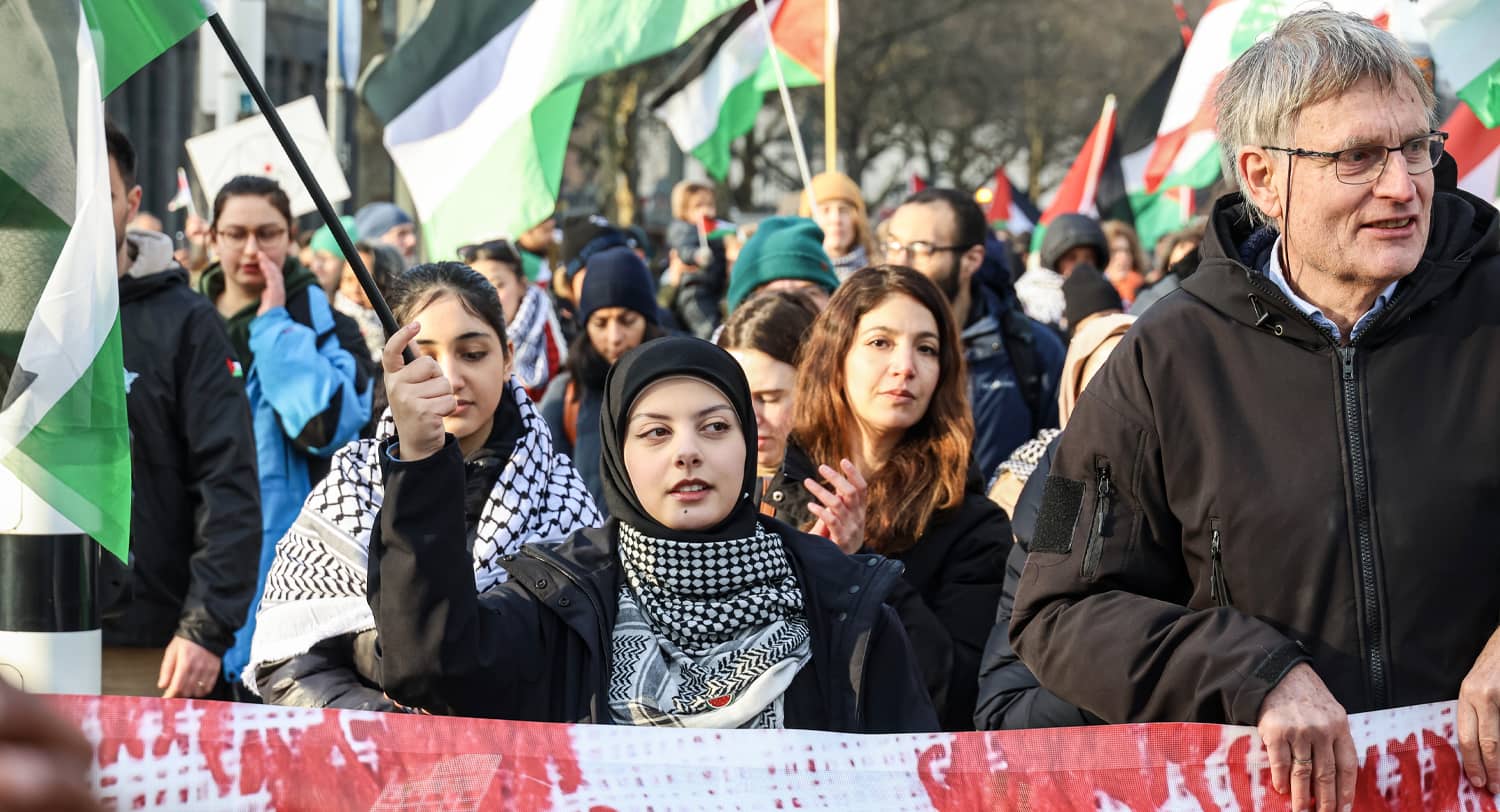
During the Cold War, ideological solidarities were defined by stark lines of allegiance and opposition. Today, a different, far less coherent convergence is emerging: segments of the Western left have found themselves aligned, in practice if not in principle, with radical Islamist movements.
This partnership does not stem from shared values but from shared adversaries. Progressive activists still champion sexual freedom, secularism, and individual autonomy, while Islamist groups advocate strict Shari’a law and moral governance. Rather it is built on shared antagonisms: anti-imperialism and antisemitism. The consequences of this intersection are significant, including for Israel, whose standing in the West is increasingly filtered through these ideological lenses.
For young Westerners on campuses and in social media discourse, ideological clarity is replaced by moral simplicity. Oppressors are to be opposed and victims to be championed, a framework that rarely invites historical nuance. Israel, with its democratic institutions, pluralistic society, and protections for minorities, becomes a convenient symbol of Western power and perceived injustice. Meanwhile, radical Islamist actors are reframed as embodiments of resistance, their internal contradictions and authoritarian tendencies largely overlooked.
The phenomenon is particularly striking among Lesbian, Gay, Bisexual and Transgender activists, who often enthusiastically support movements whose legal and cultural frameworks would punish them severely under Shari’a law. Same-sex relations, alcohol consumption, and secular freedoms are criminalized in some Islamic jurisdictions.
Young activists rarely consider these realities, highlighting a deeper issue: a drive toward symbolic solidarity and moral simplicity that has replaced substantive understanding. This is not necessarily malice or hypocrisy; it is a reflection of a generation raised in a social and educational environment where moral clarity is sought through simplified binaries and social belonging, rather than engagement with complex realities. This symbolic activism, combined with historical ignorance, makes anti-imperialism and antisemitism an unexpectedly effective bridge between these disparate movements.
Anti-imperialism functions as the bridge; antisemitism reinforces this alliance and becomes the common language. Western radicals perceive Israel and the United States as structural oppressors, while Islamist groups see them as civilizational adversaries. Both groups, for very different reasons, converge rhetorically against the same targets. While explicit and theological among Islamist movements, antisemitism on the Western left is recast as anti-Zionism or critique of Western power structures. Together, these narratives produce a shared vocabulary that enables cooperation and mutual reinforcement.
This trend is symptomatic of a broader cultural drift within Western societies. Institutions that once confidently articulated liberal and democratic values now struggle to do so. Civic education has weakened, leaving many young people without a historical understanding of how freedoms were won and how fragile they can be.
Social media accelerates the problem. Algorithms reward outrage and moral clarity, accelerating the drift from analysis to slogan. Identity-based frameworks for interpreting the world replace civic and historical literacy. The result is an environment where movements with incompatible goals can nonetheless appear aligned, unified by selective empathy and grievance.
Historical parallels can be found in two places where cultural disorientation preceded radical political transformation: pre‑revolutionary Iran and Weimar Germany. In Iran during the 1970s, rapid Westernization and the widening gap between civic institutions and the rising middle class produced a generation torn between modern aspirations and revolutionary narratives. In Germany of the 1920s, universities and urban circles incubated radical ideas and normalized antisemitic discourse, creating a social environment in which extremist movements could later seize political power. In both cases, the erosion of liberal and civic coherence created an ideological vacuum that more radical forces were prepared to fill. A similar pattern is emerging in the contemporary West, though with different actors and stakes.
Ideological drift often begins in culture before it manifests in policy; today a new cultural antisemitism is taking shape before it reaches politics. The intellectual and moral confusion now evident in Western campuses, media, and advocacy circles parallels earlier periods of cultural disorientation in other societies. Recognizing this intersection is not alarmist; it is pragmatic. It highlights the importance of cultivating historical literacy, encouraging intellectual rigor, and reaffirming the principles that underpin Western liberal democracies.
Addressing the challenge requires clarity rather than polemics. Western societies must reassert the value of individual liberty, secular governance, pluralism, and protection of minorities — including those most vulnerable under radical ideologies abroad.
Israel serves as a test case and a partner in this effort. Its democratic institutions, rule of law, and protection of Lesbian, Gay, Bisexual and Transgender rights offer a model that contrasts sharply with the authoritarian visions promoted by Islamist actors. Supporting Israel, therefore, is not merely a question of foreign policy; it is a reaffirmation of shared values.
The convergence between the Western left and radical Islamist movements is not likely to endure indefinitely. Contradictions are inherent, and the alliance is fragile. Yet while it persists, it reshapes cultural and political discourse in ways that have practical implications for Israel and Western democracies alike. Understanding the nature of this intersection — its ideological foundations, generational appeal, and cultural consequences — is essential for anyone concerned with the stability of liberal civilization, including the strategic environment in which Israel operates.
Ultimately, this is a call for sober awareness. Western societies do not need fear; they need intellectual rigor and cultural confidence. Israel does not need blind advocacy; it needs a Western public capable of distinguishing between moral symbolism and lived reality. The challenge is to defend principles consistently, articulate values clearly, and recognize that today’s cultural drift is tomorrow’s foreign policy. Failure to do so will leave the West unmoored from the very principles that once sustained its civilization.
