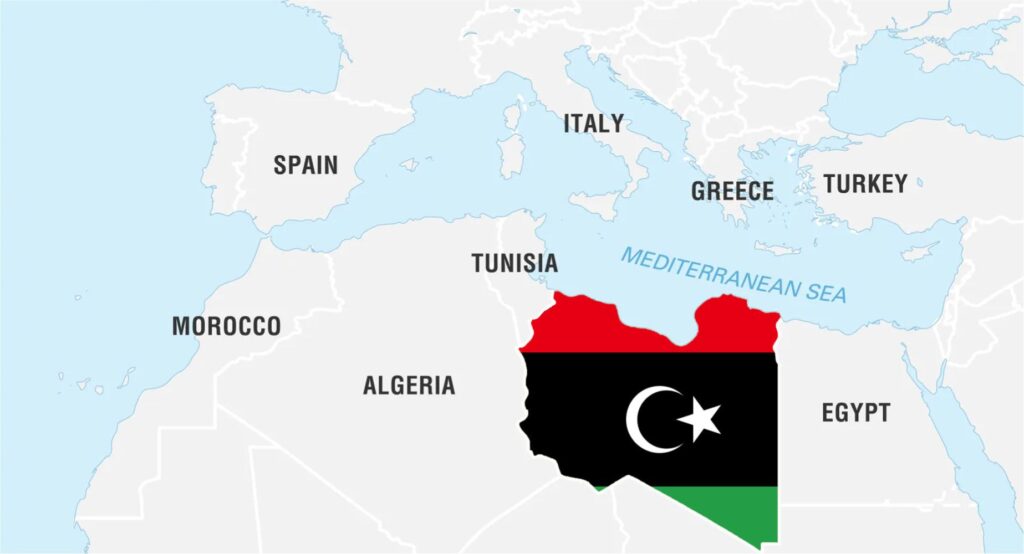
For more than a decade, Libya has stood as a symbol of unfinished intervention — a country liberated from dictatorship but never stabilized into durable statehood. The result has not merely been internal fragmentation. It has been the steady erosion of security across the central Mediterranean, the expansion of external influence, and the normalization of instability along NATO’s southern flank.
Libya today is not simply a humanitarian concern or a diplomatic puzzle. It is a strategic test of whether the United States intends to remain a shaping power in the Mediterranean — or whether it will accept a future defined increasingly by others.
The United States cannot afford continued passivity.
The Mediterranean is not a peripheral theater. It connects Europe, North Africa, and the Middle East. It is a corridor for energy flows, migration routes, commercial traffic, and security partnerships. Instability in Libya reverberates directly into Southern Europe, testing alliance cohesion and creating pressure points that adversaries are quick to exploit.
Over the past decade, international diplomacy has centered largely on political roadmaps, ceasefire arrangements, and election timelines. These efforts have reflected good intentions. Yet they have repeatedly faltered for one fundamental reason: sustainable political processes cannot succeed in the absence of a unified and credible security architecture.
Statehood begins with security. Without territorial control, a coherent chain of command, and disciplined armed forces capable of enforcing national authority, elections become aspirational rather than transformative. Libya’s fragmentation has not persisted because of a lack of conferences or communiqués; it has persisted because the country remains divided between competing armed structures with no integrated national command.
This is where strategic realism must guide policy.
In eastern Libya, the Libyan National Army (LNA) has established a degree of territorial control and internal cohesion that contrasts sharply with the militia fragmentation seen elsewhere in the country. This reality does not require endorsement of every past action, nor does it imply disregard for the complex political and humanitarian dimensions of Libya’s conflict. But effective strategy must begin with facts on the ground.
Engagement is not endorsement. It is influence.
If the United States chooses not to engage the actors who exercise meaningful control over territory and security structures, others will. Recent years have already demonstrated that external powers are prepared to expand their leverage in Libya, whether for military positioning, energy access, or geopolitical advantage. A vacuum in North Africa does not remain empty for long.
For Washington, the question is not whether Libya is complicated. It is whether the costs of disengagement exceed the risks of structured involvement.
There are four strategic interests at stake.
First, counterterrorism. Ungoverned or weakly governed spaces have historically provided fertile ground for extremist networks. While major terrorist organizations have been degraded in Libya, the absence of consolidated national security institutions leaves open the possibility of resurgence.
Second, alliance stability. European partners continue to bear the immediate pressures of irregular migration flows across the Mediterranean. Persistent instability in Libya contributes directly to these flows and, by extension, to political volatility within allied democracies.
Third, energy security. Libya possesses significant hydrocarbon resources whose reliable production contributes to global market stability. Fragmentation and insecurity undermine consistent output and discourage long-term investment.
Fourth, geopolitical competition. Strategic competitors understand the importance of positioning along the Mediterranean littoral. Military access, port facilities, and political leverage in North Africa carry implications far beyond Libya’s borders.
A more coherent U.S. approach to Libya would not require large-scale military intervention. It would require leadership.
Such leadership could include the appointment of a senior-level envoy empowered to coordinate interagency policy and align closely with European allies. It would involve shifting diplomatic emphasis toward security-sector integration as a prerequisite to national political reconciliation. It would require calibrated engagement with existing security structures in both eastern and western Libya, encouraging gradual unification under civilian authority rather than perpetuating parallel systems.
Importantly, engagement must be conditioned and purposeful. Support for security consolidation should be tied to measurable steps toward national integration, professionalization of forces, and respect for basic governance norms. The objective is not to empower a faction indefinitely, but to create the foundation upon which a unified Libyan state can emerge.
Critics may argue that Libya’s divisions are too entrenched, its political class too fragmented, and its regional dynamics too complex to justify renewed American focus. Yet history suggests that prolonged strategic neglect often proves more costly than disciplined engagement. The longer fragmentation persists, the more entrenched external influence becomes and the harder eventual stabilization will be.
The United States retains significant diplomatic credibility and alliance networks in the Mediterranean. It has relationships with European capitals, dialogue with regional actors, and experience in security-sector reform. What has been lacking is not capacity, but sustained prioritization.
Libya will not be stabilized by rhetoric alone. Nor will it be stabilized by attempting to bypass those who command forces and territory. Durable peace requires the integration of security structures into a national framework — one that reflects Libya’s sovereignty and is supported, rather than shaped, by external partners.
The alternative is continued drift: periodic ceasefires, stalled elections, fragmented institutions, and opportunistic interference by outside powers. That path leads not to resolution, but to normalization of instability.
The Mediterranean has long been a central arena of strategic competition. It remains so today. The United States must decide whether it intends to help shape Libya’s trajectory toward unified statehood, or whether it will remain a distant observer as others define the outcome.
Strategic leadership does not demand perfection. It demands engagement guided by realism, alliances, and long-term national interest.
Libya’s future is ultimately for Libyans to determine. But whether that future unfolds within a stable sovereign framework — or within a fractured landscape vulnerable to external manipulation — will depend in no small part on whether the United States chooses to reassert steady, disciplined leadership in the Mediterranean.
