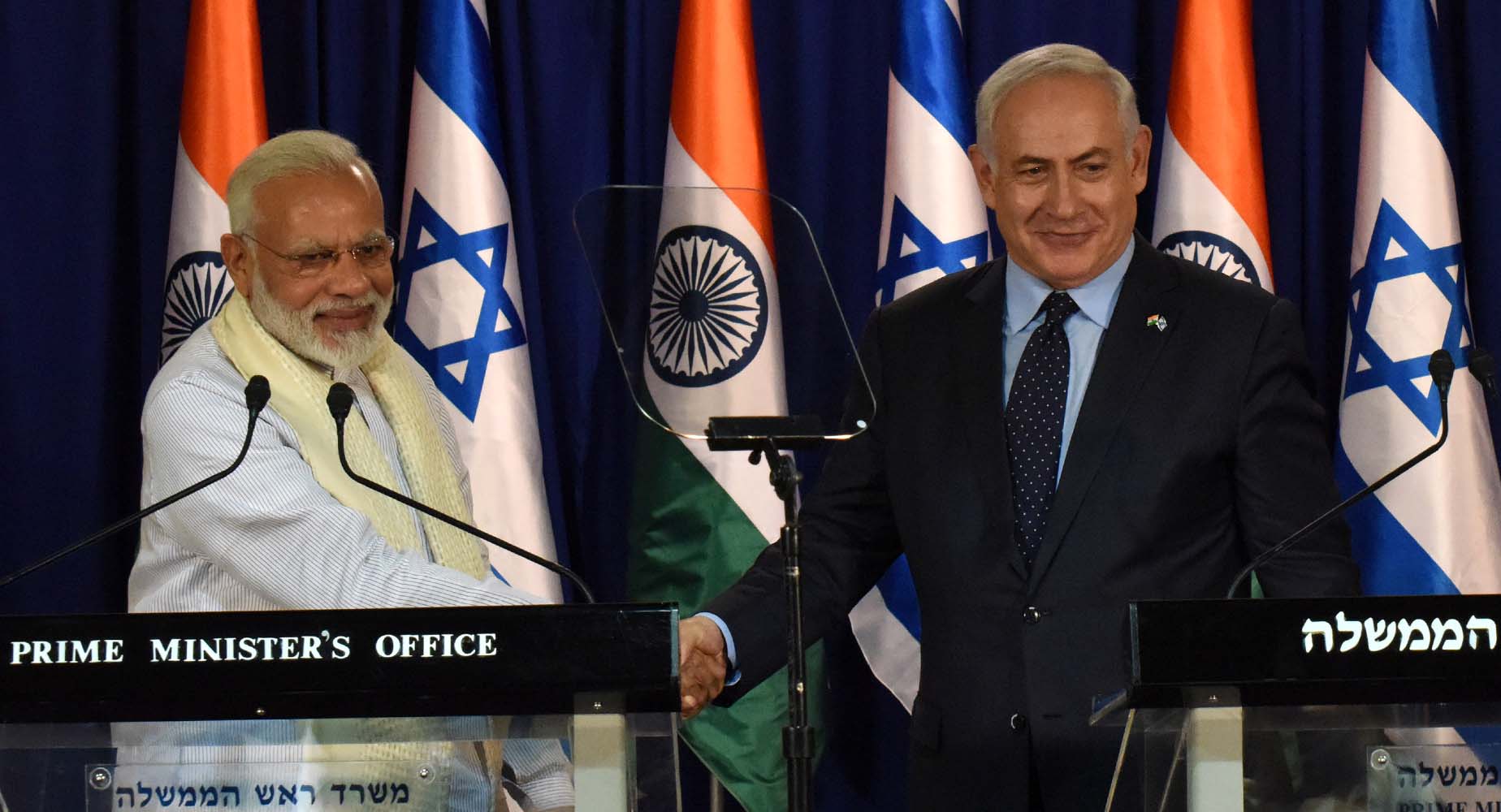
Prime Minister Narendra Modi’s decision to visit Israel, for the first time since 2017, and to address the Knesset for the first time ever, is a significant milestone in the emergence of what his long-time Israeli partner, Binyamin Netanyahu, calls a “tremendous alliance”: an overstatement, perhaps, insofar as the two nations are not formally allied (and on some issues, such as the attitude toward the present brutal regime in Iran, their views are quite far apart) — but nevertheless a testament to the importance of the relationship for both.
Things have not always been that way. Both countries were born, amidst painful and violent partitions, as British power waned in the wake of World War II. But India, mindful of its need to build relationships with the emerging nations of the Arab and Muslim world despite its conflict with Pakistan, was among the minority in the UNSCOP discussions on a Jewish state and voted “no” in November 1947. For a long while it was firmly associated with the Non-Aligned Movement: indeed, India’s Nehru alongside Egypt’s Nasser, Yugoslavia’s Tito, and Indonesia’s Sukarno were the NAM’s founding fathers. This did little to endear Israel to Delhi’s heart.
While such sentiments can still be reflected in the attitudes of some political figures in India, particularly those who adhere to the legacy of the Congress Party, it was in fact a Congress government that in 1991 crossed the crucial threshold of diplomatic recognition. This came about as part of a changing international order: the Soviet Union (for years India’s friend), as well as China, took a similar step so as to have a say in the multilateral working groups that were part of the peace process ensuing after the U.S. victory over Saddam Hussein. Israel was no longer perceived as an active enemy of the Arab world but as an interlocutor. This came well before the Oslo breakthrough, and thus the claim of Arafat and the PLO that it was they who opened the gates for Israel in India, Russia, and China is patently misleading.
In any case, the relationship was soon transformed by major political and strategic events, and the course was set for what was to become — if not an alliance in the full sense of the word — at least a partnership of growing significance for New Delhi and Jerusalem alike. Politically, with short interludes, both countries came to be dominated by parties with a preference for strong national (and in some respects religious) identities: the BJP in India, led for years now by Modi as a dominant figure, and the Likud in Israel, similarly dominated by Netanyahu. The two leaders built up a personal relationship; memorably, they went wading together in the shallows of Israel’s Mediterranean coast during Modi’s previous visit. Yet what truly cemented the relationship was Israel’s willingness and ability to respond with remarkable alacrity to India’s military needs during the Kargil crisis in 1999. Soon enough, Israeli weapon systems worth billions of dollars were pouring in, with arrangements to “Make in India” some of their key components. Military cooperation was complemented by intelligence sharing, as both countries found common ground in facing Islamist terrorism and radicalism.
Muslim nations opposed to such violent versions (or rather, perversions) of a noble religion could therefore find common ground with both Israel and India. Thus it was not only shared interests — and the vision of the India–Middle East–Europe Corridor (IMEC), a potentially formidable competitor to China’s “Belt and Road” — that brought together India, Israel, and the United Arab Emirates. It was also a broad set of shared ideas and indeed common enemies. This in turn brought about what India referred to as the “Western Quad,” in parallel with its partnership in the Indo-Pacific with the U.S., Japan, and Australia. The Biden Administration chose a different, rather catchy title — the I2U2 (India, Israel, USA, and UAE), launched in a summit (half in Jerusalem, half by Zoom…) in October 2021. Another summit was held in July 2022; and while turbulent events made it difficult to solidify the partnership further, the underpinning imperatives — in strategic terms as well as in the realm of ideas — remain in place and are bound to be reflected as the summit in Israel reaffirms their importance.
This is all the more so at a time in which Erdogan’s Turkey openly asserts its affiliation with Pakistan — as it did during the latest round of fighting, Operation Sindoor, in May 2025 — while also seeking to position itself at the head of an anti-Israeli regional grouping, trying to draw in Saudi Arabia and Egypt. Both Israel and India have reasons to look askance at the Turkish bid to dominate the region in the wake of Iran’s strategic decline. Once again, not only interests are at stake but also the ideological challenge posed by radical Islamism. The manner in which this threat is viewed by moderate regional players such as the UAE is another factor that binds it to both Israel and India.
Sadly, the fourth leg of the I2U2 table was somewhat loosened in recent months by rising tensions between the Trump Administration and Modi’s government over tariffs and trade. Yet “though much is taken, much abides” (to quote Tennyson’s Ulysses), and the foundational commonality of the largest democracy in the world with its American partner remains intact. While India does take pride in belonging to the BRICS group, challenging Western hegemony in the global economy, it is clearly not part of the strategic and military alignment that brings China, Russia, Iran, and North Korea (the “CRINK”) together in open enmity toward America. Whatever authoritarian traits may be attributed to Modi — and Netanyahu — both countries are and will remain democracies, and India’s disagreements with Washington can be settled. Israel, in its own way, may be able to be of help.
A trite joke has it that the reason relations between Israel and India are so important is that together the populations of both countries constitute about one-sixth of humanity. The disproportion in demographic and geographic size is indeed a matter of two orders of magnitude. Yet Israel proved itself to be of strategic significance to India at moments of need, and India — today the most populous nation on earth — is obviously not only a market for Israeli technology but a global presence from which Israel can draw benefits, even if its first and foremost association is bound to remain with America (not least because the other three-sevenths of the Jewish people live there).
India is not only a growing military power and an economic powerhouse on the rise. For many Israelis — specifically young people seeking a change of scenery after military service — it connotes a spiritual alternative to the pressures of post-modern consumer society. You will find them hiking unexpected trails at unexpected hours; as one Indian officer once told me in my days in government, “you have ruined a perfectly good line from Kipling — now it is not only mad dogs and Englishmen who go out in the midday sun.” These experiences, and the bonds they help build over the years, are part of the reasons why Modi’s visit — coming at a dramatic time, on the eve of possible conflict and shattering attempts to isolate Israel in the international community — is bound to leave a long-term imprint.
