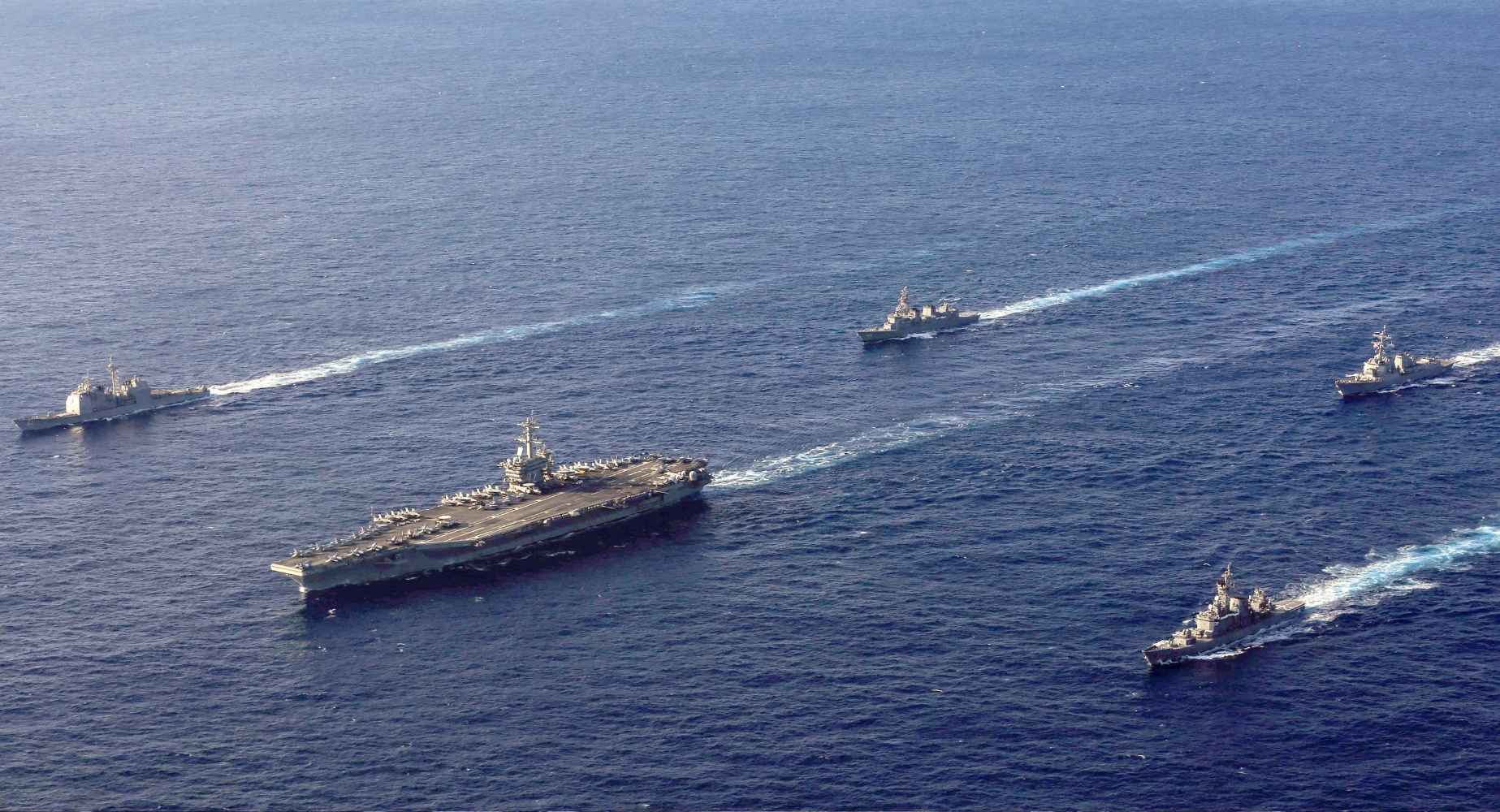
When American policymakers think of the Indo-Pacific region and the challenges it poses for U.S. security interests, it is understandable that the Pacific part comes to mind first. From the constant possibility of a Chinese invasion of Taiwan to North Korea’s menacing nuclear arsenal, threats to stability in the Western Pacific have enormous implications for the United States. It would be a mistake, however, to ignore or downplay the Indo part.
The U.S. has a major stake in events in the Indian Ocean and the surrounding countries. While many events in and around that ocean may not require a U.S. military response, a constant U.S. military presence in key locations can ensure America maintains regular dialogues with countries that can help maintain stability in that part of the world. This includes helping America balance against China, a task it needs willing allies and partners to accomplish.
While the sinking of the Iranian frigate IRIS Dena by the American submarine USS Charlotte off the coast of Sri Lanka is an impressive feat of U.S. military prowess, it also has the potential to be disruptive in the long term. The location of Dena’s sinking was far closer to India’s coastline than it was to Iran’s, and Prime Minister Narendra Modi’s reluctance to criticize the U.S. is seen by many Indians as a sign of weakness. Even when an American military action serves a clear American interest, if it ruffles feathers in many nearby countries, it behooves the U.S. to smooth them.
Homeporting naval vessels in several Indian Ocean countries can indicate decisively that America is paying close attention to developments in the region, and that Washington is not only interested during especially tense times like the conflict with Iran. American sailors interacting regularly with the military and civilian populations of key partner countries, and naval officers interacting regularly with the countries’ political leadership, would establish a high level of trust in a U.S. policy of uninterrupted engagement. It would also allow for quick reactions to sudden events.
Current Challenges
When the U.S. deploys vessels to the Persian Gulf or other outlets of the Indian Ocean, they must generally come from the continental United States, a time-consuming process. It can take three weeks for a carrier strike group (CSG) to reach the Middle East from the U.S. Navy’s base in San Diego, for example. This puts significant strain on ships that must cross two oceans to reach their destination. Backlogs in ship repair and maintenance add to that strain.
Vessels can reach the Indian Ocean from the U.S. East Coast via the Suez Canal, but this presents issues, too. In 2021, the container ship Ever Given ran aground in the canal, blocking traffic for six days. If a similar blockage were to occur during a crisis to which Washington was responding with a naval deployment, American ships may not be able to reach their destination quickly enough.
Furthermore, while Egypt is a longtime ally of the United States that allows the U.S. Navy to use the Suez Canal, it is not guaranteed to continue playing that role forever. Russia’s invasion of Ukraine disrupted the vital supply of wheat to Egypt (a source of leverage for Moscow), while Chinese investment has made Egypt a significant part of Beijing’s Belt and Road Initiative. America’s rivals may one day use their economic muscle to force Cairo to deny the U.S. access to the canal.
Even if Iran is forever deprived of the ability to make nuclear weapons, there may be situations that call for a U.S. military presence in the waters around the Arabian Peninsula. Terrorists, pirates, and other violent groups can wreak havoc on international trade – as the Houthis have done since 2023 – and failed states and civil wars can allow new malevolent actors to arise. These threats may be less significant to American interests than Chinese aggression in East Asia or Russian aggression in Europe, but they are still relevant.
Furthermore, China has increased its military presence in the Indian Ocean in recent years. In 2017, Beijing established its first overseas military base in Djibouti. The People’s Liberation Army Navy has stepped up its training activities in the region: in 2023, for example, it conducted exercises in the Indian Ocean with Iran, Kuwait, Oman, Pakistan, Russia, Thailand, and the United Arab Emirates. While some of these nations seek to maintain good relations with the U.S. at the same time, the more friends Beijing wins over across the Indian Ocean, the more headaches it can create for the U.S. in the event of a major conflict.
It would be difficult for the U.S. to counter China’s growing naval presence with one of its own by relying on temporary or rotational deployments. Because America can never know when exactly its Navy will be called upon in great numbers to defend European or Pacific allies, positioning a small portion of its naval strength in the Indian Ocean allows the U.S. to hedge against uncertainty far from its homeland. Three locations in particular suggest themselves.
Kenya
At the western end of the Indian Ocean, Kenya would be an excellent location for American warships. Kenya has proven itself a valuable partner in protecting U.S. security interests in East Africa and beyond. In 2024, it became the first sub-Saharan African country to receive Major Non-NATO Ally (MNNA) status from Washington. Shortly before Russia invaded Ukraine, Kenya’s ambassador to the United Nations gave an eloquent condemnation of Russian aggression, drawing a parallel between Ukraine’s resistance to Vladimir Putin’s tyranny and African peoples’ struggles against European rule. Recent analysis by the American Enterprise Institute shows Kenya to be largely aligned with Israel and the United Arab Emirates in proxy struggles in East Africa.
Basing Arleigh Burke class guided missile destroyers in Kenya would give the U.S. Navy convenient access to the waters around the Arabian Peninsula without the stress of a long journey from the U.S. mainland. These workhorses of the Navy have been instrumental in shooting down Iranian and Houthi drones and missiles. In January, U.S. Deputy Secretary of State Christopher Landau attended a ground-breaking ceremony for a runway expansion at Kenya Navy Base Manda Bay, a sign of how highly the U.S. values Kenya’s friendship. Washington can build on this good rapport to ask Nairobi if it is willing to host American vessels in its bases.
Australia
At the opposite edge of the Indian Ocean, Australia’s western coast provides another good site.
Near the city of Perth sits HMAS Stirling, one of the largest facilities of the Royal Australian Navy, which is rising in prominence as a location for American vessel maintenance. Through such institutions as AUKUS and the Quadrilateral Security Dialogue (Quad), Australia and the U.S. are already working closely together to balance China’s rise in the Indo-Pacific.
Much as the CSG based at Yokosuka, Japan, gives the U.S. a naval force with which to quickly react to any Chinese aggression toward Taiwan, placing a CSG at HMAS Stirling would give it a way to quickly react to any provocative Chinese presence in the Indian Ocean. Alternatively, should the carrier, its aircraft, and its escort ships be needed in or near the Persian Gulf, they would have a quicker route than what faces a CSG heading there from the American homeland. Australia’s west coast provides an excellent pivot point for these purposes.
Mauritius
Diego Garcia, one of the Chagos Islands, is an intriguing possibility for basing ships. While the United Kingdom is in the contentious process of turning over the Chago Islands to Mauritius, the British military will retain access to its facility on Diego Garcia, which it shares with the U.S. There are currently U.S. Navy maritime prepositioning ships based there.
If the U.S. were to expand its naval presence in Diego Garcia to include combat vessels, that would give it another convenient location from which to deploy into the Indian Ocean, or else toward the Arabian Peninsula and the Horn of Africa. It would be vital for the U.S. to maintain good relations with Mauritius, giving American diplomats a strong incentive to keep the island country from falling into China’s orbit. Basing combat vessels here, while unorthodox, is worth Washington’s consideration.
Conclusion
After the current fighting in Iran has ceased, the United States will still have reasons to keep a close eye not only on the Persian Gulf, but on the Indian Ocean. Basing vessels at key locations can help American policymakers quickly respond to both emergencies in the Middle East and China’s growing presence in the Indo part of the Indo-Pacific. In an era when security challenges are constantly evolving, speed and flexibility are key for the leading nation of the free world.
