In 1949, Theodor Heuss, the first president of the Federal Republic of Germany, warned his countrymen that “we should not make it so easy for ourselves to forget what the Hitler era brought us.” Heuss, who had been a member of the pro-democracy German State Party during the Weimar Republic, was a keen student of Hitler’s rise. He had published a book called Hitler’s Rise in 1932 that warned about the dire threat Nazism posed to German democracy. Yet a year later Heuss, in the aftermath of the Reichstag fire, together with the four other members of his party, voted for the Enabling Act, which vouchsafed Hitler the authority unilaterally to make laws. They hoped against hope that it would bind Hitler into the existing legal system. Instead, the measure served as a death sentence for Weimar, establishing Hitler’s dictatorship.
In 53 Days, his brilliantly absorbing book about Hitler’s early weeks as chancellor, Timothy W. Ryback minutely examines his dismantlement of Weimar. Ryback is the author of several books on the German tyrant, including the widely lauded Takeover: Hitler’s Final Rise to Power. He offers a timely reminder that Hitler and his camarilla did not engage in a seizure of power, but, as the Nazis themselves liked to emphasize, obtained it by constitutional means. Within 53 days, Hitler implemented what might be called Project 1933. In clear and compelling prose, Ryback emphasizes that the Führer drew upon his mephitic tract Mein Kampf as a playbook for consolidating his rule. He quickly moved to ban much of the print press and radio, purge the civil service, suspend civil liberties, impose tariffs on a variety of countries, attack the central bank and denude the Reichstag, or the federal parliament, of its powers.
Hitler’s lifelong obsession, as the German historian Joachim Riecker underscored in his study Hitlers 9. November, was with November 9, 1918. In right-wing demonology, Jewish “November criminals” had stabbed Germany in the back by arranging its surrender to the western allies. The Weimar Republic was viewed by the right as an illegitimate and traitorous creation that had to be overthrown.
But how to do it? The 1920 Kapp putsch in Berlin had flamed out. An impetuous Hitler had a go at it on November 9, 1923, when he collaborated with conservative officials on an attempt to topple the Bavarian government that was to be followed by a march on Berlin. His abortive putsch persuaded Hitler that he should seek to rise to power by legal rather than extra-constitutional means. “The failure of the putsch,” Hitler later said, “was perhaps the greatest good fortune of my life.”
Hitler enjoyed a lot of good fortune, but it is advisable to remember that there was nothing inevitable about his rise. The Nazi party had experienced a decline of two million votes between the July and November 1932 parliamentary elections. What’s more, its finances were also in a state of disrepair. But as the Yale University historian Henry Ashby Turner showed in his book Thirty Days to Power, the readiness of craven conservative elites to collude with Hitler in January 1933—most notably, the former chancellor Franz von Papen who believed that he could manipulate Hitler for his own ends–ultimately ensured that he was appointed chancellor by Paul von Hindenburg, the World War 1 war hero and president of the Weimar Republic. Though he had been named chancellor, only two other members of the new cabinet were Nazis—Wilhelm Frick and Hermann Göring. Faced with the legal and constitutional restraints of a democratic republic, Hitler’s mission was to annul them. In essence, Ryback writes, “Hitler was declaring war on his own government.”
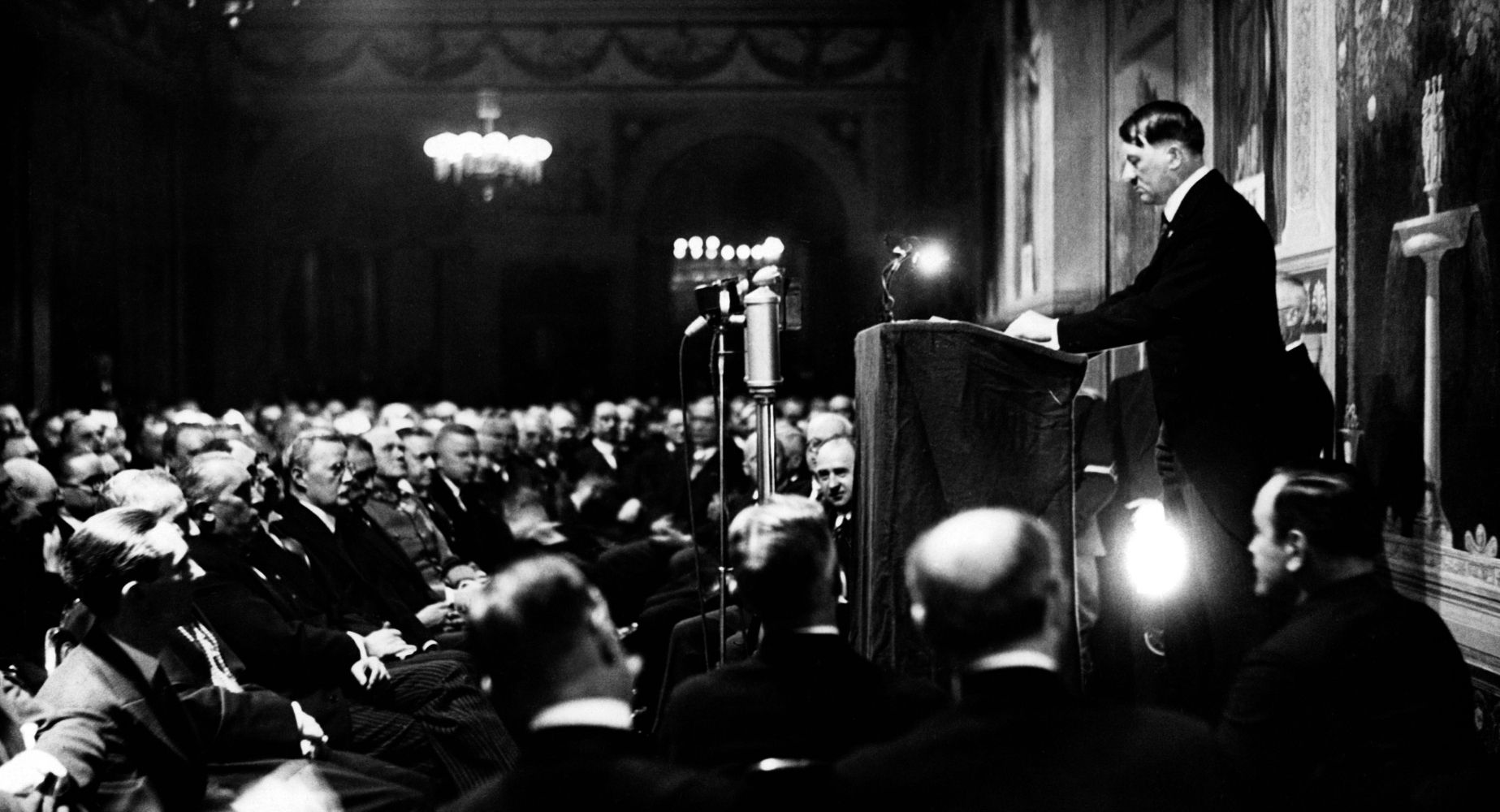
Hitler’s first move was to wage war on the press. On February 6, his government issued an emergency decree banning newspapers that criticized the new regime. 171 out of 190 social democratic newspapers were closed. At a press conference in mid-February, “Hitler,” Ryback reports, “told the reporters that he regretted having been `forced’ to the extreme measures of curtailing the press but the persistent attacks and provocations from the left-wing press had left him no other choice.” At the very same time, Hitler seized upon the opportunity to hold a state-funded media spectacle in the Berlin Sport Palace, which was outfitted with cameras for newsreels feeds and live radio transmission. Wearing a brown shirt, breeches and jackboots, Hitler made no bones about his intentions, declaring that he would root out the founders of the Weimar Republic who had “destroyed, degraded and ruined” the great German nation. “HITLER PROCLAIMS WAR ON DEMOCRACY AT HUGE NAZI RALLY,” ran the New York Times headline.
Another target of Hitler’s obloquy was the German civil service or, if you prefer, deep state. Ryback points out that the principal target was the Free State of Prussia, which was the largest of the Weimar Republic’s seventeen federated states. It was Prussia, of course, that had originally united Germany in 1871 and the monarchy had always insisted upon its prerogatives. The first move of the Nazis was to fire twenty-four out of thirty-five police commissioners in Prussia and to replace them with their own creatures. Joseph Goebbels wrote in his diary that they were “cleaning house. We are gradually entrenching ourselves in the administration.” Hitler defended his measures by claiming that national socialists had been the victims of the Weimar government and that it was time for payback.
Despite the sweeping measures that he had instituted, including widespread violence and terror, Hitler’s position during his first month in power was by no means impregnable. In early February, for example, two hundred thousand social democrats gathered in Berlin to defend the republic, some ten times the number of torch-bearing storm troopers who had clamorously assembled to celebrate Hitler’s ascension on January 30. “If the pro-democracy voting blocs held firm,” Ryback writes, “with potential gains in some constituencies, and if support for national socialists continued to erode, Hitler could face electoral headwinds in the March 5 elections.”
He did not. Hitler seized upon the Reichstag fire of February 27 to launch a nationwide purge of his adversaries, declaring “We can’t let a single communist, a single social democratic traitor get through our fingers.” The next day Hitler persuaded Hindenburg to approve the Reichstag Fire Decree, terminating a free press and the right to habeas corpus. On March 22 Dachau concentration camp was created. A day later the Reichstag approved the Enabling Act. Soon enough Germany was converted into what Thomas Mann called a “thick-walled torture chamber.” By the time this sinister drama reached its final act, the Prussian aristocracy that connived at Hitler’s rise had been wiped out by him. Germany itself lay in ruins, shorn of its eastern territories and sundered in half.
Not until 1990 was Germany reunited. Since then, revisionism about Nazism has received something of a fillip with the rise of the Alternative Party for Germany, a populist right-wing party that dismisses the need for atonement of the Nazi past. One of its leaders has condemned the Holocaust memorial that is located near the Brandenburg Gate in Berlin as “a memorial of shame.” A recent 1500 page report from the Society for Civil Rights concludes that the party seeks to subvert Germany democracy by creating separate classes of citizens. This is why Theodor Heuss’ admonition about the importance of recalling the Nazi era remains as pertinent as ever.
This article first appeared in the National Interest.
