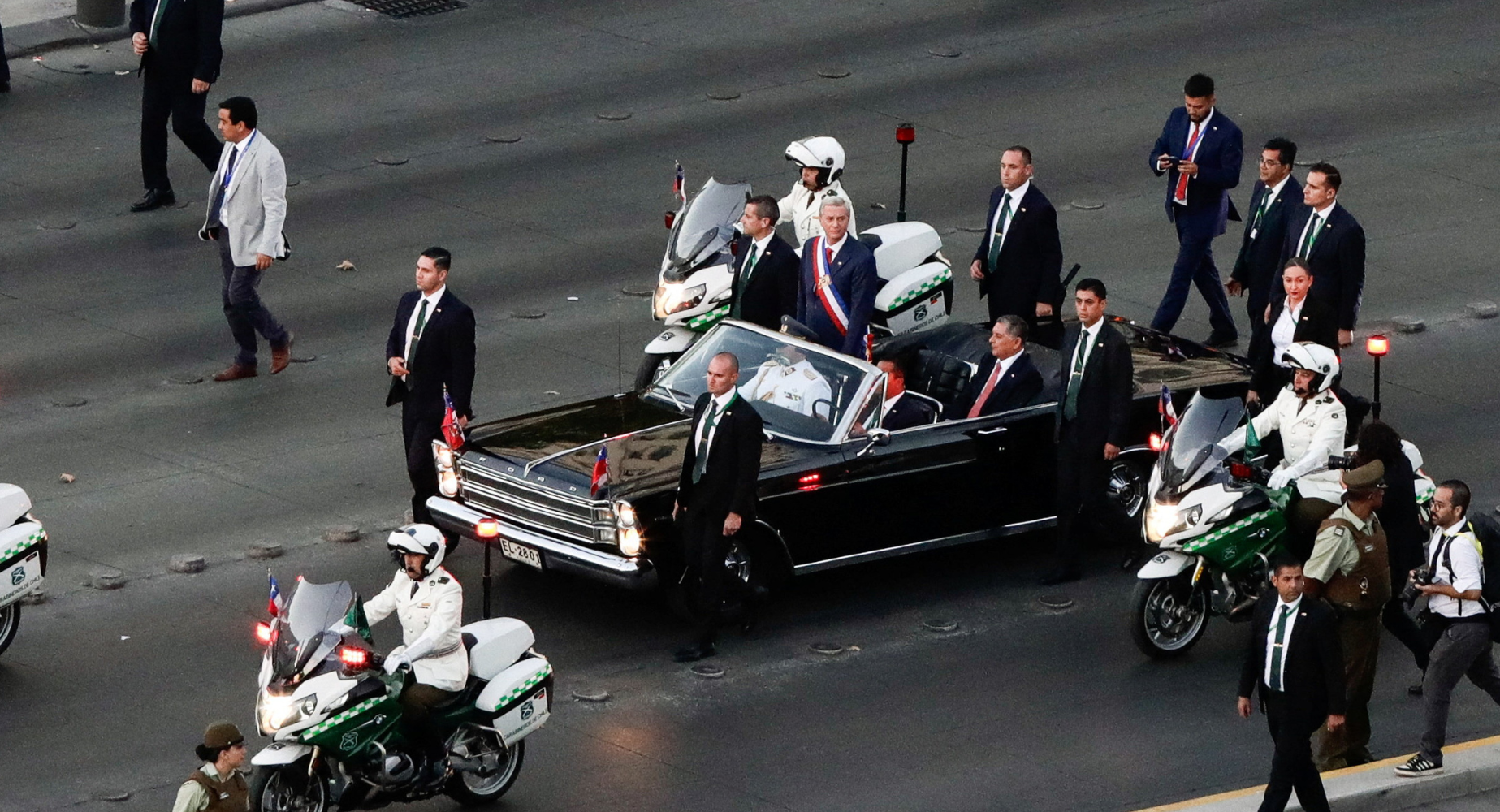
Since taking office in March, Chilean President José Antonio Kast has had one major victory, the narrow passage of a “mega-reform” which will allow him to implement his strongly conservative economic prescriptions. However, his other main legislative priority, a hardline reform of public security, faces a tougher time, as it has received sharp criticism for allegedly curtailing civil liberties.
Kast rode to victory by emphasizing the economy and security, while downplaying the social and cultural issues for which he had been known. But governing has proven difficult, as his core support in Congress falls short of a majority, and he has had to obtain votes from two parties, one even further to the right than his own, and the other characterized by an amorphous populism.
While his victory may be part of a conservative wave in Latin America, he has not yet cultivated the personal relationship with Donald Trump that some of his counterparts have, and is aware of the need to maintain good relations with China, Chile’s top export market. Kast’s success in a country which has grown suspicious of politicians will depend on whether his business-friendly economic policies will spark a recovery, and whether he can find a way forward on security.
The Right Gets Its Turn
Kast’s victory reflected public disillusionment with the outgoing administration of Gabriel Boric, who had once seemed a fresh alternative to establishment politics. Boric had promised to “refound” Chile on egalitarian, environmentally sensitive lines. However, his popularity petered out, as popular concern rose over a sluggish economy and rising crime. He tacked to the right, putting more conventional personalities in his cabinet, but his support never recovered, as he staggered to the end of his term.
In the late 2025 election it was now the turn of the right to take advantage of public disgruntlement. Representing the Republican Party, a vehicle which he had created in 2019, Kast defeated a more conventional center-right figure in the first electoral round. Then, in the second round, he bested a prominent member of Chile’s Communist Party who represented the leftist coalition which had supported Boric, winning a resounding 58 percent of the vote. During the campaign he had stressed that his would be an “emergency government” focused squarely the economy and security.
As in many Latin American countries, Chile’s political system is fragmented. Kast has four parties which formally support him, his own hard right Republicans and three center-right formations; however, to gain even narrow congressional majorities, he must also obtain votes from two other relatively new parties.
One is the National Libertarian Party, a grouping which finds even Kast to be insufficiently conservative on both economic and social issues and is particularly suspicious of the traditional center-right parties within the governing coalition. Both the National Libertarian Party and some elements of Kast’s Republicans are fond of the distinction, first coined within Spain’s hard right party Vox, between the “valiant right” and the “cowardly right.”
The other party which Kast must woo is the Party of the People, an ill-defined populist grouping. Under the banner of “neither fascist nor communist,” it takes its support from Chile’s lower middle class, and has pressed for such causes as sales tax exemption for medicine and diapers and an additional national holiday. The leaders of both parties have future Presidential ambitions and no loyalty to Kast personally.
From the beginning Kast has faced a challenging environment. In response to the rise in oil prices occasioned by the American-Israeli conflict with Iran, he accepted his finance minister’s guidance, refusing to provide subsidies to mitigate rising gasoline prices, which led to a rapid decline in his popularity. Chile’s economy has remained subdued and there is little sign of any “feel good” factor from the change in administrations, with polls indicating continued pessimism regarding the future.
An Orthodox Economic Recipe
Kast has remained focused on making good his plans for a rightward shift, and has had one major success, the passage of his so-called economic “mega-reform.” Its most prominent feature is a binding commitment to investors not to increase the taxes which they will have to pay for a period of up to 25 years, giving them a long term horizon for their decision making. This to some degree replicates policies which existed under the Pinochet regime which saw a boom in investment, particularly in mining.
This measure was criticized on the left as a giveaway to business, as was the reform’s other main feature, the gradual reduction in corporate income tax from 27 to 23 percent by 2029. However, many feel that Chile has over time become a less competitive business environment, and even some opposition members in Congress came close to supporting the bill’s passage, although ultimately party loyalty prevailed and they did not. As a result the reform passed by a one vote margin.
Kast’s government has also begun an austerity drive, ordering a three percent reduction in government spending on purchases of goods and services and on outside contracting. Actual levels of service to the public are theoretically to be maintained (a Kast campaign promise). However, there are complaints that Chile’s already overburdened public health system is already suffering adverse effects from the cuts.
Another change has been the decision to refrain from seeking transfers to the treasury of funds from state-owned enterprise CODELCO, the world’s largest copper producer. As a result of under-investment, poor management and alleged corruption, CODELCO, historically a major contributor to government revenue, now faces an extended rebuilding period.
Stumbling on Security
Having achieved passage of his economic package, Kast has sought to move forward on his “Agenda Against Organized Crime and Terrorism.” His Ministry of Public Security has orchestrated the highly publicized transfer of 1500 prisoners to a new “super-max”-type facility with the explicit aim of “sending a message” both to criminals and the general public. This has raised criticism from the left, which has compared it to the tactics used by El Salvador’s Nayib Bukele.
Kast’s proposals for legal changes to promote security are likely to undergo extensive revision in Congress. Most controversial has been a constitutional amendment would allow the President to order—without seeking prior congressional approval—a “state of exception” in defined locations for up to eight months which would permit suspension of freedom of movement and of association, allow wiretaps without court orders, and permit the deployment of military forces in support of the police.
This proposal, which, as a constitutional amendment, would require passage by a super-majority in Congress, has been rejected not only by the left which views it as an infringement of human rights, but even by many on the right including the National Libertarian Party and the Party of the People, both of which supported his economic package. Another constitutional proposal which has provoked resistance would render persons convicted of terrorism, serious crimes, and even vandalism ineligible for state medical, educational, and pension benefits.
Kast’s agenda also includes multiple legislative proposals, many of which had already been submitted to Congress. Among them are: granting off-duty police officers the same presumption of legitimacy in the use of force as ones on duty now enjoy; prohibiting the wearing of masks (a tactic favored by small, violent anarchist groups); and criminalizing illegal immigration.
In the face of resistance to its security agenda, the government has withdrawn its request that it be fast-tracked in Congress and it will now have to pass through lengthier ordinary procedures or even be withdrawn so that a new package may be submitted. However, in some form it may yet see light of day as both among Kast’s’ supporters and even among many of his opponents there may be a desire to not be seen as blocking progress on this subject. But compared with the speed with which Kast’s economic package emerged, this could be a slow, painful slog.
An International Balancing Act
While Kast is putting his conservative stamp on Chile’ foreign policy, he is doing so cautiously and has not gone out of the way to identify directly with Donald Trump, unlike Argentina’s Milei or El Salvador’s Bukele. His only direct interaction with Trump thus far has been his attendance as president-elect at the conference inaugurating the “Shield of the Americas” regional security initiative. However, prior to his election, Kast was an active participant in the “Madrid Forum,” a grouping of hard right European and Latin American figures. Kast’s willingness to participate at its September 3-4 meeting in Santiago has dismayed the center-right parties in his coalition which had argued that it would be “divisive.”
Although Kast is unlikely to break with his international ideological affiliations, his foreign policy has maintained an economic thrust aimed at encouraging new investment in Chile; to that end he named business executive Francisco Pérez MacKenna as foreign minister with the task of balancing relations with China, a key destination for Chilean natural resource exports, with ties to the United States, which seeks to limit China’s presence in Latin America. Pérez has already visited Beijing in his first trip abroad as minister.
At the same time, Chile is seeking relief from the new round of tariffs which the Trump administration has imposed. It now faces a rate of 12.5 percent, while neighboring Argentina only faces a 10 percent tariff. Kast has found some ways to demonstrate alignment with the United States. Moves already undertaken which could be viewed positively in Washington include withdrawing from the Non-Aligned Movement and naming a new ambassador to Israel three years after the ardently pro-Palestinian Boric had withdrawn one.
Chile, however, is not withdrawing from the International Court of Criminal Justice, a step which the U.S. is urging worldwide. And its participation in the Shield of the Americas may be nominal; Chile’s defense minister has stressed that the country is “nobody’s back yard.” With this mixed record, it remains to be seen whether Chile will gain any tariff relief from the United States.
A Steep Path Ahead
Maintaining a working majority in Congress will be an ongoing challenge for Kast, as he struggles to retain focus on the economic and security issues on which he campaigned. He is facing pressure from the right to make good on a commitment to provide pardons to police and military officers convicted of human rights abuses during the 2019-20 unrest. And he has had to beat back an effort to tighten Chile’s law on abortion (ironically a cause he had championed as a congressman).
Kast can claim a major legislative victory on the economic side with his “mega-reform” and is proceeding with spending restraint. But even if this proves to be the right prescription, it is unclear how soon Chile will see positive results. Argentina, where Milei’s similar program has yet to generate needed levels of employment, provides a cautionary tale. While Chile faces a far less dire situation, it is impossible to say how soon this program will bear fruit. Still, he has raised expectations of an improved economy, and as is always the case in a democracy, the clock is ticking.
On security, his immediate task is to retool his legislative proposals. His aggressive plan for an expansive “state of exception” overreached; it seems that while Chileans are concerned about rising crime, they are not prepared for major infringements on democratic liberties. Kast may have to focus more on the slow work of assuring that police, prosecutors and judges are well resourced, that intelligence into criminal organizations is deepened, and that Chile’s borders are well patrolled.
As for foreign policy, the reality is that Kast’s views may be simply the mirror image of his predecessor’s. While Boric moved in international progressive circles and made performative gestures such as recalling his ambassador to Israel, Kast maintains his ties with the international right and makes his own gestures such as leaving the Non-Aligned Movement. But on the key issue which Chile faces, managing its relations with China and the United States, there is more continuity than rupture, as Chile continues a cautious, low profile policy.
