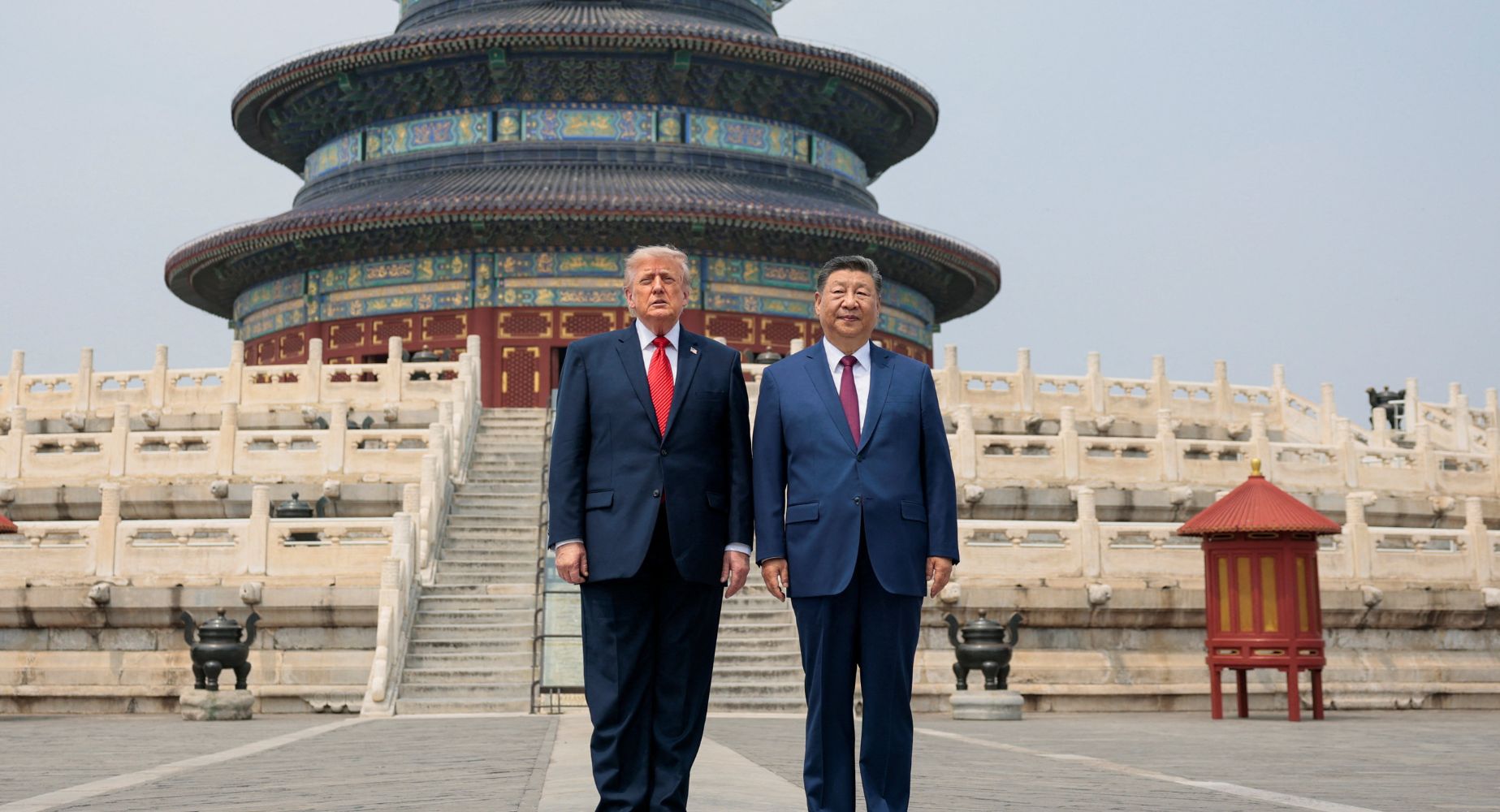
Donald Trump’s May visit to Beijing and Xi Jinping’s reciprocal visit to Washington in September were widely discussed in terms of tariffs, semiconductors, supply chains, and artificial intelligence. Yet the rivalry between the United States and China is also playing out in less obvious places: American sanctions on Iran, arguments over Gaza, and even a New York activist forum displaying a Palestinian flag alongside Lenin’s portrait and Mao-era Chinese slogans. These settings do not constitute a coordinated front. They reveal how criticisms of American power can converge across otherwise disconnected political worlds and why Washington cannot treat the contest for international legitimacy as a matter of trade concessions alone.
The post-Cold War international order was sustained not only by American military and economic power, but also by something less tangible: the willingness of other states to broadly accept the United States’ authority to define what counted as “rules,” “order,” and “legitimacy.” That acceptance formed the foundation of sanctions regimes, alliance structures, and the broader credibility of the so-called rules-based international order. Today, however, that consensus is beginning to erode.
The timing of Trump’s May 13–15 visit added a layer of symbolism. On May 14, the anniversary of Israel’s founding in 1948, Trump met Xi in Beijing. On that same calendar date in 2018, the United States formally opened its embassy in Jerusalem following Trump’s earlier recognition of the city as Israel’s capital. The juxtaposition need not imply intentional diplomatic choreography. It nevertheless highlights how the symbolic geography of American foreign policy extends well beyond trade: Washington’s choices about recognition, alliances, and the Middle East also express a particular vision of political order.
In many ways, this logic ran throughout Trump-era foreign policy. From withdrawing from the Iran nuclear deal (JCPOA), to moving the embassy to Jerusalem, to promoting the Abraham Accords, the Middle East ceased to be merely a question of energy or security. It became an arena in which the United States defined allies, threats, and the boundaries of “civilization”.
China first began to grasp these implications through the Iran sanctions regime. For years, U.S. sanctions on Iran were largely understood as conventional security measures related to nuclear proliferation and regional stability. From Beijing’s perspective, however, Iran gradually came to symbolize something broader: the extent to which Washington could use the dollar system, financial sanctions, and extraterritorial jurisdiction not merely to enforce rules, but to define the rules themselves. Who qualifies as a sanctions violator? Who can be excluded from the global financial system? Who has the authority to designate a state or company as a threat to international order?
The Huawei case made this reality unmistakably clear to many Chinese observers. Meng Wanzhou was arrested in Canada in connection with U.S. allegations that she misled a bank about Huawei’s Iran-related business, potentially exposing it to sanctions risk. For many Chinese observers, the episode exposed how deeply international rules had become intertwined with American geopolitical power. In September 2026, Huawei’s long-running U.S. criminal case went to trial in Brooklyn, with charges including alleged violations of U.S. sanctions against Iran. The persistence of the case illustrates how sanctions, dollar-based finance, and technology competition continue to intersect.
The Gaza war after October 7, 2023 expanded those tensions into a much broader global arena.
Following the outbreak of the war, Israel rapidly became more than a Middle East issue, but evolved into a global issue. In United Nations debates, disputes surrounding the International Criminal Court, and diplomatic statements across the world, a widening gap emerged between Washington’s support for Israel and the positions adopted by many countries in the Global South.
The consequences extended far beyond rhetoric. South Africa’s genocide accusation against Israel at the International Court of Justice received support from multiple Global South governments. States that had long accommodated U.S.-led sanctions structures began adopting more independent positions on certain international issues.
At the same time, growing numbers of international organizations, university communities, and transnational social movements have begun openly questioning the “rules-based international order” promoted by the United States.
Gaza became rapidly symbolized across different political spaces. In Chinese online discourse, Israel was no longer understood merely as a Middle Eastern state, but as part of a larger framework involving American hegemony, Western double standards, and broader structures of global inequality.
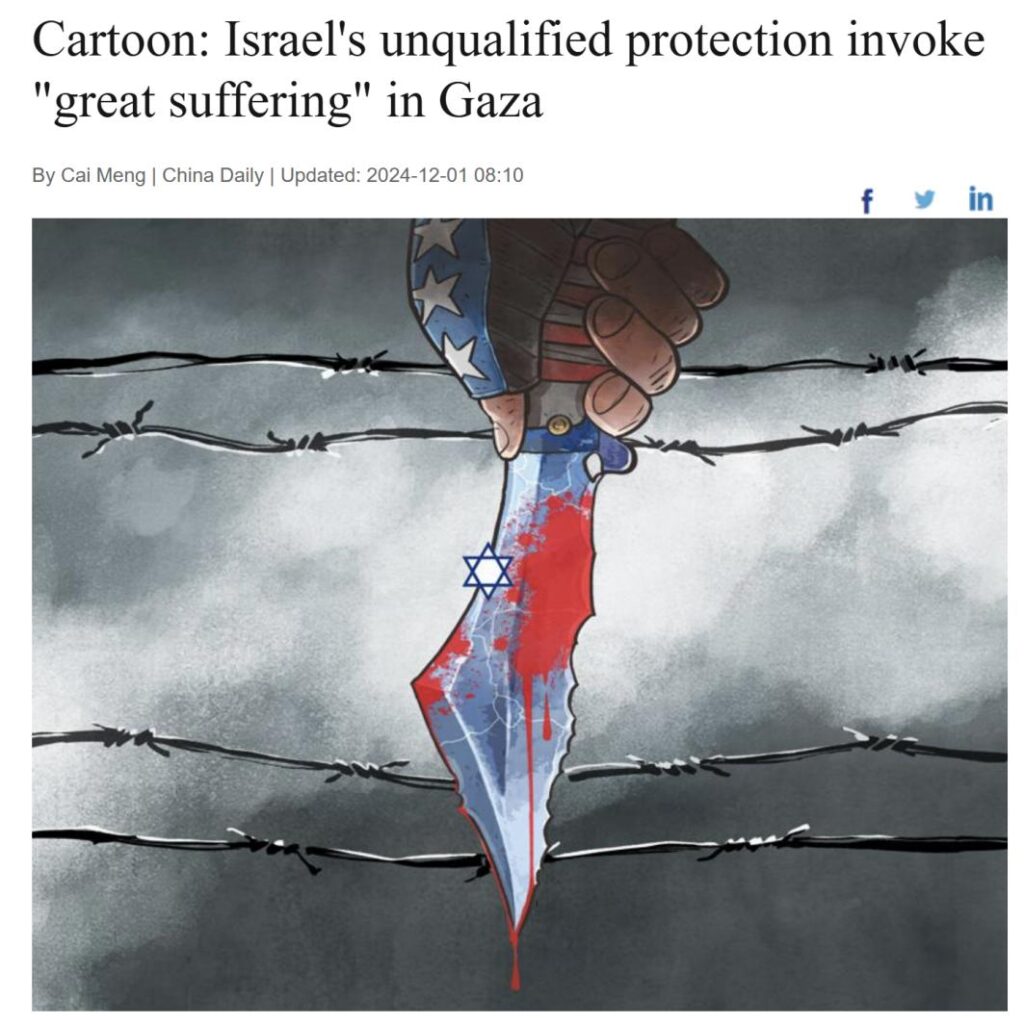
This transformation became highly visual as well. In December 2024, the Chinese state-affiliated newspaper China Daily published a controversial political cartoon depicting a hand marked with the American flag holding a blood-covered dagger shaped like the map of Israel. Blood flowed specifically from the geographic areas corresponding to Gaza and the West Bank, while barbed wire in the background evoked unmistakable concentration-camp imagery. In this imagery, the United States and Israel are portrayed as parts of the same global power structure, with Israel depicted as a violent extension of American power.
The Gaza war also triggered political realignment within the United States.
Traditional Republican establishment figures and evangelical conservatives continued to frame support for Israel as central to American leadership. Yet among parts of the “America First” populist right, a different perspective began to emerge. Long-term Middle Eastern conflict and the possibility of deeper confrontation with Iran came to be viewed as a drain on American resources and national interests.
Meanwhile, pro-Palestinian activism within the American left became intertwined with broader narratives surrounding anti-colonialism, anti-imperialism, and Global South solidarity. Organizations such as The People’s Forum gained growing visibility in campus protests and activist networks after the Gaza war. Their rhetoric emphasized colonialism, social inequality and resistance to American hegemony.
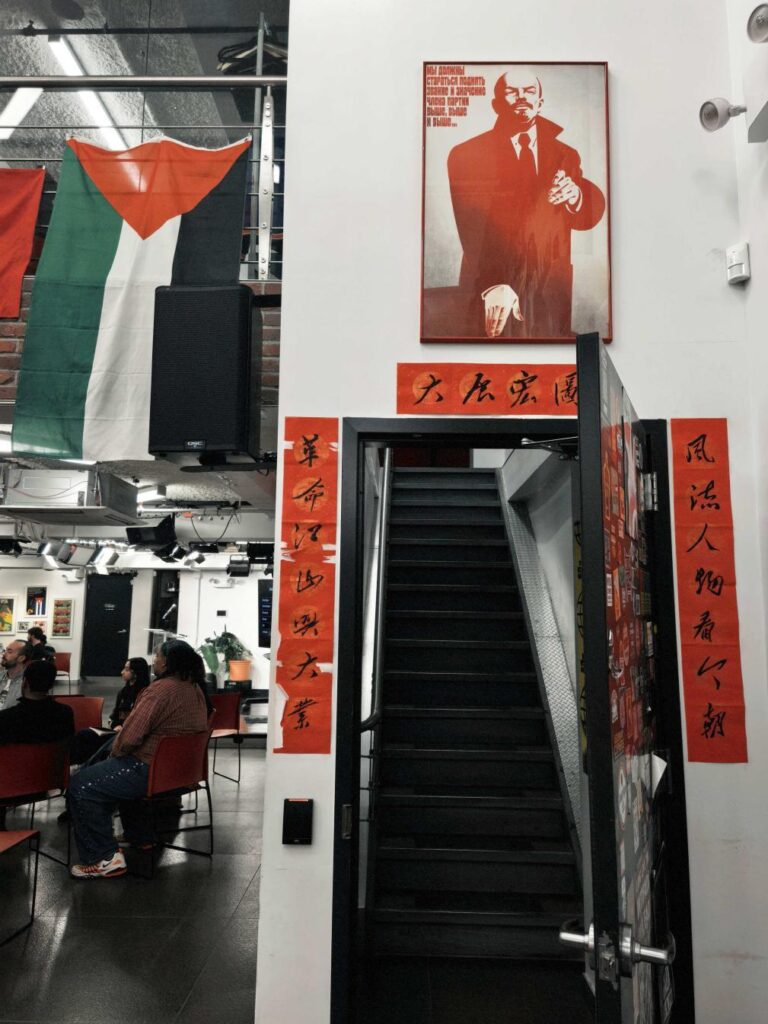
This photo, taken inside The People’s Forum in New York, captures a blend of global left-wing political symbolism. Visible in the same space are a large Palestinian flag, a Soviet-style portrait of Lenin, and Chinese Spring Festival couplets written in calligraphy. Credit: YANG Meng
The horizontal banner reads “大展宏图” (“Grand Ambitions”). The right-side couplet includes “风流人物看今朝” (“The truly great figures belong to the present age”), echoing Mao’s famous poem. The left-side couplet invokes “revolution,” “great undertakings,” and “the nation,” language associated with Chinese revolutionary political culture.
Together, the Palestinian flag, Lenin portrait, and Mao-era political language show how Palestinian solidarity, socialist imagery, Global South narratives and Chinese revolutionary language coexist within parts of the contemporary American left.
This does not suggest a unified political alliance. The American left, China, and some Global South states differ sharply in their interests and political commitments. Nor does the presence of these symbols establish direction from Beijing because comparable criticisms of American power can arise independently, circulate across borders, resonate and reinforce one another. Washington risks misunderstanding the phenomenon if it treats every overlapping narrative as evidence of a Chinese operation.
In this sense, geopolitical competition today is no longer confined to military power, trade, or technological rivalry. It is also a contest over historical narratives, political symbolism, and the authority to define what counts as justice and order.
These developments have also given Beijing new opportunities to promote its global diplomacy. Themes such as Global South, anti-colonialism, anti-hegemony, and criticism of Western double standards have become increasingly prominent within Chinese diplomacy and international messaging.
Through this language, China is not merely criticizing specific American policies.
The Beijing Declaration reflected this shift. Compared with the U.S.-backed Abraham Accords, the Beijing initiative emphasized Palestinian factional reconciliation and diplomatic mediation rather than normalization between Israel and Arab states. Yet criticism of American leadership does not necessarily translate into support for a Chinese alternative.
The reciprocal presidential visits between China and the United States in 2026 therefore matter far beyond tariffs and technology. The leaders sought practical stability and channels for cooperation, yet each government also offered its own account of what responsible great-power leadership should look like.
The White House described Xi’s September visit as a demonstration of American strength and an advance for U.S. economic interests. Chinese official statements stressed respect, reciprocity, and strategic stability. The two governments also reported concrete cooperation, including trade mechanisms and discussions of Iran. For Washington, the lesson is practical. When U.S. sanctions reach foreign firms and banks, officials should explain the legal grounds and security objectives clearly enough to answer concerns about extraterritorial power. When supporting Israel, they must also engage seriously with questions about Gaza and whether international legal standards are applied consistently. And when activists in New York or governments in the Global South criticize American policy in language that Beijing also uses, policymakers should examine the underlying grievances before assuming Chinese coordination. Such criticism can benefit China’s diplomacy without having been created by China. Trade agreements can ease tensions, but American leadership ultimately depends on the legitimacy of the international rules it seeks to uphold.
The May 14 meeting in Beijing, coinciding with the anniversary of Israel’s founding, may have been a scheduling coincidence. On that day, Trump and Xi visited Beijing’s Temple of Heaven, where Chinese emperors once performed rituals linking political authority to cosmic order. The setting offered a powerful symbol of the deeper contest between the two countries: beyond tariffs and technology, the struggle is over who can define international order and secure broader acceptance of that vision.
