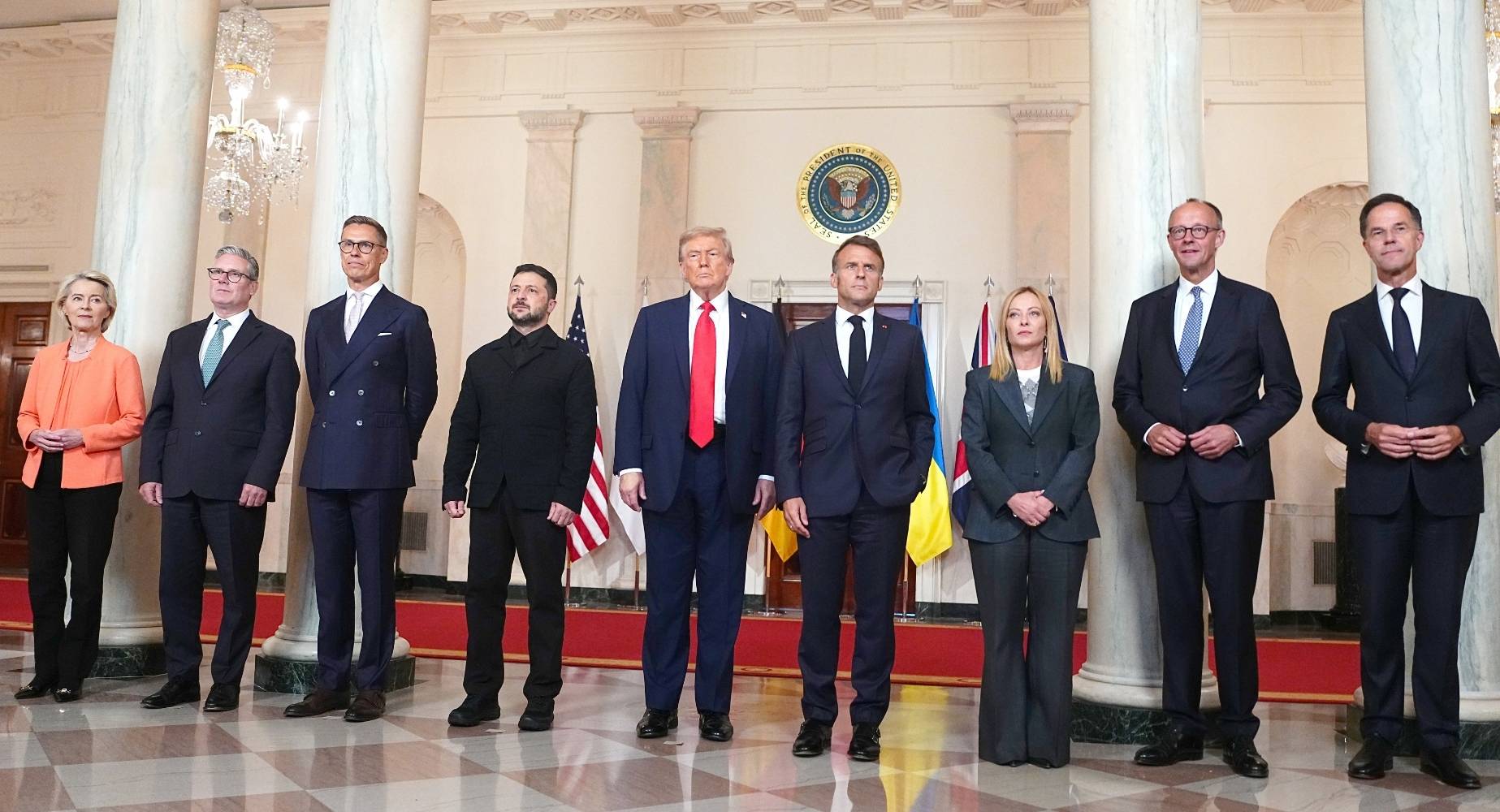
In early July a major NATO conference will take place in Ankara, Turkey. It arrives right after America’s 250th anniversary celebrations and at a moment of rising tensions between America and Europe over a welter of geopolitical issues, including trade, immigration, the Middle East, Ukraine and Russia. Will President Donald Trump seize the moment to improve relations—or will he issue what amounts to a second declaration of independence from the Old World?
Over the past several weeks, leading Trump administration officials have regularly registered their hostility towards developments in Europe. Vice-president JD Vance intervened into domestic British politics, seizing upon the murder of the British student Henry Nowak by a Sikh man named Vickrum Digwa to accuse the authorities of failing to stymie immigration. “Henry Nowak died the same way a civilization dies,” Vance wrote on X. “He should still be alive today, and he would be if the last few generations of European elites had stood their ground against the politics of self-hatred and the mass invasion of migrants, many of whom despise the West and the people who love it.”
His statement was echoed by Defense Secretary Pete Hegseth who complained in a speech at the June 6 D-Day ceremony in France that Europe has remained passive in the face of a foreign threat. Hegseth observed that “freedom is not free” but that some European countries had become complacent about defending it. He went on to state that “Today, different European beaches are stormed by different dangerous ideologies,” he said. “Boats and men arrive. When will European capitals do something about that invasion? Or is it too late?”
The truth is that the 27-member European Union and Great Britain have instituted a crackdown on immigration that critics are likening to Trump administration policies. The EU has recently approved sweeping new regulations that create detention centers abroad—mainly in Africa—and that allow law enforcement officers to enter public institutions such as hospitals without a warrant from a judge. Already illegal border crossings in Europe are down 40 percent. Immigration to Great Britain has almost fallen in half.
But the Trump administration is tapping into anxieties about immigration and multiculturalism that remain acute in Europe. In Germany, for example, the Alternative Party for Germany continues to hammer away at cultural issues. One of its politicians, Björn Höcke, has caused a furor by alleging that West Germans are inauthentic Germans because, unlike East Germans, they were seduced by American culture after World War II. They are, he asserted, “German-speaking Americans” in contrast to the “German-speaking Germans” in the East. In France, Jordan Bardella, the president of the National Rally party, is polling strongly to replace Emmanuel Macron as president. And in Hungary, the new Prime Minister Peter Magyar has vowed to pursue a strict course on immigration.
Immigration will continue to provide a potent rhetorical issue for the Trump administration to throw brickbats at Europe, but it is in the sphere of defense and trade policy that the real action will take place. Despite a lavish visit to Great Britain this past September where he was feted by King Charles, Trump has not been slow to express his vexation with Prime Minister Keir Starmer for refusing to back his foray into Iran, deeming him “no Winston Churchill.” Since then, Starmer has allowed the United States to employ British military bases for “defensive purposes.”
It is Ukraine that poses the most acute challenge for Europe. The Trump administration has repeatedly tried and failed to establish an armistice between Ukraine and Russia. That failure can in large measure be ascribed to its hostility toward Ukraine and eagerness to placate Russian president Vladimir Putin who remains intent on conquering the Donbass. Europe has become the main supporter of Ukraine, including a 90-billion-euro loan package for 2026-2027. It has proven a winning bet. Against all the odds, Kyiv has battled Moscow to a standstill. In divesting itself of support for Ukraine, the Trump administration has vitiated its own ability to direct events in the region.
The Trump administration’s war against Iran has also prompted Europe and the Gulf states to improve their partnerships. The Netherlands, France, Italy and the United Kingdom have all sent military assets to help protect the Gulf states from Iranian attacks. The UK and France are floating the idea of a maritime coalition for the Strait of Hormuz that ensures freedom of passage.
Other changes are occurring. Germany has embarked upon a massive rearmament campaign, the most far-reaching since World War II, when the country ended up being sundered in half. The Economist predicts that Germany could in a few years become the “benchmark military power in Europe,” somewhat to the unease of France. Its annual military budget will reach 150 billion euros in 2029. In this regard, Germany is living up to the stipulation of the 2025 Hague Summit, which set a 5 percent outlay of GDP on defense spending for NATO members.
Whether the Trump administration has fully pondered the implications of a more independent and powerful Germany is an open question. The issue is not that Germany would go rogue, but that it would be less inclined to cooperate with America, whether in the Middle East or in Asia. But the Trump administration has not sought to bolster its ties with Berlin. Instead, the Pentagon, at the behest of Hegseth, has instituted a drawdown of 5,000 troops from Germany, which will leave it hosting about 30,000 American service members. Poland, in turn, has issued a formal request to create a permanent American military presence that would include the 5,000 troops that Trump intends to remove from Germany. Currently, 10,000 American troops are stationed in Poland. The Russian attacks on NATO’s eastern flank, mainly in the form of drone incursions, have highlighted the dangers that the military alliance confronts.
The bottom line is that an American leadership role in Europe is not an option. It is essential. There have been previous periods of tension—during the 1960s, when Charles de Gaulle removed France from NATO’s integrated military command and during the 1980s, when the Euromissile crisis occurred—but they have never led to the dissolution of NATO itself. At the Ankara summit, Trump should seek to strengthen, not undermine, a military alliance that has since its inception in 1949 successfully promoted two main goals: deterring Russian aggression and bolstering American power and influence around the globe.
