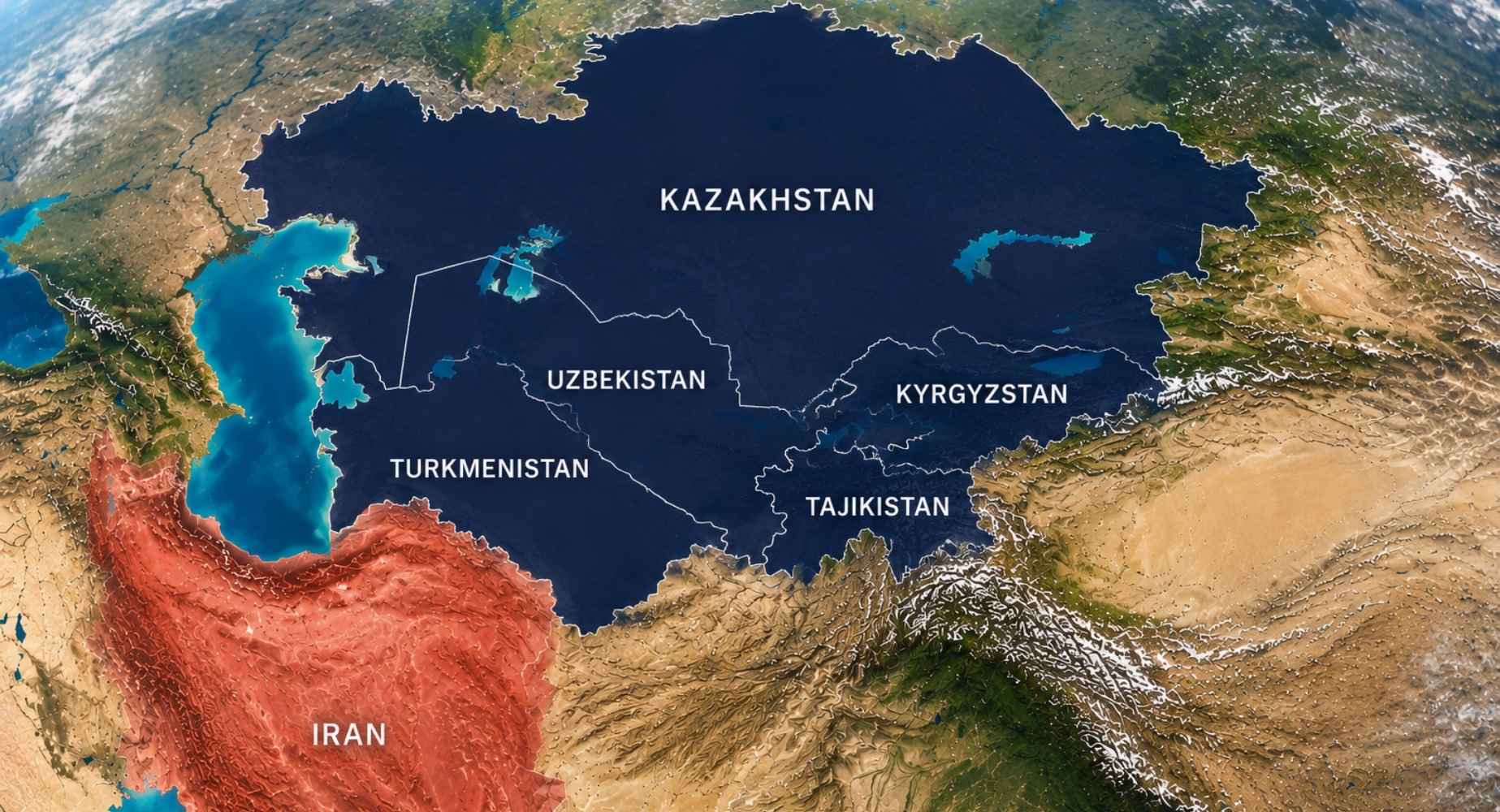
By far the greatest issue of concern for most Central Asians as they react to the ongoing Iran crisis is stability. They recognize that they live in an unstable neighborhood, sandwiched as they are between Russia and China, with Turkey, Pakistan, and Afghanistan also looming large.
Iran was an important provider of agricultural goods and access to the sea, though no longer because of the crisis. Interlocutors mourned the loss of Iranian produce, particularly high-quality dairy products, and easy access to trade with Turkey.
People are also aware of the potential positive economic impacts of the crisis on certain Central Asian countries. Higher energy prices are already benefiting energy producers, such as Kazakhstan. Yet several Kazakh observers mentioned a fear that Iran would bomb Kazakh energy installations, which they see as vulnerable to attack, because they are owned by American interests. Even more bizarrely, some Kazakhs fretted over Ukrainian attacks on pipelines needed to export Kazakh oil. While most American analysts do not see these fears as realistic, they are nevertheless tangible in the area.
Interlocutors throughout Central Asia rejoiced that a long-sought land transportation route through the region is now looking more attractive because of the tense situation in the Straits of Hormuz. Among the major communication routes gaining attention are several key corridors of China’s Belt and Road Initiative (BRI). The Northern Route traditionally runs from China’s Xinjiang through Kazakhstan and Russia into Europe, but geopolitical tensions have elevated the importance of the Middle Corridor, also known as the Trans-Caspian International Transport Route. This path crosses Kazakhstan via the Dostyk and Khorgos dry ports, proceeds across the Caspian Sea by ferry to Azerbaijan, then continues through Georgia and Turkey or the Black Sea to reach European markets. Another emerging link involves multimodal connections from China through Uzbekistan and Turkmenistan toward Iran and the Caucasus, though current instability disrupts its reliability. These land routes promise faster transit times than congested maritime paths and reduced dependence on vulnerable chokepoints. Some note that such a land route would have international balance of power implications. While it would be terrible for the U.S. (as the Caspian Sea is the only sea without a U.S. naval presence) it would greatly strengthen China, shifting transport away from waterways the U.S. can control and giving China direct access to Iran and the Middle East. This would also further diminish Russia’s role in the region. While some welcomed such a development as a long overdue assertion of Central Asia’s strategic significance as a land route between China and Europe, others worried that by diminishing American and Russian influences in the region, it would deprive Central Asia of its long-standing ability to triangulate between these three major powers and leave it naked facing China.
But it is stability that matters most to Central Asians and is now in jeopardy. If the current Iranian regime collapses and another one does not immediately take its place, Central Asians fear twin dire outcomes. One is impossible to contain refugee flows, which Central Asians admit their governments are very ill prepared to cope with and lack the capacity to provide humanitarian assistance for. The leader of a Kazakh NGO noted that the United Nations’ Office of Migration (IOM) is already doing some training in Kazakhstan, “as if it already knows there will be refugee flows.” He acknowledged that the current Kazakh regime aspires to the role of “the Switzerland of Central Asia and therefore won’t say no to the UN, but will nevertheless do all it can to minimize the numbers it accepts.” He added that Central Asia’s countries are not ready “mentally or infra-structurally” to be refugee recipients and speculated that governments would speed eventual refugees on to Western Europe by whatever routes possible, probably mainly through Turkey.
The second outcome, even more serious in many Central Asian eyes, is the threat to the unity of the multiethnic fabric of both Iran and Central Asia. If the Iranian regime were to collapse, they anticipate the Iranian state would fragment into warring factions along ethnic lines. In turn, they fear contagion into Central Asia, with their own states falling apart, aligning with parts of ex-Iran, and falling into civil wars. Therefore, the consensus among the majority of Central Asians interviewed is that the nature of whatever regime rules Iran is not relevant to them per se. What they need from Iran is stability, with trade and sea access as welcome byproducts.
Religious issues (ie Sunni versus Shias) and the human rights record of the current Iranian regime were seen by most (with some conspicuous outliers) as largely irrelevant to the current situation. Tajik observers acknowledged the importance of ethnic ties with Iranians but largely downplayed the religious ones. Of other Central Asians, only some Uzbeks expressed suspicion that Iranians might not be “real Muslims” but even for them that was not top of mind. Surprisingly, one Kyrgyz female Muslim activist inveighed stridently against Iranians protesting the mullahs’s regime, particularly female ones. She praised the regime’s enforcers for shooting the unveiled ones in the face as “they deserved it for desecrating Islam.” A Turkmen economist might have summed up the attitude of young Central Asians best. A veteran anti-USSR activist, he had chafed under totalitarian Soviet control of the media and thrived on VOA broadcasts. With the fall of the USSR, he says Central Asian media has not become more free, just fragmented into more controlled, smaller markets. “Our youth knows about the Iran crisis what our governments want it to know. Essentially: nothing.”
The U.S. versus Russia context of the crisis makes Central Asians supremely uncomfortable, as ideally they wish for good relations with both. No Central Asian interlocutor condemned the U.S. over the bombing of an Iranian girls’ school, which had garnered opprobrium in some American media. Neither did they think that American aggression towards Iran somehow let Vladimir Putin off the moral hook over his aggression towards Ukraine. One female Uzbek academic openly laughed at the suggestion, made in some Western media. “Putin couldn’t care less about being justified by the Americans, and that’s why my parents wish he were our leader!” Bottom line: Central Asian public opinion wants the Iranian conflict to end as soon as possible, without regime change (unless it is miraculously exceedingly quick and not messy) and even dissidents support their governments’ efforts at neutrality in the conflict.
This assessment is based on Zoom and in-person conversations conducted by Ambassador Tatiana C. Gfoeller, nonresident Senior Fellow at the Atlantic Council Eurasia Center, with approximately 30 Central Asian observers, including religious leaders, academics, NGO activists, government employees, dissidents, and others. Ambassador Gfoeller served as Chief of Mission in Kyrgyzstan from 2008 to 2011 and as Deputy Chief of Mission and Charge d’Affaires in Turkmenistan from 1996 to 1998.
