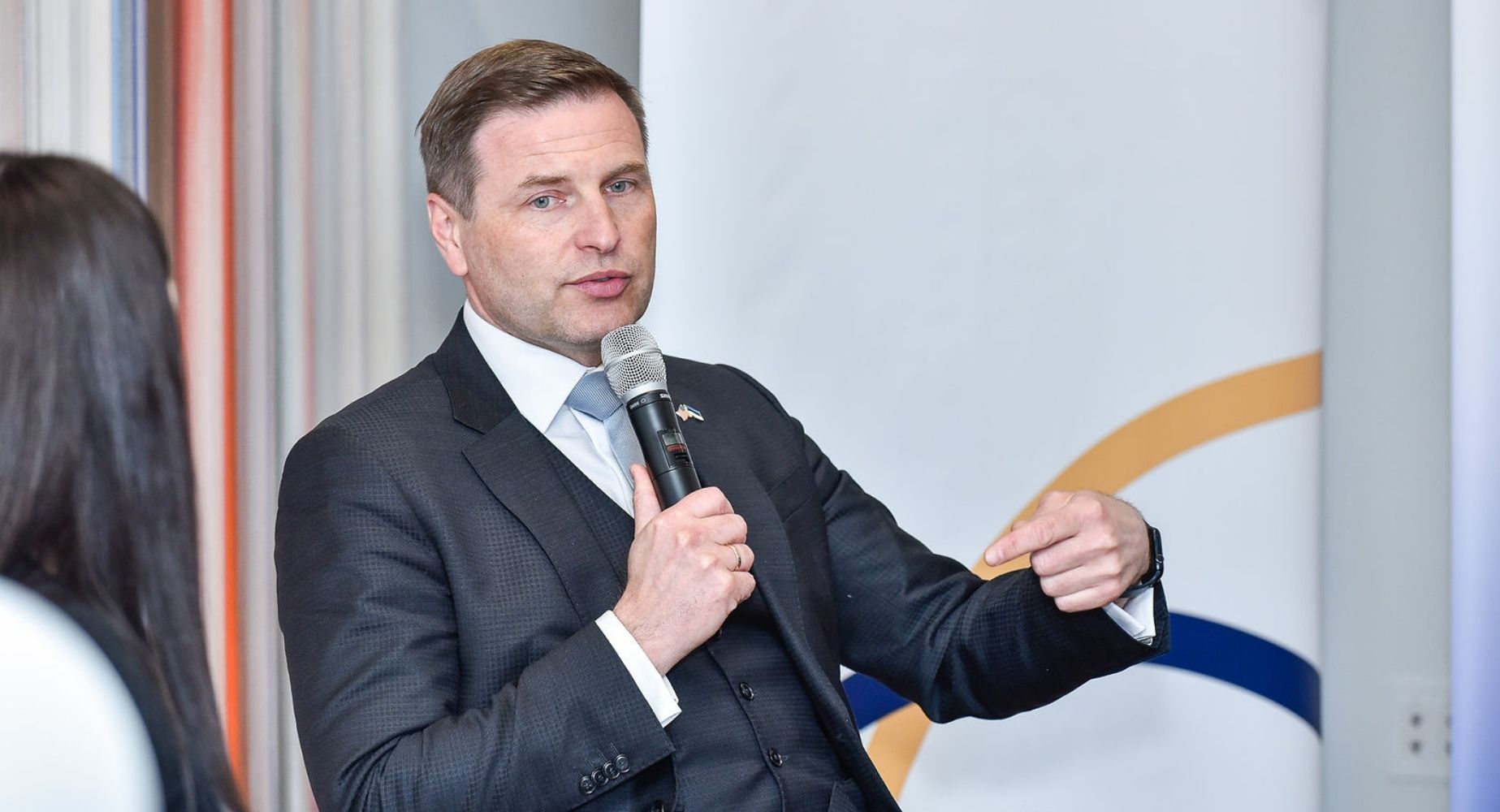
Estonian Defense Minister Hanno Pevkur spoke with the Jerusalem Strategic Tribune’s Melinda Haring on March 19, 2026 from Miami, Florida, where he was attending the Miami Security Forum. Pevkur assumed his position in July 2022. From 2022 to 2025, Estonia’s defense sector has grown seven-fold, and Pevkur expects more growth. Estonia has focused on automatization, robotics, AI, drones, and unmanned systems. The interview has been edited for clarity and length.
HARING: Let’s talk about Iran and the Strait of Hormuz. You called for unity between the US and Europe and expressed willingness to talk. What might Estonia be able to offer?
PEVKUR: The situation in Iran and the blockage of the Strait of Hormuz affects all of us globally. The price of oil, gas and fertilizer has an impact on farmers, so it is clear that we need to find solutions. For me, it is more a question of free trade and freedom of navigation than a military question.
From a military point of view, Estonia has been a long and strong military partner in NATO’s mine hunting group, so everything regarding mine hunting, there we have good strengths.
In Washington I met with Deputy National Security Advisor Andy Baker and Army Secretary Dan Driscoll. I didn’t hear any specific requests so far, but I told them that we are ready to discuss.
HARING: Do you have something similar to what the Ukrainians are using to take down Iranian Shaheed drones?
PEVKUR: The Ukrainians are using a lot of Estonian equipment. For drone detection, one Estonian-Ukrainian company is producing acoustic censors which are important to detect drones early. Many Estonian companies are producing interceptor drones, which are needed to take down Shaheed drones and have been quite effective in Ukraine. So yes, Estonia has specific capabilities which might be helpful in the Iran conflict.
HARING: You said that Estonia doesn’t have the capacity to make fighter jets and tanks but it does have the capacity to build small and smart systems. Please give me some examples.
PEVKUR: Absolutely. We are focusing on disruptive technologies in Estonia, mostly on how to make older legacy systems smarter. We have one company producing a high-end camera system without any lag. The camera is mounted on a tank or infantry fighting vehicle. This means that the commander of a tank, for example, has a 360-degree view outside of the tank plus a view from drones and other sources of information. It has been tested in Ukraine.
There is a joint Estonian-Ukrainian company called telearmy which is producing self-driving vehicles that can evacuate wounded soldiers. The driver is sitting comfortably in a safe location.
HARING: Estonia has two companies building cruise missiles. What can you tell us?
PEVKUR: There are two companies that are working on cruise missiles quite successfully. They are already in the testing phase. The aim is still to have very long-range cruise missiles.
HARING: Estonia has a long tradition of boat building and there was a deal between Estonia and Oman in the past. What can Estonia offer the Middle East?
PEVKUR: We’ve built 14 patrol vessels for the Omani government. And we have two or three companies that can produce everything from smaller boats to bigger ships. In Europe, they’ve built many vessels for Germany and Norway, and also for the Gulf.
HARING: Do you agree that the United States is behind on integrating drones into the armed forces? And if yes, what can we do about it?
PEVKUR: Drones are here to stay and we’ve seen how much they are changing the battlefield in Ukraine. For that reason, Estonia established the Force Transformation Command last October that is specifically focused on the drone industry and how to integrate drones into the Estonian Army and Air Force. We clearly see that starting from detection and interception, we need to develop our loitering drones and attack drones much more. But my understanding is clear that every army or every military around the world has to take drone development very seriously.
HARING: We are starting to see more cooperation between European and U.S. companies. For example, Rheinmetall and Lockheed are cooperating on building long-range ATACMS missiles. What kinds of partnerships are you seeing? What are they a result of?
PEVKUR: I can already confirm that Estonia has agreed that Lockheed will bring one of their units to Estonia and we’re looking for even further cooperation. For instance, Anduril is looking for a greater European presence. From this industrial cooperation point of view, we have different companies who are interested to come to Europe, who are interested to cooperate. It’s not about competition between countries, but rather it’s about the partnership and cooperation to prevent any kind of risks to Europe and NATO.
HARING: Is there anything else you’d like to add?
PEVKUR: Estonia is changing its laws to reduce bureaucracy. We have a state program to help foreign companies come to Estonia. For instance, we established the Defense Industry Park, where we can host companies to work with explosives. We established our own explosive factory, and we are looking for investors. It’s a state-owned company, but we are starting the bidding process to give away 49% of the shares. And we have a special program for companies that reinvest their profits. Every reinvested dollar or every reinvested Euro is tax-free in Estonia. And now, in 2025, we also introduced a new investment support tool, which is that when you invest at least 100 million euro in an Estonian factory or Estonian production, you will get 20% of that amount back immediately, so 20 million euro back.
