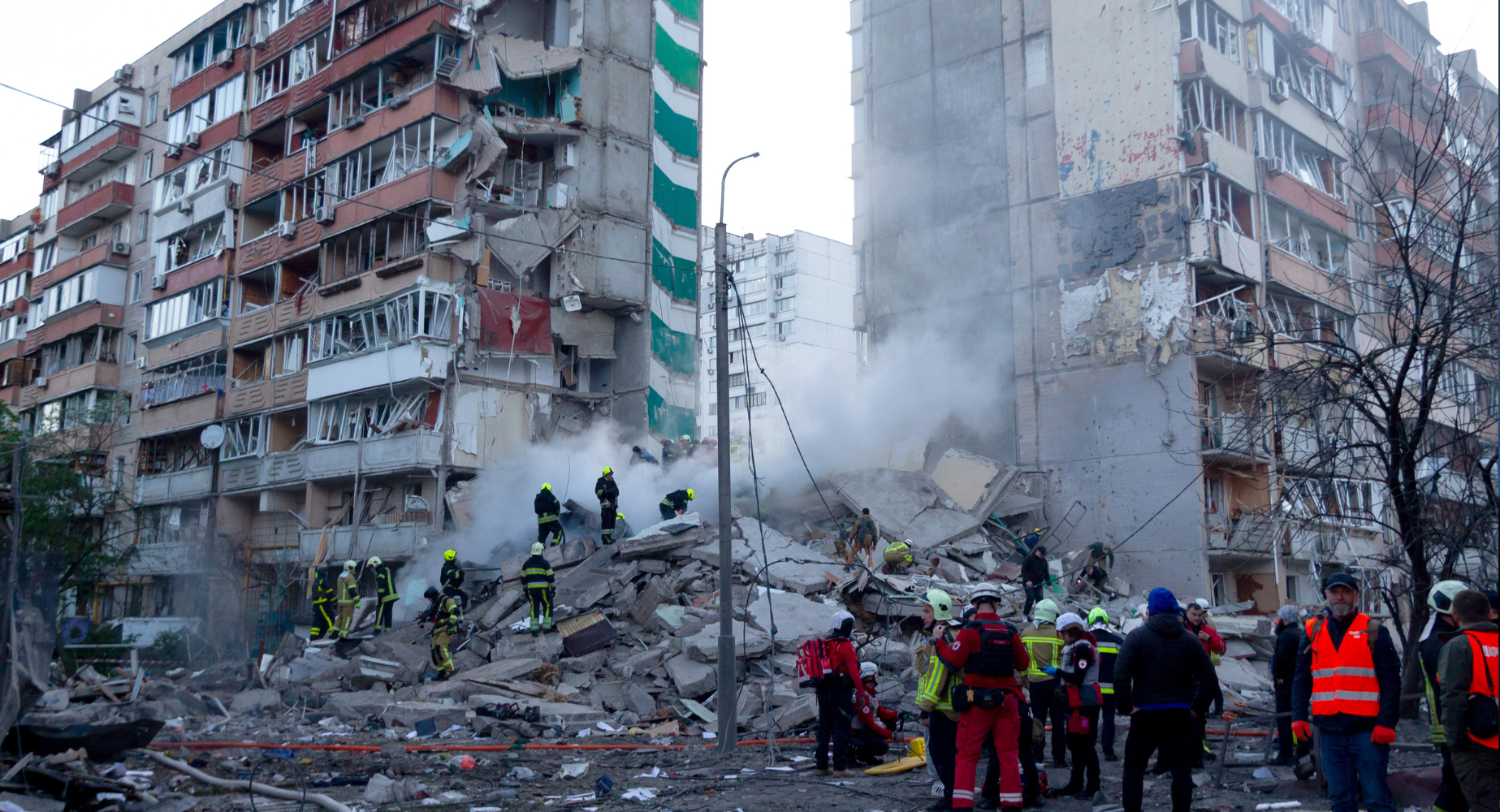
For more than a decade, Russia has waged a war of aggression that is directed against Ukraine while systematically terrorizing its civilian population. Missile and drone attacks on Ukrainian cities and critical infrastructure have become increasingly systematic. Since August, air-raid alerts have at times seemed almost continuous. Schools, hospitals, energy facilities, transportation networks, and other infrastructure essential to civilian life have served as prime targets.
The purpose of these attacks is increasingly difficult to explain as simply the collateral damage of war. Their apparent purpose is not to destroy military targets, but to render normal life impossible—in short, to deprive millions of Ukrainians of electricity, heat, water, transportation, and security, and ultimately to break their will to resist.
Recent evidence makes this strategy even harder to dismiss as collateral damage. In September, Ukrainian authorities revealed Russian planning documents outlining a winter campaign against Ukraine.
According to The New York Times, the document describes attacks intended to deprive Ukrainian cities of electricity, heat, and water services. Among the targets are substations connecting three of Ukraine’s operating nuclear power plants to the national grid. The document also describes planned ballistic-missile and glidebomb attacks on pumping stations and water treatment facilities.
The Kremlin is not waiting for winter to demonstrate the logic behind such a campaign. On September 29-30, for example, Russia launched one of its largest recent attacks on Ukraine’s energy infrastructure, deploying hundreds of drones and missiles.
The United Nations has repeatedly called for an end to attacks that threaten civilians and civilian infrastructure. Yet such appeals have not changed Russian president Vladimir Putin’s behavior and cannot deliver what Ukraine and the wider world need: a stable and just peace.
The reality is that the root cause of this war lies in Moscow’s ambition to restore the Russian Empire. Its negotiating demands demonstrate that Moscow’s objective is not to end the war, but to pursue a goal it has articulated consistently: eliminating Ukraine as an independent state andUkrainians as a nation.
Russia’s war is not merely a test of Ukraine’s ability to survive. It is a test of whether terror can become an accepted instrument of state power and international politics. The problem no longer stops at Ukraine’s borders. In August, a drone carrying explosives was discovered at Leipzig/Halle Airport in Germany. The German authorities subsequently linked the attempted attack to individuals associated with various Russian state structures, while the European Union characterized the incident as part of a broader Russian campaign involving sabotage, disruption of critical infrastructure, information manipulation, and interference in European states. What’s more, Estonia is accusing Russian intelligence services of organizing the arson attack against Milrem Robotics, a defense company that supplies assistance to Ukraine. European authorities have described networks that are comprised of Russian “one-time agents” recruited to carry out acts of sabotage against those countries that are supporting Ukraine.
And now we are seeing the same pattern reach the United States itself. On September 15, for instance, the U.S. Department of Justice charged five alleged members of a network linked to Russian intelligence with conspiring to finance acts of terrorism, conduct sabotage in European countries, and organize targeted killings in the United States and Europe.
In July 2022, the U.S. Senate unanimously passed a resolution calling on the State Department to designate Russia as a state sponsor of terrorism because of its actions in Chechnya, Georgia, Syria, and Ukraine. Yet that designation was never made. Why not?
In June 2024, Congress returned to the issue. The grounds for labeling Russia a state sponsor of terrorism were already substantial: the illegal annexation of Crimea, the invasion of Ukraine, the killing of civilians, the poisoning of Viktor Yushchenko, the murder of Alexander Litvinenko, the downing of MH17, the bombing of Aleppo, the poisoning of Sergei Skripal and his daughter in Great Britain, and the murder of Alexei Navalny.
But the evidence accumulated since then points to a broader phenomenon. Russia does not merely sponsor terrorism. It uses terror as an instrument of state policy – against Ukrainian civilians, against critical infrastructure, against European countries supporting Ukraine, and, according to the U.S. Department of Justice, against the United States itself.
The existing designation of a “state sponsor of terrorism” is therefore insufficient to describe the phenomenon we are witnessing.
A sponsor assists terrorists. Russia, by contrast, organizes and conducts terrorist acts through its own state institutions and intelligence networks. It is therefore not merely a sponsor of terrorism, but a terrorist state.
Some may object that there is no established legal category called a “terrorist state.” That is true. But the designation “state sponsor of terrorism” was itself a legal category created by the United States Congress. Federal law defines a state sponsor of terrorism as a country whose government the Secretary of State has determined has repeatedly provided support for acts of international terrorism.
If Congress can establish a legal category for states that sponsor terrorism, it can also establish a legal category for states that themselves use terrorism as an instrument of state policy. Indeed, this is precisely the kind of situation in which the law can develop new categories when existing ones no longer adequately describe a new reality. Congress could establish a statutory category of “terrorist state,” define objective criteria for such a designation, establish its legal consequences, and create a mandatory mechanism requiring the executive branch to apply those criteria.
The choice, therefore, is not simply between passing another non-binding congressional resolution and leaving the matter entirely to the discretion of the State Department. Congress can create a legal framework that recognizes a fundamental distinction between a state that sponsors terrorism and a state that itself uses terrorism as an instrument of national power.
Such a framework would address a growing anomaly: the international community criminalizes those who assist terrorism while continuing to treat a state that directs and conducts terrorist operations as an ordinary diplomatic partner.
Most importantly, if Russia is judged according to the reality of its conduct, then American policy toward Russia would have to reflect that distinction.
It would affect the approach to sanctions, diplomatic relations, financial, economic and trade restrictions, as well as to intelligence and counterintelligence operations, the protection of American citizens and allies, and accountability for Russian state institutions involved in terrorist activity.
Those who openly destroy thousands while commanding armies and intelligence services remain shielded by the very sovereignty they systematically abuse.
This moral and legal paradox must be addressed.
