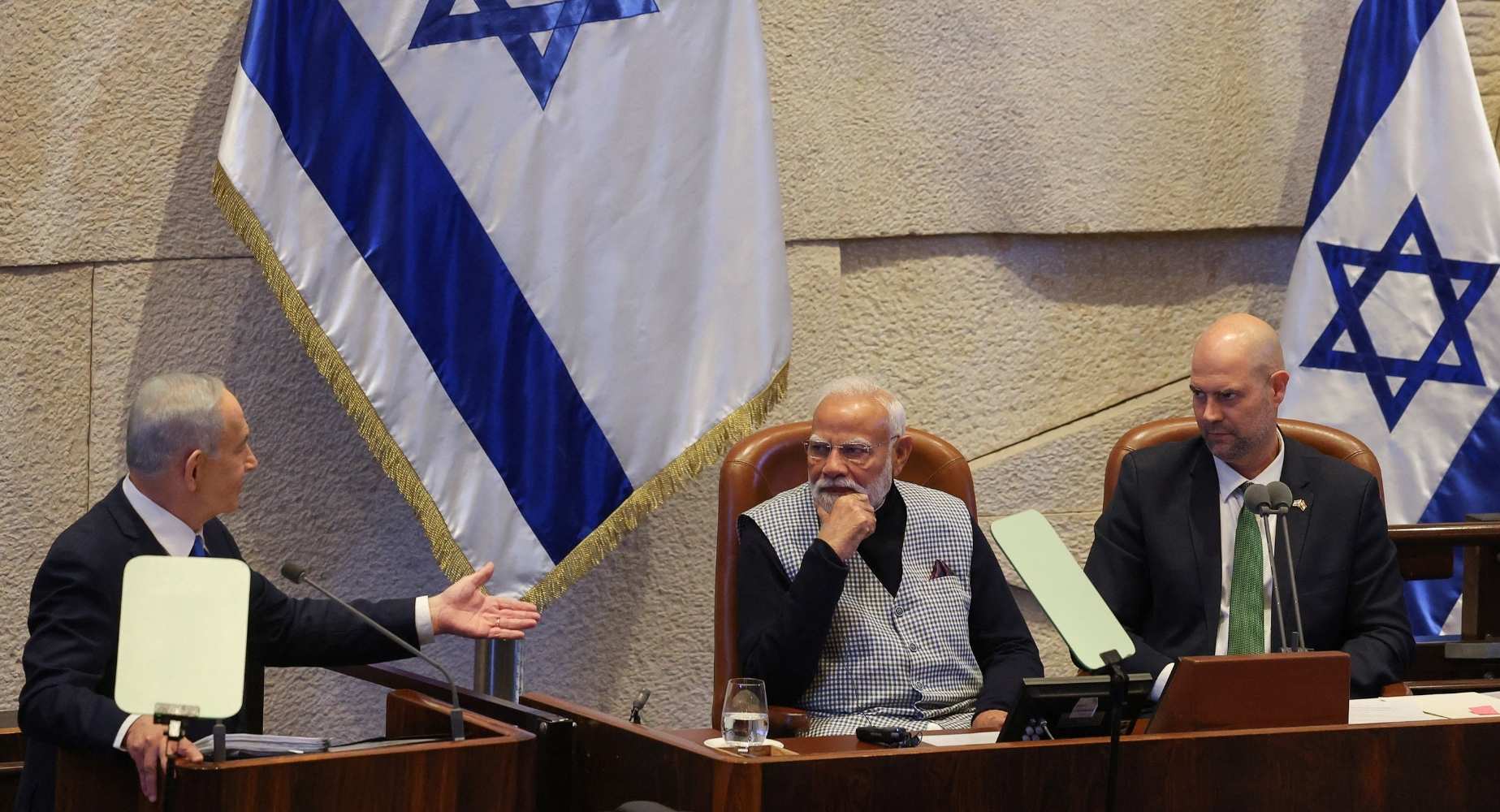
With all eyes now on the unfolding conflict with Iran, it would be easy to ignore a very different regional development of recent weeks. That, however, would be a mistake. Although it has since been overshadowed by the new Gulf war, Indian Prime Minister Narendra Modi’s recent state visit to Israel – complete with a historic address to the Knesset – speaks volumes about how New Delhi sees the Jewish state, and how one of Israel’s most promising bilateral partnerships might progress.
For starters, it must be noted that India’s ties to Israel run deep. Prime Minister Modi made his first visit to Israel nearly a decade ago, back in 2017. It marked the first such state visit by an Indian Premier, and it was far more than merely a ceremonial milestone. Rather, it signaled the start of a sophisticated geo-economic gambit – one that is now coming more clearly into view.
That much was evident during Modi’s visit last month. In his Knesset address, India’s leader outlined both his government’s broader strategic outlook and Israel’s place within it. In his remarks, Modi signaled a commitment to building a regional architecture designed to embed India more deeply into trade and connectivity to its west.
That effort is driven in large part by New Delhi’s search for strategic autonomy as it seeks to escape China’s growing shadow in the Indo-Pacific. No longer defined by its Cold War-era doctrine of non-alignment, India is now prioritizing issue-based coalitions and partnerships with countries whose strategic trajectory is durable and predictable. This logic, in turn, favors states whose survival and prosperity are tied to the stability of the rules-based international order.
At its heart of India’s vision for the Eastern Mediterranean is the India-Middle East-Europe Economic Corridor (IMEC). IMEC is much more than simply a commercial route. It is designed to offer India’s international partners a “values-based” alternative to China’s Belt and Road Initiative (BRI), thereby reducing Beijing’s leverage over Eurasian trade and energy flows.
The problem IMEC seeks to address is a significant one. Over the past decade, Beijing has leveraged large-scale investments in transportation, energy, and telecommunications to establish a profound presence across the Middle East, South Asia, and Europe. This has created a structural interdependence in which economic relationships are inextricably linked to Chinese strategic interests.
From a strategic perspective, IMEC represents an effort to break up this monopoly. It serves as a normative counterweight to China’s model of state-centric control and top-down financing. Instead, it envisions a smaller and more flexible framework in which the economic and political interests of partners, while not identical,overlap in their desire to mitigate Chinese unilateralism.
This is where Israel comes in. For India, a reliable corridor requires anchor states that offer institutional stability and technological maturity. This explains why Indian planners have increasingly looked toward Israel and Greece as key destinations. While other prospective routes may offer more convenient geography, they lack the normative reliability and security predictability that India requires for long-term strategic investment.
Nevertheless, China’s structural advantage remains formidable. The BRI rests on a foundation of already-commissioned projects and established logistical networks, such as the China-Pakistan Economic Corridor (CPEC) and the strategic Port of Gwadar. Furthermore, China’s influence is further reinforced by its deep diplomatic engagement with Iran and the Gulf states, as well as its control over critical infrastructure components such as subsea communication cables.
For this reason, the challenge for IMEC is not simply to propose a technical alternative, but to establish institutional credibility and long-term resilience. For New Delhi and its partners, the corridor’s viability depends on its ability to create a de-risked ecosystem that prioritizes transparency and distributed governance over dependency and top-down control.
For both New Delhi and Jerusalem, the IMEC moment is about distinguishing between diplomatic weather and geopolitical climate. Middle Eastern regimes often pursue tactical rapprochements in order to manage domestic pressures or regional developments, but such moves rarely alter underlying threat perceptions or ideological fault lines. By contrast Indian statecraft, rooted in a tradition of cautious realism, tends to prioritize structural alignment over tactical flexibility. Strategic infrastructure – from fiber-optic cable to energy pipelines to port facilities – requires a durable foundation that only stable, technologically advanced and strategically committed partners such as Israel can provide.
Still, much work remains to be done. If IMEC is to progress beyond the conceptual stage, it must be institutionalized across three domains: security, standards, and government commitment. Israel can contribute on all three fronts, from sharing expertise on cyber-resilience to establishing permanent working groups and financing frameworks that can survive turbulent political cycles. Encouragingly, Jerusalem is showing signs that it is increasingly prepared to do so.
The significance of the current Indo-Israeli momentum lies in its shift from symbolism to operational synergy. India’s westward connectivity strategy views Israel not merely as a market, but as a security provider for the corridor itself. Ultimately, the success of this vision will be measured by the number of tangible projects that it yields that embed Israel more deeply into the Indo-Pacific and make it a meaningful player there.
