The State of Israel is not often associated with the persistent problems of governance that have beset many of its neighbors over the years. With a powerful military, a highly accomplished intelligence community (despite its catastrophic failure is), a well-respected judiciary (albeit under political siege by the present government), a thriving high-tech driven private sector, and fairly strong health and other social services, it has nurtured its image as a functional and resilient state, even under duress. And yet at this time, three patterns of semi-chaotic disruption have emerged – not counting a wildcat strike at the national airport – which point to basic problems now exacerbated by political concerns.
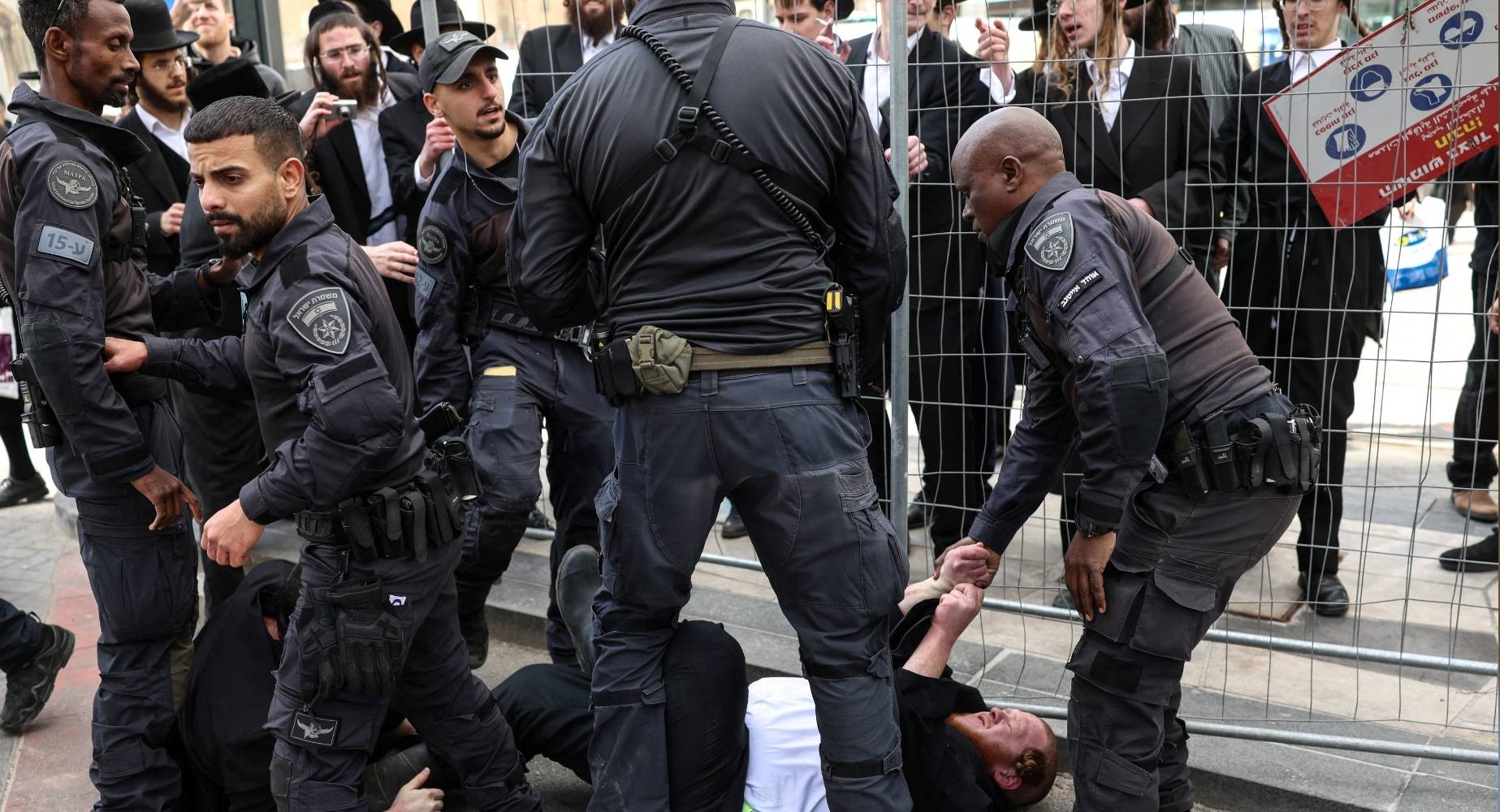
The one which casts the longest shadow, and does threaten to tear the social fabric apart, is the adamant refusal of the Ultra-Orthodox religious leadership to allow the young men of their communities to enlist – although a few thousand do so every year – and the violent demonstrations and road closures caused by their protests against the arrest of draft dodgers.
A second sign of weakening governance, causing considerable damage to the country’s already tarnished reputation abroad, is the lawless conduct of some elements among the hard right – some of them settlers living in makeshift communities in close proximity to Palestinian villages, others come from Jerusalem and elsewhere to lend a hand. Their attacks and provocations have pitted them in a struggle with the IDF forces on the ground, which often fail to impose order.
Third but not least, Arab communities in Israel are increasingly subject to the whim of well-armed gangs, and to a pattern of violence: manslaughter rates continue to escalate, as the result of warfare between crime organization, of vicious family feuds, and of “honor” killings (women murdered by their own families). The authorities are unable to reverse the trend.
While powerful issues of identity and ideology are at play in all three cases, major contributing factors, which are bound to play a role in the 27 October elections, have to do with the partisan politics in the narrower sense of the word. The Ultra-Orthodox parties – Netanyahu’s current coalition partners – use their leverage to block the draft, angering those who do serve and see the lives of their children at risk. The nationalist hard right which dominates the coalition – and includes prominent figures within Netanyahu’s own Likud party – tends to back the violent elements within the settler community. As for crime in Arab communities, given that their political representatives are deeply opposed to the ruling coalition, there are doubts whether the present government, and more specifically the present Minister of National (i.e, Internal) Security, are willing or able to muster the resources – financial and institutional – necessary to fight the crime wave in close cooperation with local Arab authorities.
Given the impact on daily life and the hourly news cycle, as well as on moral and identity issues, these themes will be as important as the war and the economy in determining voting patterns. Moreover, even amidst a highly competitive and complicated party rivalry, it is fairly safe to assume that any future Israeli government will be judged by its ability to restore governance on all three fronts.
The Ultra-Orthodox and the Draft
Israel’s founding father, David Ben-Gurion, was the first to grant an exemption from military service to what he thought would be a relatively small group of Ultra-Orthodox – called in Hebrew Haredim, those who are fearful of The Lord – students of religious studies. Given his modernist, socialist outlook, he probably saw this as a transient phenomenon, a relic of diaspora life soon to be swept away by the vital culture of a re-born nation returning to its land. But they did not dwindle, and with remarkable birth rates just grew apace. By the time Menahem Begin and the Likud came to power in 1977, his political coalition included the Haredi political parties, and the exemption was extended much further.
While morally problematic and economically harmful (to avoid the draft, Haredi young men declare that Torah, religious study, is their profession – and hence cannot legally earn a living in any other, more productive ways), this remains an unsolved problem. Numerous attempts have been made to legislate a solution, after the Supreme Court struck down some overtly discriminatory legislation: but even Netanyahu’s present coalition partners, Shas (representing Haredis whose recent origins are fromiyah from Middle Eastern countries) and United Torah Judaism have not been able – at this particular time – force through laws which would exempt their young men while other segments of Israelis society bear the terrible burdens of a prolonged war. Even those who do not actually study are instructed to resist the draft: service, they are told – in the presence of women! – would corrupt their way of life.
No issue seems to roil emotions (on both sides of the divide) more than this one. Indeed, the Modern Orthodox element of Israeli society – ideologically committed to military service, and bearing a disproportionate part of the war losses and reserve service periods – is increasingly angry in the face of Haredi intransigence. The pain of the last three years made the utter disregard of these communities towards the price paid by other segments of society (which also carry the main burden of economic activity, and hence of taxation) increasingly intolerable, and the opposition parties have adopted this as a rallying cry. All attempts at driving the necessary legislation thus failed, not least because of a group of rebel Members of Knesset from within Likud who refused to vote for what was being proposed.
Thus, in the absence of an exemption law, young Haredi men are liable to be drafted. Some, in fact, do join up: an infantry brigade where practices are adapted to their needs has been created, and others bring their considerable talents to bear on intelligence and IT. The numbers are in the thousands, an indication that there is greater diversity in these communities than meets the eye. But the many who do not show up for service, and vehemently refuse to do so, can occasionally be tracked down and arrested: and when that happens, there are radical groups in the Ultra-Orthodox communities which quickly organize to disrupt daily life, close off main traffic arteries, clash with the police, as well as lay siege to the homes of officers, officials and even, at one point, a Supreme Court Justice. Police reactions have been feeble, and frustrated drivers (and Israel citizens at large ) have come to feel that the country as a whole is going off the rails.
Extremist Anti-Palestinian Violence
Many reports in recent months have generated the impression – certainly in Western media -that “The Settlers” are on the offensive against their Palestinian neighbors. This is not the case: just as not all Haredi groups block roads and wreak havoc, the great majority of the so-called settlers – Jews who live in areas which came under Israeli control in the Six Day War of June 1967 – are law-abiding citizens and keen to maintain good relations with adjacent Arab villages. But a small segment, encouraged in recent years to move into open area and establish wildcat “farms” (which then gain the support of Finance Minister Betzalel Smotrich, who also hold a position in the Ministry of Defense in charge of affairs in the territories), have made it their practice to clash with the Palestinian locals over grazing areas, olive plantations, or just the sheer right to roam around. Once provocations ensue, regardless of “who started”, they bring violence to bear (sometimes against Israeli and international protesters, and even against the IDF units which try, often belatedly, to intervene.
The result is another spectacle of lawless behavior, often enacted quite deliberately in front of TV cameras, aimed at advertising what the extremists see as their undisputed claim to the entire Land of Israel, as they see it. They have an audience: with the wounds of 7 October 2023 still open, such attitudes towards the Palestinians at large do resonate in significant segments of Israeli society. The IDF and the intelligence community – let alone the Israeli public diplomacy officials struggling against widespread defamation – may castigate such conduct as deeply destructive to Israel’s standing, and as carrying the potential of explosive reactions in the West Bank: but in the heated atmosphere of an election campaign, with right wing politicians catering to the hardline base, it is the perpetrators who often feel they have the backing they need.
Thus, the Minister of Defense took issue with the OC Central Command over the administrative detention of one activist suspected of lawless violence – and then even went so far as to announce on television that he will have the General replaced (which he had no authority to do). As such tensions persist, questions arise as to the rule of law in this context: even US Ambassador Mike Huckabee, no enemy of the settlement project as such, used the term “terrorism” to describe some of these cases.
Lawlessness and homicides in the Arab sector
Year by year, the number of homicides among Arab citizens of Israel has been rising, from 230 in 2024 to 252 in 2025 and 196 in the first eight months of 2026 – as the most salient, and shocking, aspect of a terrifying rise in violent crime and the regular use of firearms. Some of the case involved the horrifyingly misnamed “honor killings” – women murdered by members of their own family for what they deemed to be unbecoming behavior. Most of them, however, were men (as well as women and even children – deliberately shot because of their family connections, or the victims of fire aimed at others) killed as part of warfare between criminal gangs and cartels, or murderous feuds and vendettas between clans in the same town. Easy access to weapons – stolen from IDF stocks, or smuggled in (increasingly, by drones) – has made the scourge even worse.
There is a paradox attending what is happening in this significant sector – more than 20% – of Israeli society. In many ways, Arabs have found their place in business, industry, and particularly the medical professions: their standard of living has risen dramatically and so has the level of education. Notably, the incidents of political radicalization and involvement in terrorism have been relatively rare (certainly when compared with Muslim minority communities elsewhere). And yet, against this significant background, the rampant rise in crime, the power of cartels over aspects of daily life, and the terrible murder rate, far exceeding that of any other sector, all stand out as signifying yet another case of a profound crisis of governance.
Here, too, politics play a role. The parties representing the Arab sector have not been part of governing coalitions – except for a remarkable episode between 2021 and late 2022, when Mansour ‘Abbas supported the “government of change” led by Naftali Bennet and Yair Lapid. Indeed, this period did witness an effort to come to grips with crime in the Arab sector: Abbas is now openly seeks to bring into his list a key Jewish figure – Yoav Segalovich, a former senior police officer, who as Deputy Minister of Internal Security led this effort at the time. In terms of budgets and institutional investment, political clout can make a difference if a major battle is to be fought against the crime families and against the proliferation of firearms.
At present, the Netanyahu government as a whole and certainly the ultra-nationalist Minister of “National” (i.e. Internal) Security, Itamar Ben-Gvir, seem to have a rather limited span of attention when it comes to fighting organized crime or collecting weapons: he is more keen on populist (and popular) measures aimed to make life tougher in jail for those convicted of terrorism – including the novel idea of moats with crocodiles… – then of the thankless job of working with the local municipal authorities on suppressing gangs and offering Arab youth alternative courses.
What Lies Ahead?
The multi-front war has yet to be brought to a successful end; and with the mixed bag of the economy (strong Shekel, massive investments in Israeli corporations, alongside a painful rise in the cost of living), the problems of governance are bound to be the subject of heated exchanges in the last, punishing weeks of the election campaign. The opposition has taken to calling the coalition “the draft-dodgers government”; Netanyahu, in response, signaled that he would offer the exemption only to those who truly study, and that he would seek to broaden his base of support and rid himself of the dependence on the Ultra-Orthodox. He has been less specific as to curbing the nationalist extremists – although he did denounce the act of a nationalist MK who in defiance of IDF rules tried to smash a monument to a dead terrorist in the West Bank. As for Arab crime rates, they may become the argument in favor of bringing ‘Abbas and his party into the fold (as netanyahu himself tried to do in 2021 and failed).
Election results are never easy or safe to foresee, ever more so in Israel today, with complex calculations about the impact of the smaller parties on the outcome making the makeup of the next government even less predictable. Still, there are reasons to believe that the present patched-up coalition will not be there when the dust settles (if it ever does: Israel saw five election cycles because of indeterminate results in recent years): and that the need to deal with each of the problems of governance outlined above will be reflected in the next coalition’s policy guidelines.
