There is an old sailors’ proverb which holds that a red sky at night is a sign of fair weather to follow, whereas a red sky at morn brings storm clouds and rough weather. If this proverb applies to geopolitics, the modern state of maritime security resembles a crimson sky with storm clouds on the horizon, as new threats to freedom of navigation and the global economy emerge daily. It is therefore imperative that America and its allies not only maintain strong alliances but also strong navies that can take swift action to mitigate threats posed to freedom of navigation and the global economy.
The mission of the United States Navy for the last 250 years has been to keep the sea lines of communication open and promote the free flow of maritime commerce upon which the global economy depends. For over a century, the United States Navy has been the largest and most technologically advanced Navy in the world and has largely operated with impunity in any body of water since the end of World War II. However, the adoption of asymmetric maritime warfare by America’s adversaries has put this at risk. To prevail against such threats, western navies must adapt quickly by bolstering the size and strength of their navies and embracing non-traditional methods of warfare in critical theaters such as the Baltic Sea, Black Sea, Red Sea and the Arabian Gulf.
In my two years as the Commander of the U.S. SIXTH Fleet and Striking and Support Forces NATO in the Mediterranean, I commanded the annual Baltic Operations (BALTOPS) exercise in 2015 and 2016, mustering 50 ships and 5,000 sailors to dominate the Baltic theater in the wake of Russia’s illegal annexation of Ukraine in 2014. The Russians responded by sending their auxiliary general intelligence (AGI) ships and Steregushchiy-class corvettes to monitor us and their aircraft to harass us, but there wasn’t much they could do to deter us. In recent years, however, the Russians have resorted to asymmetric warfare techniques in the Baltic Sea, employing their shadow fleet to disrupt one of the most important sea lines of communication: critical undersea infrastructure (CUI). Since then, several undersea pipelines and communication cables have been cut or disrupted, with ships dragging their anchor for 100 nautical miles and then feigning ignorance. The significant economic harm these actions caused to Baltic nations prompted NATO to establish Operation Baltic Sentry (December 2024), a naval operation which deployed dozens of ships to protect Baltic CUI and significantly mitigated its disruption, furthering obviating the need for powerful navies.
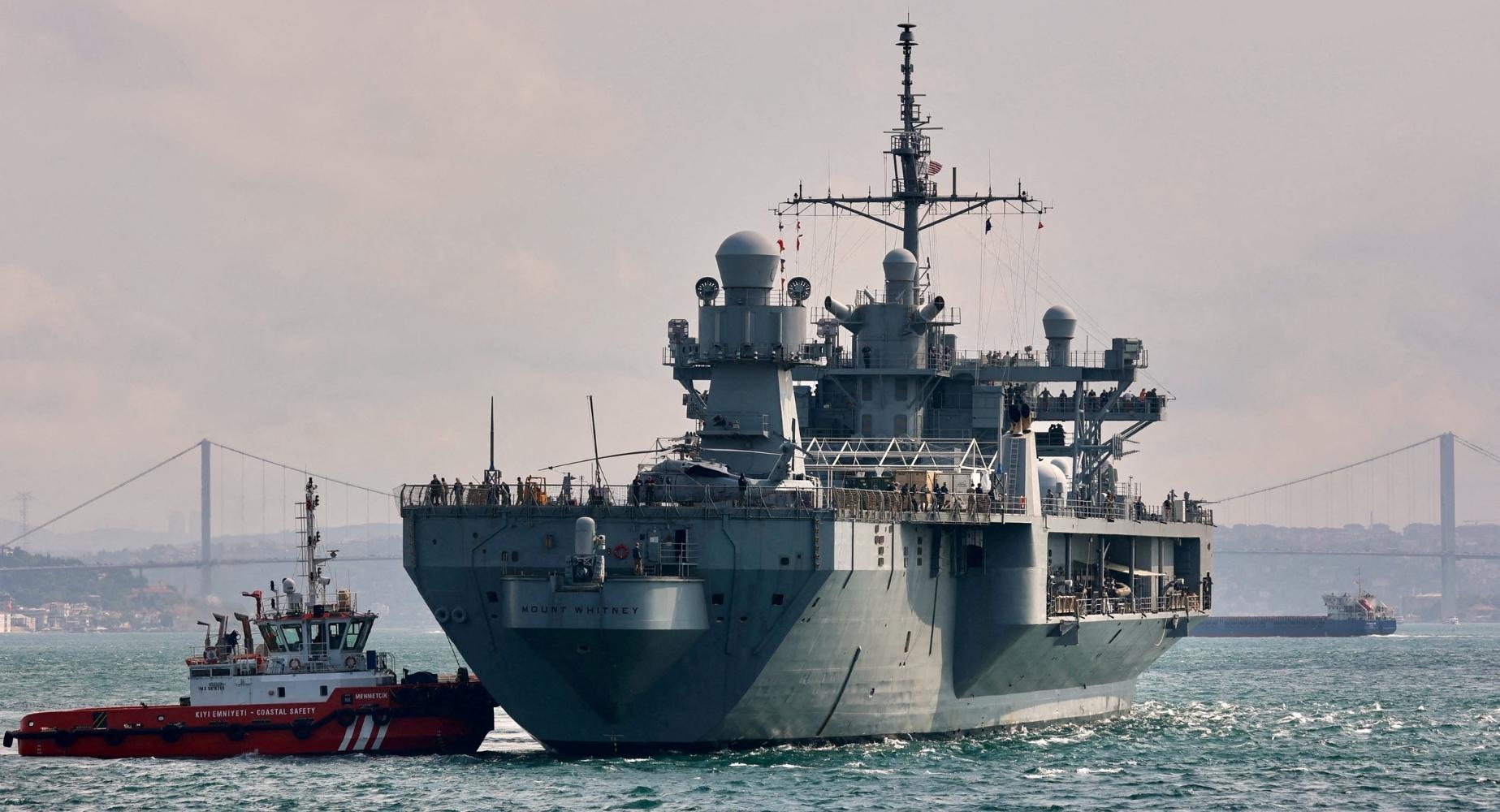
Similarly, during my tenure as Commander of the U.S. SIXTH Fleet and Naval Forces Europe, I supported a significant naval presence in the Black Sea Region. Typically, US warships operated for about 125 days in the Black Sea, augmented by another 125 days of NATO presence, resulting in either a U.S. warship or a NATO warship patrolling Black Sea waters for two-thirds of any year. The Russians may not have liked this, but they gradually became acclimated to a western maritime presence and periodic naval exercises. All this changed with Russia’s unprovoked attack on Ukraine in February 2022. SIXTH Fleet had three warships in the Black Sea in December 2021—the Command Ship USS Mount Whitney and two DDGs: USS Arleigh Burke and USS Porter. They were withdrawn from the Black Sea without replacements so as not to antagonize Vladimir Putin, who ironically attacked Ukraine anyway. Unfortunately, no American warships have patrolled the Black Sea since.
Ukraine’s navy and port infrastructure suffered repeated Russian strikes, and Ukraine was forced to scuttle its flagship Hetman Sahaidachny in March 2022 to prevent her from falling into Russian hands. Without any ships, Ukraine turned to asymmetric warfare, using airborne, surface, or sub-surface drones to destroyed over a third of the Russian Black Sea Fleet, including its flagship Moskva. Ukraine’s ability to execute asymmetric warfare against the Russian Federation at scale has contributed to a global rethinking of maritime strategy and naval force design.
The U.S. Navy confronted its own asymmetric challenge head-on when Houthi militia groups, as part of a broader Iranian proxy network, began attacking Israel and targeting hundreds of ships in the Red Sea. The Navy responded with a near continuous presence in the Red Sea and the establishment of a U.S. brokered coalition, named Prosperity Guardian. While some allies and partners showed interest in keeping the Red Sea corridor and access to the Suez Canal open, the preponderance of the risk was taken by the U.S. Navy.
The presence of American warships to deter and defend against Houthi strikes had several consequences. Houthi strikes have increased awareness of the cost-imposing strategy of asymmetric warfare, as American warships have expended missiles worth millions of dollars to shoot down a Houthi drone worth about $20,000. Defending against attacks in the Red Sea has depleted U.S. Navy missile magazines aboard warships and in global storage, driving increased interest and investment in lower-cost alternatives to a two-million-dollar missile. This underscores the urgent need to field electronic warfare and directed energy weapons as drone warfare becomes more prolific. Finally, the evolving nature of naval warfare has created a sense of urgency to modify tactics or update sensor data in real time. The U.S. Navy perfected this exquisite level of analysis after each interaction in the Red Sea, giving it unparalleled experience countering this type of warfare.
This brings me to my final example of lessons learned from the outbreak of hostilities between the United States and Iran in the Arabian Gulf. In response to forty-seven years spent undermining the U.S. and her allies, President Trump’s Operation Epic Fury authorized strikes on Iranian military targets, nuclear facilities, and political leadership to decapitate the regime, destroy Iran’s nuclear weapons program, and severely weaken its military forces, specifically, the Iranian Revolutionary Guard Corps (IRGC) and the Quds Force. With three aircraft carrier strike groups operating near the Arabian Gulf, the preponderance of force in Epic Fury came from these afloat offshore assets, which further reduced America’s missile stockpiles. The USS FORD, set a record not surpassed since WWII for a continuous 330 days (11 months) deployed at sea during multiple combat operations, including Operation Absolute Resolve in Venezuela. Clearly, more carrier strike groups are needed to keep deployments down to a notional seven months at sea and reduce the wear and tear on any one ship or on the Sailors embarked.
Many of the objectives of Operation Epic Fury were accomplished but with notable caveats. Iranian regime leadership has proven to be more resilient than expected and the IRGC has demonstrated the ability to maintain continuity of operations in a decentralized manner. Furthermore, the Iranian nuclear program has been set back but not irreparably destroyed. The Iranian Navy was destroyed, but the IRGC still operates hundreds of fast attack craft that can harass, interdict, or damage shipping near the Strait of Hormuz. Iran demonstrated its capability to mine the Strait of Hormuz, effectively shutting down or significantly reducing commercial traffic in the Strait amid rising fuel prices.
Operation Epic Fury illustrates why a larger, more powerful Navy is needed. It is no surprise that the Department of War asked Congress to approve a $1.5 trillion defense budget for the first time in history. America will continue to face the asymmetric warfare challenges encountered during Operation Epic Fury will likely be repeated, perhaps in a conflict with China in the Western Pacific.
To prepare for such a conflict, America needs more ships, period. Specifically, we must continue to build nuclear-powered aircraft carriers built on “five-year centers”, i.e. one carrier produced every five years, which will guarantee a fleet of at least 10 carriers over a fifty-year lifespan. Alongside the aircraft carriers, we need a robust and modern fleet of destroyers, frigates, and replenishment ships. In the undersea domain, we currently field the quietest and most lethal platform in the world— the Virginia-class (VACL) submarine. Likewise, the continuity and credibility of our nuclear deterrent depends on the most secure part of the Triad—the Colombia-class ballistic missile submarine. The Navy’s requirement is to build one Colombia and two VACL submarines a year, and we cannot afford to fall any further behind on submarine production. We must also ramp up production of weapons to fill our depleted magazines with more conventional weapons, hypersonic missiles, and directed energy weapons as soon as possible. Finally, America’s counter mine warfare capability is insufficient, and while I laud the Navy’s desire to deploy unmanned systems to conduct traditional mine detection and mine sweeping operations, we must have more of it and with a stand-alone capability in all the theaters that we operate.
These are just a few of the things necessary to optimize a modern fleet. The Chinese Navy currently possesses more warships than America, and there is a certain quality in quantity. However it is never too late to invest in the U.S. maritime industrial base and reverse the decline in warship inventory in the USA to ensure America is prepared for its next conflict at sea and ready to sail into a red sky and the storms that are sure to follow.
