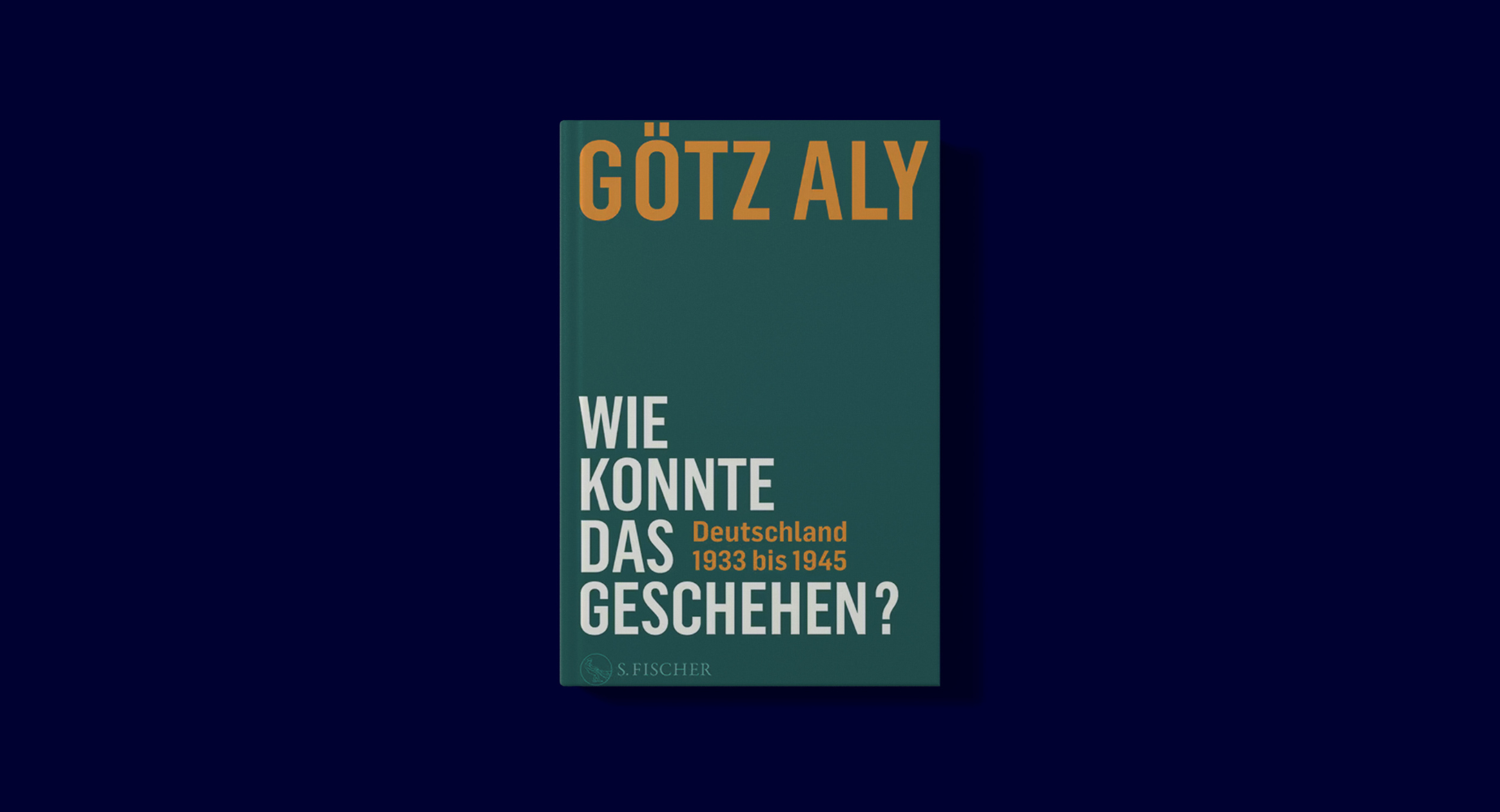
Götz Aly, “ Wie konnte das Geschehen. Deutschland 1933-1945 “ (How Could This Happen? Germany 1933-1945), S. Fischer, 2025
In 1936, the year of the Berlin Olympics, the scholar W.E.B. Du Bois traveled through Hitler’s Germany. Germany was not unfamiliar territory for him: four decades earlier, Du Bois had studied at the Friedrich Wilhelm University in Berlin for a year before becoming the first African American to earn a Ph.D. at Harvard in 1895. Now Du Bois observed that while he was received with “uniform consideration,” the new Nazi regime was conducting a “campaign of race prejudice” against German Jews that “surpasses in vindictive cruelty and public insult anything I have ever seen.” Indeed, he reckoned that nine out of ten Germans were supportive of Hitler.
In his penetrating new study, How Could This Happen?, Götz Aly, a leading German journalist and historian, examines the widespread support that Hitler and his confederates enjoyed as they consolidated power during the 1930s. Based on extensive archival research, it underscores that many Germans came to believe that Nazism was a good thing. Social barriers were crumbling. Marriages between social classes were encouraged. Unemployment was falling. Germany was rising. By 1938, Hitler was likely the most popular German chancellor of the twentieth century. The historian Sebastian Haffner once observed that had Hitler died then, he would likely have gone down in German history as a great statesman.
To the astonishment of the mainstream conservative cabal that had helped hoist him into power, Hitler outflanked it by eliminating any constraints on his personal power and becoming a popular dictator. Aly emphasizes that Hitler and the Nazi elite gradually fostered a broad antisemitic consensus among the German people. Hitler recognized and exploited it as an integrative tool to broaden his appeal beyond voters of his Nazi party. “Das geschieht denen recht” (it serves them right) was often the reaction of Germans watching the early Nazi discrimination and exclusion measures towards the German Jews, albeit without any thoughts or demands towards deportation let alone physical extinction. Aly identifies social envy as a major reason for antisemitism.
Aly has scant patience with terms like “Nazi ideology” and assortments of “fascist theories,” and he avoids getting trapped in the still ongoing controversy between “intentionalists” and “functionalists” about the origins of the Holocaust. For his new work, Aly has deeply mined (greatly facilitated by recent digitization) a huge trove of documents, among them Josef Goebbel’s extensive diary, recently emerged documents and letters, and written observations from many Germans. His new study opens new windows (and reopens some older ones) into Hitler’s Germany, World War II, and the Holocaust.
Immediately after World War II, denial and reinterpretation of German history were at a peak. For many, silence was a convenient mechanism to collectively suppress and forget the horror of the murderous war and the holocaust. The rage of Hitler, and the small and unscrupulous Nazi elite around him, became the obvious scapegoats to distance oneself from personal guilt. May 8, 1945 was labeled “total collapse” (totaler Zusammenbruch), it became “Zero Hour” (Stunde Null), and later Germans called for a “New Beginning” (Neuanfang), altogether a terminology to separate the crimes of Hitler’s Germany from one’s own history. In 1946, the prominent historian Friedrich Meinecke wrote a book called The German Catastrophe that depicted Nazism as a “fatal accident” and an “alien force.”
Aly cogently suggests that Germans prior to 1933 were not more prone to criminal behavior than their neighbors in the West, nor after 1945. German culture and science were admired globally. Yet between 1933 and 1945, Germany mobilized 10 million soldiers, invaded most of Europe, robbed and murdered millions, and committed genocide by killing 6 million Jews. What’s more, only during the last 10 months of the war, after the failed assassination attempt on Hitler in July 1944, 70 percent of German cities were destroyed by Allied bombing while 9,000 German soldiers were killed each day. During the final battle of Berlin–in April of 1945–some 90,000 Germans and 80,000 Soviet soldiers perished, along with some 30,000 civilians caught between the lines.
What is new and provocative in Aly’s elucidation of Hitler’s Germany? He identifies a set of key central elements that the Nazis skillfully exploited to merge the “community of the people” with a criminal regime. Aly rejects the diffuse term “Nazi ideology”–instead he identifies varies manipulative governing techniques, situationally applied, and always supported by an effective and sophisticated propaganda machine. Nazism represented the first young “people’s party,” crossing all sociological and religious boundaries. It is important to remember that the Nazi elite in 1933 was quite young: Hitler (43), Goebbels (35), Himmler (33), Goering (40), Mengele (22), many of them upstarts who had experienced the economic and financial hardship of the Weimar republic.
To consolidate his power as quickly as possible, Hitler implemented a battery of sweeping social measures. Hitler terminated within the first 100 days all pending court orders to repossess property; he prohibited evictions and forced auctions of farms failing to service their debt. He instructed all bailiffs to immediately represent only the interest of debtors. Hitler slashed the co-pay for doctor visits and prescriptions in half, and widows, orphans, and veterans paid nothing. Special needs for crippled World War 1 soldiers–orthopedic shoes, among other things–were fully covered by state health insurance. According to Aly, the phrase “they care” became a popular sentiment.
Nor was this all. In 1934, Hitler declared May 1 “International Labor Day”–and turned it into a fully paid holiday. For Aly the notion that on May 2, 1933, the Nazis smashed the free union movement is too simplistic. Yes, the Nazis dissolved the old labor umbrella organization and confiscated substantial funds held by the union bank and insurance. However, Aly also documents that more than a few union leaders voluntarily encouraged their old members to smoothly transition into the new Nazi-Organization “Deutsche Arbeitsfront“ (German Labor Front). Some after 1945 even assumed leadership positions in the West German union movement. Whenever Aly identifies individuals, he lists the year of their birth and death. It’s remarkable how many prominent Nazis lived on – some for decades – in West and East Germany, some in prominent positions.
Despite Hitler’s longtime racial hatred towards Jews, and widespread antisemitism, Aly rejects the notion of any “master plan” in 1933 to murder the Jews in Europe. Instead, various concepts for the deportation and resettlement of the Jewish population were circulated over some years. Aly provides details for the “Madagascar Plan,” the idea of resettling on the French colonial island.
At this juncture Aly distinguishes himself with another unorthodox argument: The Nazis knowingly had built the welfare state on a Ponzi scheme. After 1934 the national budget remained an unpublished secret. Hitler had planned the war to plunder and rob the invaded countries. In the fall of 1940, when England remained undefeated, Hitler needed a fresh front to finance his “Third Reich,” to keep it stable from total financial and social collapse. Hitler invaded Russia in June 1941, which he was confident he could conquer by November. Hitler’s objective was unconditional annihilation, and many in the leadership of the German Wehrmacht heeded his orders. During the first months of Operation Barbarossa, some 900,000 Jews were killed along with 12,000 civilians. Over a million Russian prisoners of war were deliberately starved to death. The war in the East also opened the gates for the mass execution of Western Europe’s Jews.
The knowledge of the atrocities in the East and the deportations of Jewish communities to the East, which were witnessed by the “Aryan” Germans back home, marked the turning point from a “People’s community” to a collective of complicity and fear. Aly points out that Goebbels often used the example of a fast train–all German people had boarded it, and nobody could now disembark, without being killed. Aly confirms what the pioneering Holocaust scholar Raul Hillberg established decades ago: the Holocaust was an open secret. How could it happen? Rather easily, it turns out.
