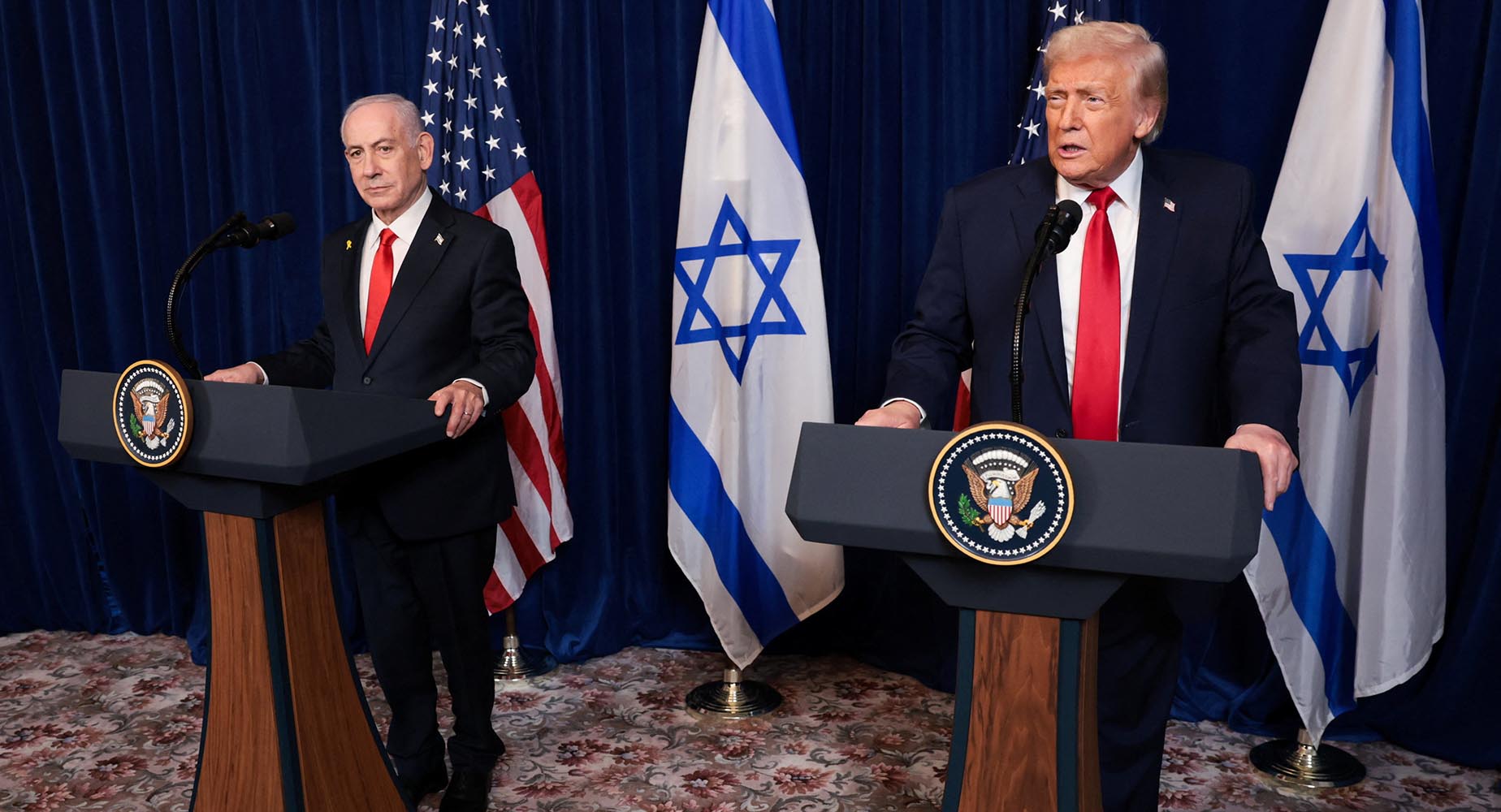
With the combined American and Israeli strikes against Iran on 28 February 2026 the Middle East has entered a new strategic phase. Military operations, in this respect, were the continuation of events during the past two and a half years — from October 7 onward — which have not merely reshaped tactical realities; they have altered the regional balance of power.
The following assessment is based on conversations with Maj. Gen. (res.) Yaakov Amidror, former National Security Advisor to the Prime Minister of Israel.
The American decision was driven, above all, by the ultimate need to terminate Iran’s nuclear ambitions. Israel, for its part, had a broader and longer perspective. The Iranian project of encirclement has been built patiently over decades. It has been disrupted, and the time has come to remove it altogether. The assumptions that guided Tehran’s strategy no longer hold. Israel is no longer simply reacting to a tightening ring of proxies. It is reshaping the strategic environment, while facing new and complex challenges. This transformation is measurable, structural, and consequential, and its full impact will only emerge once the present conflict is brought to an end.
The Collapse of the Ring of Fire
The offensive operations against Iran in June 2025 and again now come against a background of persistent hostility, as well as two previous direct assaults by Iran. Moreover, for years the Islamist revolutionary regime in Iran had pursued a doctrine of indirect confrontation. Hamas as an ally and Palestinian Islamic Jihad as a proxy in Gaza, Hezbollah as Iran’s arm in Lebanon, Shiite militias in Syria and Iraq, and the Houthis in Yemen formed a coordinated architecture designed to surround Israel with continuous pressure while shielding Tehran from direct consequences.
This “ring of fire” was meant to deter Israeli initiative and to create a multi-front paralysis, ultimately creating the conditions for bringing about Israel’s collapse. That architecture has now been severely degraded by effective Israeli actions on several fronts, triggered by Hamas’ assault on October 7 2023, reducing the possible impact of retaliatory action that Iran may try to launch.
Hamas has been largely dismantled or at least degraded as a governing military force, and is now facing the internationally sanctioned demand that it must disarm. Hezbollah, though still heavily armed, lost its key leaders and much of its infrastructure, and now understands that large-scale escalation would endanger not only its own survival but the stability of Lebanon itself. Iranian logistical corridors through Syria have been systematically targeted. Most importantly, Iran has learned that distance no longer guarantees immunity, and that Israel enjoys intelligence and technological dominance that it cannot match. Moreover, the USA has firmly joined forces with Israel in seeking to ensure once and for all that Iran will never be able to possess nuclear weapons, and this time the two acted in unison rather than in sequence.
The strategic initiative has thus shifted. Tehran is no longer dictating escalation tempo through proxies; it tried, and failed, to manage risk under sustained pressure, with America taking the lead. Deterrence, once tilted in Iran’s favor, has been rebalanced, but apparently did not suffice to bring the regime to accept the Trump Administration’s basic demands.
The American Factor and the Logic of Action
The current regional reality cannot, indeed, be understood without recognizing the decisive role of the United States in recent developments. Iran now faces not only Israel’s demonstrated operational reach and apparent intelligence penetration but also an overt and unmistakably aggressive American military posture in the region, able to translate such joint intelligence into coordinated action.
The United States has deployed a significant part of its naval and air power not as a symbolic gesture, but for action, not merely signaling – even if the option of using their coercive presence to achieve a “deal” was left open for weeks on end in the vain hope that Iran’s leader, ‘Ali Khamene’i, would come to his senses. This matters: whether or not the regime actually collapses or merely folds on the key issues. It knows now that it misread the willingness to talk as a sign of hesitation. Now confronted with credible force and the equally credible intention to use it, there is at least a chance that it will give ground on all relevant issues, rather than revert once again to manipulative offers on the nuclear front, which has been a consistent pattern for four decades.
Today, Tehran actually faces American (and Israeli) capability, readiness, and political will all aligned. The carrier groups, advanced air assets, integrated missile defense systems, and forward deployment were designed not only to remove ambiguity, but to act – as it was instructed to do once the talks reached a dead end. There is now an added nuance to American and Israeli political messaging: nuclear breakout and unchecked ballistic missile expansion will not be tolerated, and moreover, the time may have come to create the conditions for the Iranian people to overthrow the repressive regime.
From a strategic standpoint, this provided unprecedented clarity not only for Iran itself. When red lines are uncertain, adversaries test them. When consequences are unmistakable, even ideologically driven regimes may finally behave rationally. Deterrence rests on three pillars: capability, readiness, and will. The current action demonstrates all three.
American military action is not the introduction of instability; it is a stabilizer. Adversaries now fully understand – despite Iran’s limited and ineffectual counter-strikes – that the United States. Acting in close coordination with Israel (and for the first time, launching aircraft from Israeli bases – possesses the operational capacity to conduct sustained strikes against Iran’s nuclear infrastructure, missile production facilities, and command networks, and has shown itself willing to use it despite the risks involved. Israel on its part has the proven ability to make its own contribution, which has already been brought to bear against key targets,
This alignment between Washington and Jerusalem reflects a shared doctrine: Iran’s nuclearization is not a future academic concern. It is an immediate strategic threat. Preventing that outcome was not optional — it was essential: and so is now the need to pursue action to the point of either coercing the regime to accept or bringing about its collapse and the liberation of the people of Iran from its yoke.
Gaza: Strategic Patience and Structural Dismantlement
In Gaza, meanwhile, Israel is not operating under artificial timelines. War is not measured in news cycles but in strategic outcomes.
Diplomatic efforts may continue. The United States may explore pathways for Hamas disarmament. History suggests that such efforts will not fundamentally alter Hamas’s ideological commitment to armed struggle. Israel therefore proceeds patiently and methodically, no longer constrained by the hostage issue and based upon the impact already created in two years of warfare -as well as the full implications of the action against Iran.
If required, a sustained and comprehensive campaign to eliminate the remaining military infrastructure of Hamas could extend for many months. This is not an operation designed for optics. It is a structural dismantlement process aimed at preventing regeneration, while steadily establishing alternative governance where Hamas is eliminated.
Allowing diplomacy to exhaust itself serves Israel’s legitimacy. Acting decisively when diplomacy fails serves Israel’s security.
The objective is clear: Hamas cannot be permitted to reconstitute itself as a governing military force capable of initiating another October 7: nor will it be able to claim the “victory” of survival and thus advance the broader cause of Islamist ideology across the region
The Northern Arena and Strategic Signaling
The northern front remains volatile but strategically different from previous years.
Syria’s evolving leadership introduces an element of uncertainty into the equation. Yet uncertainty can also create openings. Any potential recalibration between Jerusalem and Damascus would carry implications far beyond bilateral relations. It would signal to the broader Arab world that alignment with Iran is not inevitable. Lebanon is watching. Hezbollah is watching.
At the same time, Israel’s red lines remain firm. The Druze minority in Syria – and others, like the Kurds – cannot become victims of sectarian violence under any emerging Sunni authority. Israel’s strategic calculus integrates both security and moral responsibility.
The northern theater, in any case, is no longer defined solely by Iranian initiative. Significantly, it seems that even Hizbullah hesitates whether to commit on behalf of Iran to action that may well have disastrous consequences for it. Israel’s position is thus defined by deterrence, calibrated force, and regional reassessment. However, the ideological orientation and the strategic ambitions of Erdogan’s Turkey may well present Israel with a new set of long-term challenges, even if the Iranian threat has been removed.
Israeli Society: The Foundation of Strategic Strength
Strategic endurance ultimately rests not on hardware but on societal cohesion. Political debate within Israel is vigorous, as it is in any democracy under stress. But resilience is measured in action, not rhetoric.
Reserve mobilization rates remain exceptionally high. Combat unit recruitment exceeds expectations. Young Israelis are not withdrawing from responsibility; they are stepping forward.
This is the decisive variable that first Hamas and then Iran had misread and hence miscalculated. The expectation that prolonged conflict would fracture Israeli society has proven false.
A society that mobilizes at such a scale over extended periods is not a society in decline. It is a society prepared to defend its future.
A Window That Must Be Consolidated
The transformation described here does not yet mean that the region is stable. Risks remain. Diplomatic alignments can shift, and new challenges arise. But the fundamental equation has changed.
Iran’s encirclement strategy has been disrupted. Deterrence against nuclear escalation in general has been strengthened. The United States and Israel are aligned in both doctrine and posture. Regional actors are recalculating their positions in light of demonstrated Iranian vulnerability. This moment must be consolidated.
Strategic gains are not self-sustaining. They require clarity of doctrine, firmness of resolve, and consistency of action. The task ahead is not only to ensure that Iran cannot regenerate its proxy architecture, cannot cross the nuclear threshold, and cannot reestablish deterrence through intimidation: it is to discredit the entire Islamist project that it has come to represent.
The Middle East is undergoing structural change. Whether that change produces lasting stability depends on whether strength, now put to use, is maintained over time.
History teaches a simple lesson: when deterrence is clear, war can be avoided. When deterrence erodes, war becomes inevitable. At this moment, deterrence is being restored.
The responsibility now is to preserve it.
