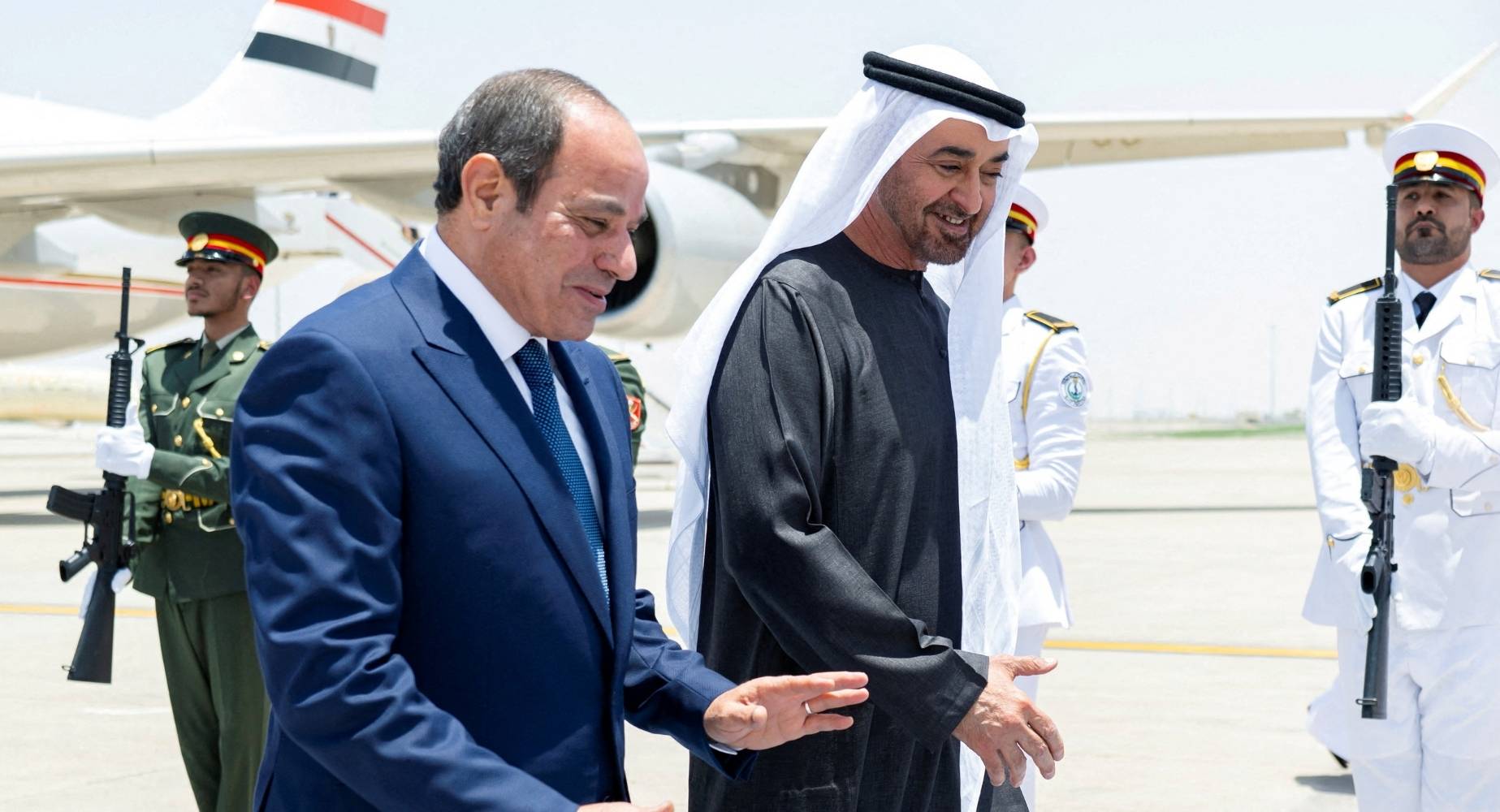
President ‘Abd al-Fattah al-Sisi’s recent visit to the UAE – which served as an opportunity to reveal that the Egyptian Air force has been playing a role in the defense of the Emirates – was an important reminder of an often overlooked aspect of the regional balance of power. Albeit beset by several significant internal and external challenges, and wrestling with persistent economic problems, it is still Egypt which plays a pivotal role. Its population, now estimated to have crossed the 120 million line – by far the largest in the region – as well as its geo-political presence, and its strategic and historical roles, in the Arabic speaking countries, the Muslim world, the Mediterranean, the red Sea, Africa, and in many UN institutional structures, all these combine to make it, in the region, an indispensable nation.
Moreover, as the first and groundbreaking partner in peace (even if this has been, in many ways, a much colder proposition than originally intended), it has established a norm which entails the rejection of radicalism – whether the old revolutionary fervor of socialist pan-Arabism, which has led Nasser’s Egypt to disaster, or the more recent Islamist totalitarian version, firmly defeated in 2013. It is this norm which has validated now, for the better part of fifty years, the commitments of the United States to Egypt’s security and stability: a pledge which has been upheld by wide variety of administrations and leaders, from Jimmy Carter to Donald Trump.
Egypt’s position in regional and world affairs has made it possible for this normative stance and the relationship with America to be sustained side by side with a good working relationship with other world powers. It made common cause with Russia on Libyan affairs, bought military materiel from China as well as from several European suppliers, and in many ways retained its posture as a member of good standing among the non-aligned, despite the overt American connection. It took a cautious stance towards the American adventure in Iraq in 2003 (as distinct from its active participation in the liberation of Kuwait in 1991), and during the long and agonizing years of the Syrian civil war Cairo was never too eager to see a regime overthrown by rebels, let alone those whose main motivation seemed rooted in Islamist ideology.
Thus, it is fair too assume that Egypt will continue to retain its freedom of action (and frankly, at times – such as the reaction to the Houthi disruptions in the Red Sea – the freedom of inaction…), as well as a healthy dose of suspicion towards the bid by Recep Tayyip Erdogan to become the key regional player amidst the impact of the war in Iran. True, Egypt has allowed itself to be drawn into a warmer relationship with Ankara, certainly compared to the icy mutual disdain during the years immediately after Muhammad Mursi’s overthrow and the defeat of the Muslim Brotherhood in 2013, which Erdogan deplored as an act of usurpation. In recent years, there have been closer contacts, culminating in Erdogan’s visit in Egypt in February 2026; and some degree of military cooperation. Clearly, Ankara is eager to offer inducements so as to draw Egypt away from the close tripartite relationship with Greece and Cyprus, which has been built in parallel with the Hellenic alignment with Israel.
Moreover, as the overt discussion over a new regional balance intensified, Egypt was often mentioned as the fourth leg of an active (so-called “Sunni”) alignment encompassing Turkey, Pakistan, and Saudi Arabia. It was assumed, moreover, that it would share their purpose, namely, to seek to utilize the ongoing effects of the war – which is clearly weakening Iran and its proxy system, but also casting doubts about the persistence of US policy – in order to establish a new center of strategic gravity in the Middle East. With Saudi resources, Pakistan’s status as a military nuclear power, and Turkey’s significant military clout (including advance defense industries), this may loom large as a key aspect of the region’s future. All four countries, moreover, are part of the group of eight Muslim powers associated with Trump’s “Board of Peace” and its purposes in Gaza.
Still, closer scrutiny – and the evidence provided by the visit to the UAE, which is quite distinctly not part of this alignment – raises questions as to Egypt’s place in this combination. The apparent rapprochement with Erdogan and the fanfare attending his visit have not altogether blunted the bitter memories of the previous decade. In terms of the domestic concerns still worrying Sisi, Erdogan remains an active friend and promoter, as he has been in Syria, of elements associated with the Muslim Brotherhood and all that it stands for. Sisi has been calling (with only limited success) on the Al-Azhar establishment to take a stance against the Islamist version (or perversion) of religion; the AKP in Turkey has been doing the opposite. This foundational aspect of the present Egyptian regime and its perception of Turkish intensions cannot be papered over, even if the optics of the relationship have become much friendlier.
Indeed, it is fair to assume, even if this is not likely to be openly stated – or even whispered – that Egypt (like Israel) has no wish to see Turkish troops or even administrators roaming in the Gaza Strip, on their own border. Egypt’s care and concern for the fate of the Palestinians is deeply-rooted, abiding and genuine: but so is their awareness that Hamas as an ideological movement is an offshoot of the Muslim Brotherhood, that its bear full responsibility for the disaster in Gaza, and that its active association with Erdogan’s ambitious meddling in the region bodes ill for Egypt’s interests.
Thus, the visit to the UAE (amidst significant Emirati-Saudi tensions) signifies that Egypt has not cast its lot irretrievably with the emerging tripartite alignment: and while there are significant differences of opinion to be bridged – notably, in Sudan – this is a relationship strong enough to be cemented by an Egyptian military commitment.
The challenge for the UAE, the US (and indeed the two other players of the so-called I2U2, India and Israel) is to find ways to sustain this Egyptian freedom from Turkish tutelage – not least, by shoring up the Egyptian economy (as the Emiratis have already been doing) by well placed strategic investments and other forms of assistance. The US can do its part: Israel’s decision to ease out its own dependence on Foreign Military Financing over the next decade should not automatically be translated (despite the residual reference to the two as the “Camp David package”) into similar reductions for Egypt. In fact, the ongoing strategic association of the Egyptian military with its American partners serves the long-term mutual interest in preserving the vital 1979 Peace Treaty. At the same time, there is a place for subtle Egyptian assurances that it harbors no designs towards its eastern neighbor, given the significant (and actually agreed with Israel) growth of its forces in Sinai, well beyond the provisions of the Treaty’s Military Annex.
The US, following up on actions already taken by the Trump Administration, should also help in bringing about an amicable resolution of the Renaissance Dam crisis with Ethiopia: while Egypt’s contribution to regional stability should come to include not only a military presence in the UAE. but also active participation in firm action in the Red Sea to deter any bid by the Houthi regime in parts of Yemen to disrupt again this vital Sea lane of Communications. It should also pull its weight in trying to get Hamas to disarm and offer the stricken people of Gaza a better life. To retain its pivotal role, Egypt needs more that the words of its highly sophisticated diplomats.
