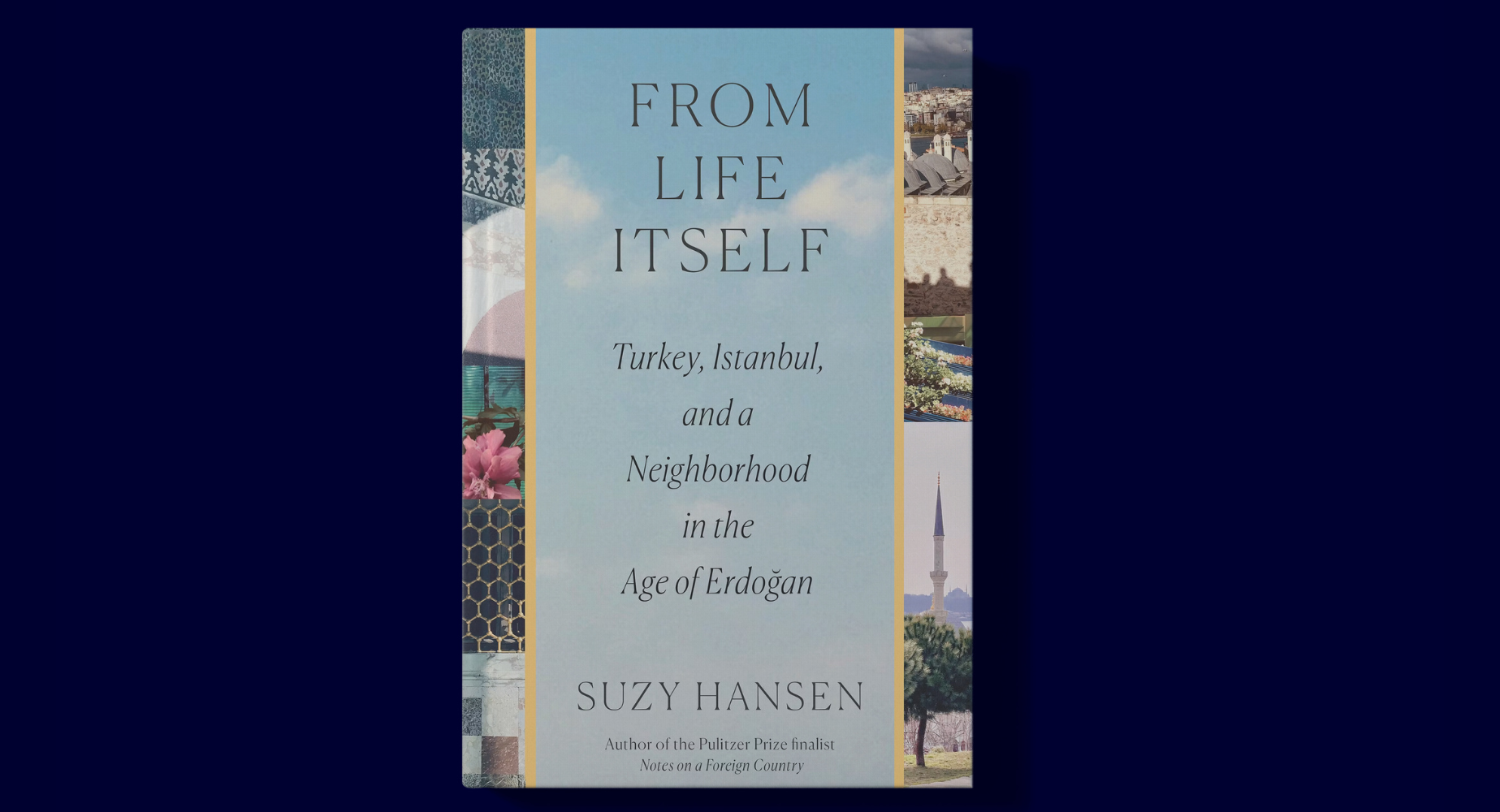
Suzy Hansen’s From Life Itself: Turkey, Istanbul, and a Neighborhood in the Age of Erdoǧan is one of the most important works in recent years about Turkey..
Hansen lived in Istanbul from 2007 to 2023, which covers the major period of Erdoǧan’s rule, and has an important asset, a command of Turkish. This is the ‘open sesame’ and made it possible for her to write the book. From Life Itself takes as its starting point the people who live on the main street in Karagümrük, a neighborhood in Istanbul, and her aim is to capture how ordinary people experience authoritarianism in the twenty-first century.
The main character is Ismail, the muhtar (local headman), with a nostalgia for Istanbul’s cosmopolitan, Ottoman past. There is his wife Ebru, a real estate agent, Hüseyin, a grocer and ardent supporter of Erdoǧan, Murat, a barber and Islamic fundamentalist, and Majed, a Syrian refugee who had opened a sweet shop. There is also Zeki, the local imam.
Social harmony was destroyed by the savage pogrom in 1955 against Istanbul’s Greeks, who constituted almost 30 percent of the city. This was followed by mass migration from the Anatolian hinterland in the 1960s. Istanbul is the heart of Turkey, and Erdoǧan was a popular mayor in the 1990s with his reforms of the city’s infrastructure.
This in turn paved the way for his leadership of the Justice and Development Party (AKP), which came to power in 2002. In Erdoǧan’s “brief golden period of liberalization” Turkey became a template for Western fantasies of a liberal Muslim nation until reality kicked in.
Hansen terms Erdoǧan’s democracy as “democracy for a day.” The Ergenekon and Sledgehammer cases opened against secularists and the military were nothing more than a campaign of revenge and a blatant power grab on the part of the AKP government together with the Gülenists.
Hansen observes that the twentieth-century Kemalist ideology with which Turkey had been founded was being undone by Erdoǧan. Instead, he set out to restore Turkey’s Islamic identity and loss of Turkish dignity. Initially, as Hansen notes, Erdoǧan’s popularity was the product of genuine political and social achievements. In Istanbul he embarked on a program of urban renewal and and there was a frenzy of construction, skyscrapers, malls, bridges, tunnels, palatial mosques. Construction and expansion became the byword, but as the muhtar Ismail lamented, the people of Istanbul began to mourn the loss of their green Istanbul.
Hansen is evocative. “For hundreds of years, it was a lush of forests, lush tangles of Hungarian oak, oriental birch, Anatolian chestnut, quaking aspen, goat willow, cypress, and hornbeam, wildlife warrens for wild boars and storks and catfish, a kind of paradise dense with moisture and sunshine and the life-force of three surrounding bodies of water: the Black Sea, the Sea of Marmara, and the Bosphorus.”
A recent report details the environmental damage done to Turkey in the search to exploit its mineral wealth.
The AKP government turned the public housing authority TOKI into a mega construction machine. Among other projects, in Istanbul it gentrified Sulukule, the traditional Roma area and built high rise apartment buildings to house the migrants. As Hansen writes, this made the AKP municipalities and their business friends a tremendous amount of money. The AKP made over 150 amendments to the public procurement law, which benefited contractors with ties to the party.
Hüseyin the grocer, once an Erdoǧan supporter, deplored what had happened to the neighbourhood, the city, and the way the government enriched itself at the people’s expense.
There was one major error, characteristic of many developing countries. Turkey used to be self-sufficient in food, but decades of industrialization had forced farmers into factories and mines to make a living. By 2018 a financial crisis because of mounting domestic and foreign debt became a food crisis, and people were impoverished by the cost of living.
Karagümrük’s muhtar noted, “The children work and struggle. They live in luxury.” and his wife warned, “People will be quiet, and then there will be an explosion.”
Already in 2013 there was what Hansen calls “a counterrevolution”, when there were protests all over Turkey at plans to demolish a small park in Istanbul, Gezi Park, to make way for a shopping mall. Erdoǧan panicked with the ensuing crackdown. Last year the arrest of Turkey’s popular mayor of Istanbul, Ekrem Imamoǧlu, led to the biggest protests since Gezi Park. The fact that Erdoǧan closed Bilgi University, a private university in Istanbul, on Friday 22 May and reopened it on Monday morning after protests by thousands of students indicates he is treading on thin ice.
After the attempted coup in July 2016, the purge of Erdoǧan’s erstwhile ally, Fethullah Gülen and his movement, completes the picture. As a paraphrase of German pastor Martin Niemöller, Hansen writes, “First, they came for the Gülenists; then they came for the Kemalists, the liberals, the intellectuals, and Kurds.”
The book’s last chapter, “The Architect is the President,” deals with the edifice’s collapse, the tremendous earthquake in Hatay province in February 2023, when Erdoǧan’s government showed itself incapable of dealing with the tragedy. Hansen concludes, “His vision was a country united by his personal ideology of Islamic sentimentality and post-Western revenge, […….] but turned out to be worthless in the face of a genuine natural catastrophe.”
In a conversation with Al-Monitor’s Amberin Zaman Suzy Hansen says that those who once admired Erdoǧan for the prosperity he brought to the country are absolutely devastated. Their self-esteem has cratered because they and their children no longer have the future they have been promised. They still need someone who can present them with an alternate vision.
The question is whether Özgür Özel and his New Party (YP) can provide Turkey with the vision it needs. With its 91 seats out of the Turkish parliament’s 600 the YP faces an uphill struggle, but given the present discontent events could pivot in its favor.
