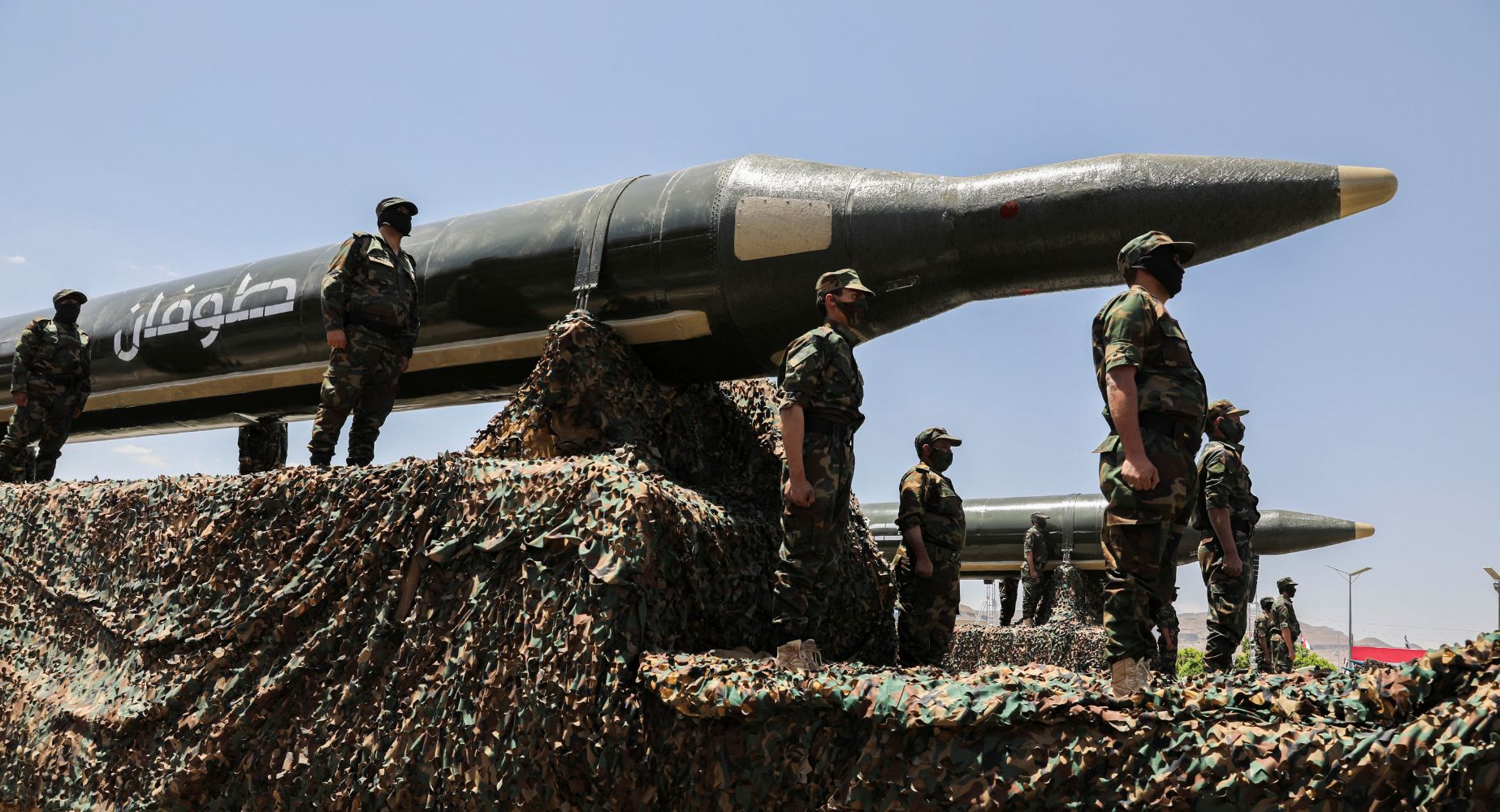
One of the principal benefits of pursuing the war against Iran to the unconditional surrender of the Islamic Republic will be the end of the Houthi regime in northern Yemen. This regime represents a strategic Iranian foothold on the Arabian Peninsula. From Sanaa and the Yemeni highlands it has launched missiles and drones at Saudi Arabia and Israel, attacked commercial shipping in the Red Sea, and threatened the Bab el-Mandeb Strait—directly endangering U.S. allies and U.S. commercial and naval interests. Thanks to the Trump Administration’s success to date in weakening the theocratic regime in Iran, Houthi external support has already been strained and the movement has been significantly weakened. Completing the campaign against Tehran, rather than accepting another fragile ceasefire, is the most reliable way to finish this crucial work. Such a policy will collapse the remaining pipeline of Iranian weapons, funds, and advisers, and remove the Iranian proxy government that still sits astride the southern gate of the Suez corridor.
The conflict that began with U.S. and Israeli strikes on February 28, 2026, killed Supreme Leader Ali Khamenei and numerous Islamic Revolutionary Guard Corps commanders in its opening hours. Subsequent operations have targeted missile and drone facilities, naval assets, command centers, and coastal defenses. A naval blockade has restricted Iranian oil exports and complicated maritime smuggling. Iranian officials have acknowledged massive economic damage. The Islamic Republic cannot pay many of its troops and its navy and air force have been severely weakened. Temporary ceasefires have repeatedly collapsed amid renewed exchanges of fire. The regime continues to limp along under successor leadership, but it is poorer and more isolated than ever before, increasingly forced to prioritize its own survival over its regional clients.
The strain is visible in Yemen. For years the Houthis received Iranian missiles, drones, components, training, and funds that allowed them to hold Sanaa and the north, threaten shipping, and strike Saudi and Israeli targets. With Iran under blockade and its own forces under attack, those supply lines are now disrupted. The Houthis retain some indigenous military production and local recruitment, yet they now operate as a far more isolated force. Reduced external support makes high-intensity conventional fighting across multiple fronts far harder for the regime in Sanaa to sustain.
The fighting that erupted in early September illustrates this point. On September 3 – 4 the Houthis opened an offensive in western Taiz and southern Hodeidah aimed at the high ground overlooking Mokha and the Bab el-Mandeb. The forces of the Saudi-backed and internationally recognized Yemeni government, the Presidential Leadership Council (PLC) based in Aden, absorbed the initial blow and launched counteroffensives on several axes. By now sources in the PLC have reported the capture of Yatma in al-Jawf, the Labanat military camp in the same governorate, and full control of Hays district in Hodeidah. They report as well advances toward al-Hazm, the capital of al-Jawf, and to the outskirts of Dhi Na’im in al-Bayda, as well as the recapture of hills and villages in western Taiz, along with operations in southern Marib.
PLC officials, including Chairman Rashad al-Alimi and Deputy Defense Minister Maj. Gen. Samir al-Sabri, have declared the objective of retaking Sanaa. Saudi airstrikes have supported the efforts of the legitimate Yemeni government. Houthi sources have naturally disputed some of these gains and have responded with missile and drone attacks on Saudi energy and military sites that wounded dozens of civilians. Inside Yemen, hundreds have been killed and more than 20,000 displaced. Despite the inevitable fog of war, the clear strategic pattern is a rare simultaneous Yemeni government push across Houthi-held territory in the crucial provinces of al-Jawf, al-Bayda, Taiz, Hodeidah, and Marib after years of stalemate.
These advances occurred while Iran was already absorbing American and Israeli pressure. A negotiated pause that leaves the theocratic regime intact would allow Tehran to rebuild smuggling networks, replenish Houthi inventories, and wait out political cycles in Washington. Unconditional surrender would remove that option. It would end state-directed transfers of weapons technology, funds, and advisers. Without this patronage the Houthis would face a better-resourced Yemeni government and continued Saudi air support, even while trying to hold out in mountainous but economically isolated terrain. Their ability to threaten international shipping through the Bab el-Mandeb, or to launch long-range strikes at two key American partners, would diminish sharply and likely collapse over time.
The commercial stakes at the strait make that outcome a core U.S. interest, not a peripheral one. Under normal conditions, Bab el-Mandeb carries on the order of 12 percent of global trade by value—roughly $1 trillion or more in goods each year—along with about 1.6 billion tons of cargo and between 20,000 and 26,000 vessel transits. The traffic is a mix of container ships on the Asia–Europe lane, bulk carriers, LNG tankers, and oil. In 2023 oil and petroleum products through the strait averaged about 8 to 9 million barrels per day; Houthi attacks later cut those flows by more than half, to roughly 4.1–4.2 million barrels per day in 2024 and the first half of 2025, before the Iran war again reshuffled tanker routes as Saudi Arabia diverted crude to Yanbu on the Red Sea. Closing Bab el-Mandeb is the rough equivalent of closing the Suez Canal from the south. The two are a single corridor: a ship sailing from Asia to Europe must pass the strait to reach the canal. Shut the southern gate and Suez becomes a dead end for most east–west traffic, forcing the same 7,000-kilometer, 10-to-14-day Cape of Good Hope detour that Houthi attacks already imposed on much of the world’s container fleet.
That role of the Bab el-Mandeb is comparable, in kind if not in terms of every commodity, to that of the Strait of Hormuz. The two waterways bookend the Arabian Peninsula and together underwrite a large share of world commerce. Hormuz is the greater energy gate: in a normal year it moves about 20 million barrels per day of oil and products, roughly a quarter of seaborne oil trade and a fifth of world oil consumption, plus nearly a fifth of global LNG. Bab el-Mandeb is the greater logistics artery. It is the southern door to Suez and carries a similar share of total maritime trade by value, including about 30 percent of global container traffic on the Red Sea corridor. If Hormuz is the world’s energy lifeline, Bab el-Mandeb is its Asia–Europe shipping lifeline. A prolonged closure of both at once would put on the order of a quarter of global oil supply at logistical risk and force almost all remaining east–west cargo to transit around Africa. The Iran war has already shown how quickly pressure on one strait loads onto the other. That is why ending Houthi control over the southern gate is not a sideshow to the campaign against Tehran. It is the other half of the same fundamental chokepoint problem.
The Red Sea corridor is also of immense strategic importance to the U.S. Navy. Suez and Bab el-Mandeb are the fastest route between the Mediterranean and the Indian Ocean or Persian Gulf. A voyage from the Arabian Sea to Mediterranean ports that takes about 4,700 miles via the canal becomes more than 6,000 miles longer around Africa — eight days at high speed for a warship, longer for a carrier strike group. Dozens of U.S. Navy vessels, including carriers, have historically used the canal each year to shift forces among European Command, Central Command, and the Indo-Pacific. When the strait is too dangerous, as it has been for American carriers since late 2023, naval groups are forced onto the Cape route, stressing hulls, time, and logistics. Keeping both chokepoints open is therefore a naval requirement as well as a commercial one. A Houthi regime cut off from Iranian resupply would lose the capacity to threaten the Bab el-Mandeb.
The strategic payoff is concrete. Houthi attacks have repeatedly disrupted Red Sea traffic and forced costly rerouting. Their missiles and drones have targeted Saudi oil infrastructure and Israeli territory. A Houthi regime that can no longer rely on Iranian resupply would lose the capacity to sustain those campaigns. Securing the strait and ending the cross-border threat would serve both commercial shipping and the security of Saudi Arabia and Israel. Half-measures have already been tried. Earlier pauses and limited strikes did not dismantle the supply relationship between Iran and the Houthis. Only the unconditional surrender of the Islamic Republic will offer a durable end to the Houthi threat to international commerce and U.S. global interests.
The United Arab Emirates is not an obstacle to such a policy. Saudi Arabia and the UAE were once at loggerheads over the Yemen war. After initially fighting together against the Houthis in 2015, they backed rival Yemeni factions: Riyadh prioritized the internationally recognized government and a unified state on its southern border; Abu Dhabi the Southern Transitional Council (STC) and control of Yemen’s southern ports. That split burst into the open in December 2025 and January 2026, when STC advances in Hadramawt and Mahra drew Saudi airstrikes on a reported Emirati weapons shipment, an ultimatum to withdraw, and the collapse of the STC as a major force. The UAE pulled out its remaining troops.
In July 2026 the two governments issued coordinated public statements affirming their diplomatic relationship. In September the UAE condemned Houthi attacks on Saudi civilian and economic sites and on Red Sea vessels, declared solidarity with Riyadh, and supported measures to protect Saudi security. Abu Dhabi now emphasizes de-escalation rather than an independent military project in Yemen. Whatever other rivalries may remain, Riyadh and Abu Dhabi are no longer fighting each other in Yemen, and Emirati diplomacy now aligns with the strategy of increasing pressure on the Houthis.
Critics will cite the costs of prolonged war, the risk of wider escalation, and the difficulty of occupying or administering a post-surrender Iran. Those risks are real. Yet the alternative — negotiating a memorandum of understanding that leaves the Islamic Republic in place — has already proved to be a failure. The Islamic Republic has used pauses in the war to rearm its proxies and reimpose costs on international shipping and its neighbors. Six months of fighting have demonstrated that American and Israeli military power can seriously degrade Iranian capabilities and isolate the regime economically. Extending that pressure until the government in Tehran capitulates is the policy most likely to lead to the end of the Houthi project.
The Yemeni government’s recent gains on the ground show that a Houthi movement with reduced Iranian support can be pushed back on multiple fronts at once. Completing the campaign against Iran will turn the Houthis’ battlefield losses into a strategic defeat. Pursuing the unconditional surrender of the Iranian regime does not represent maximalism for its own sake. It is the logical conclusion of a war already underway: the step that will sever the remaining artery of support to the Houthis, lift the threat to the Bab el-Mandeb, and remove a strategic threat to two close American partners. It is the only way to defend US interests and allies in the region adequately.
