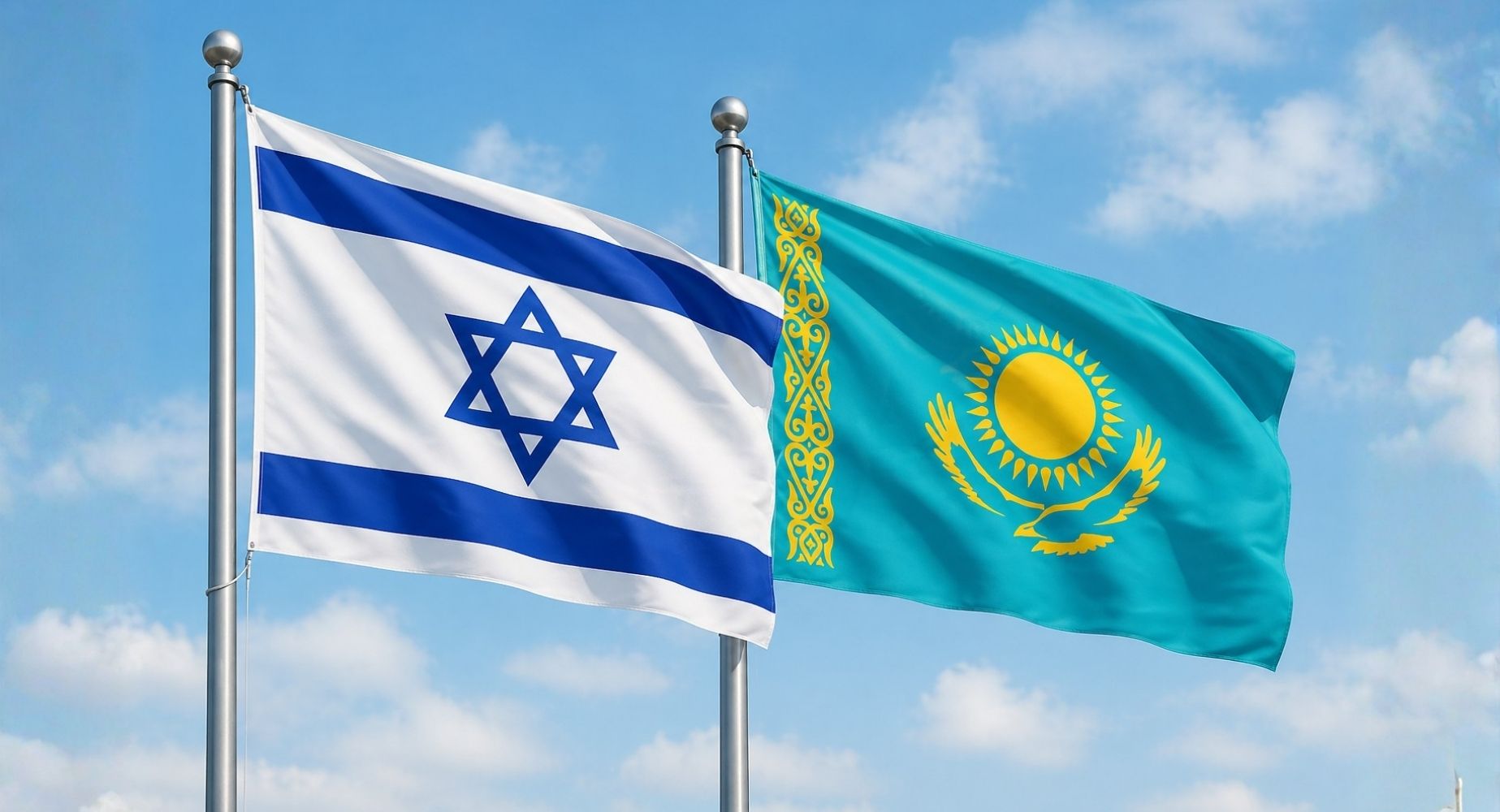
On April 27, Israeli President Isaac Herzog arrives in Astana on a state visit. It highest-level Israeli visit since that of Prime Minister Benjamin Netanyahu in December 2016 and the first such visit since Kazakhstan joined the Abraham Accords last November.
Much of the commentary on Kazakhstani accession to the Accords greeted it with a shrug and Borat memes. This is because Astana and Jerusalem have had full diplomatic ties since 1992. Several analysts called the move “largely symbolic.” But even symbolism matters when it is in short supply. Two years into the Gaza war, with Israel was facing the most sustained diplomatic backlash it has seen in decades, UN bodies, European recognition pushes, and Israeli officials accused of genocide, a Muslim-majority country of twenty million stepping into the Accords was significant and even bold.
The accession matters for three reasons. It tells us something about the Abraham Accords as a framework, something about Kazakhstan as a partner, and something about broader prospects for Israel in Central Asia.
What the Accession Signals About the Accords
Before November 6, 2025, the Abraham Accords had added no new members since Sudan in January 2021. Nearly five years of stasis spanned October 7, the Gaza war, the collapse of the Saudi normalization track, and the steady accumulation of international legal and political pressure on Israel. Most observers assumed the framework was frozen.
The accession of Kazakhstan changed those assumptions and showed the Accords can still accrete partners under conditions of maximum diplomatic hostility toward Israel. It also broke a geographic ceiling. The original Accords were an Arab-Israeli architecture: the UAE, Bahrain, Morocco, Sudan. Kazakhstan is neither Arab nor Middle Eastern. Its entry reframes the Accords as a broader Muslim-world platform. Azerbaijan, Uzbekistan, and others can now walk through the door Kazakhstan opened.
The Bilateral Relationship
Kazakhstan is an important source of crude for Israel, with one 2024 estimate putting its share at roughly one-fifth of Israeli oil imports. The supply has continued uninterrupted through every regional crisis of the past two and a half years.
In addition to energy, the bilateral relationship is unusually textured for a partner at this geographic distance. Defense cooperation dates to the mid-1990s. Cybersecurity, agricultural technology, and water-management partnerships have been steady. Air Astana opened direct Almaty-Tel Aviv flights in 2023. Tokayev was the first Central Asian leader to condemn the October 7 attacks and call for the unconditional release of Israeli hostages.
Kazakhstan’s Iran Track
For most of 2025, Kazakhstan ran what looked like genuinely parallel relationships with Israel and Iran. Iranian President Masoud Pezeshkian visited Astana in December 2025, six weeks after the Accords announcement, Kazakhstan and Iran signed fourteen agreements on trade, transit, and logistics. Tokayev described Iran as a close and reliable Middle Eastern partner, while Pezeshkian called Kazakhstan a strategic partner for Tehran. The reaction of Tehran to the Accords accession was muted and pragmatic, not confrontational.
The February 2026 US-Israeli bombing campaign against Iran tested that balance. The crisis exposed the limits of the neutrality of Kazakhstan. Astana did not break with Tehran, but its public signaling leaned more clearly toward the Gulf states and the U.S.-aligned regional order than toward Iran. When Iran retaliated against US bases in the Gulf, Tokayev sent personal messages of solidarity to the leaders of the UAE, Saudi Arabia, Qatar, Bahrain, Kuwait, Jordan, and Oman, framing the strikes as violations of sovereignty. To Iran, by contrast, Kazakhstan offered only formal condolences through Ministry of Foreign Affairs channels. Tokayev did not personally address the killing of Iranian leadership or civilian casualties. He offered Astana as a venue for eventual peace talks but stopped short of any explicit support for Tehran.
For Israel, this is the more important data point than the Pezeshkian visit. Under genuine stress, when forced toward a position, Kazakhstan tilted toward the US-Israeli-Gulf axis. It did so without breaking with Tehran openly, and without abandoning its multi-vector rhetoric, but the direction of the tilt was unmistakable. Astana is also absorbing real risk to hold this position: in August 2024, Iranian operatives attempted to strike Jewish institutions in Almaty.
The deeper point is that Kazakhstan is demonstrating a Muslim-majority country can maintain substantive cooperation with Israel without treating displeasure of Tehran as a veto.
Implications for Azerbaijan and Uzbekistan
The regional consequence matters as much as the bilateral one. Tokayev has just pulled off a diplomatic coup. After signing the accords in Washington last November at the Central Asia summit in Washington, Tokayev walked away from Washington with a $17 billion package, a personal win with President Trump, and the distinction of being the first post-Soviet state to join the Accords.
He also jumped two natural candidates. U.S. Special Envoy to the Middle East, Steve Witkoff went to Baku in March 2025 to persuade Azerbaijan to join the Accords. By every conventional measure, Azerbaijan was among the first post-Soviet Muslim-majority states to establish relations with Israel and has built one of Israel’s deepest partnerships in the Muslim world. It supplies roughly 60 percent of Israel’s gasoline needs and a deeper energy relationship than that of Kazakhstan. Its defense and intelligence cooperation with Israel is the most substantive of any Muslim-majority state. Baku has long been the obvious frontrunner for any expansion of the Accords into the Muslim world. Hesitation of Azerbaijan reflects strong opposition by Turkey to the Accords, complications with Moscow, and a potential calculation by Baku that it can extract more from a delayed entry.
If Azerbaijan is the obvious first candidate for expanding the Accords into the post-Soviet Muslim world, Uzbekistan is the second. Like Kazakhstan, Uzbekistan established diplomatic relations with Israel in 1992. It is also central to the history of Bukharan Jewry, giving it a real civilizational and diaspora link to Israel. President Shavkat Mirziyoyev has made diversification of foreign partnerships a central feature of his reform agenda. By conventional logic, Uzbekistan would be a natural Accords partner.
So why has Tashkent not moved? The answer is largely domestic. Since October 7, public expressions of solidarity with Palestinians have become more visible in Uzbekistan, including among religious authorities and online commentators. That does not mean Uzbek foreign policy is driven by the street. But it does mean that the symbolic costs of accession are higher than they are for Kazakhstan.
Uzbekistan’s larger population and more politically salient Islamic public sphere make the domestic calculus different. The Mirziyoyev government has invested considerable political capital in projecting Islamic legitimacy at home and solidarity abroad. Accession during the current conflict carries costs Tashkent is not yet willing to absorb. Its decision to join the Trump-backed Board of Peace as a founding member in January 2026 was a softer gesture: a way to signal alignment without taking on the symbolic weight of the Abraham Accords.
The strategic rationale for Uzbekistan joining is arguably stronger: critical mineral reserves Washington wants, a Taliban-bordering counterterrorism interest aligned with Israeli priorities, and a Bukharan civilizational framing, which is an authentic narrative of Muslim-Jewish coexistence–but one that may be eroding.
A Different Model
None of this is to argue that Kazakhstan is about to become a frontline partner for Israel in any military or intelligence sense. Kazakhstani foreign policy is built on parallel partnerships, strategic flexibility, and a deep aversion to being boxed into any one camp. Its alliance with Russia was upgraded to a Comprehensive Strategic Partnership and Alliance six days after the Washington announcement. Its trade with China breaks records annually.
Kazakhstan is not offering Jerusalem exclusivity. It is offering something more durable: a partnership that does not require either side to pay the costs of alignment. The relationship has survived October 7, the Gaza war, Iranian pressure, and skepticism from Russia.
This is arguably the template Israel most needs in the Muslim world over the coming decade. The Saudi grand bargain, if it comes, will carry conditions–on Palestinian statehood, on regional architecture, on political cost–that Jerusalem will find hard to meet. The Gulf model of normalization carries political and reputational costs in the Arab world that Kazakhstan, as a Central Asian Turkic state, does not pay. That is an asset.
What Kazakhstan offers is a third model: quieter, less ceremonial, more resilient, rooted in concrete interests rather than declarative breakthroughs. It also helps redraw the geography. Central Asia is usually treated as peripheral to Middle East diplomacy. The accession of Kazakhstan hints at the opposite because it links a post-Soviet, Turkic, Muslim-majority space to a normalization framework originally designed for the Arab world, reframing the Accords as a Eurasian connectivity instrument rather than a narrowly Middle Eastern one.
The diplomatic future of Israel in the wider Muslim world may depend less on grand gestures than on the steady accumulation of bilateral relationships with countries that have strategic significance.
