In 1748, Charles-Louis de Secondat, Baron de Montesquieu, published The Spirit of the Laws, one of the foundational works of modern political thought. The French philosopher, whose ideas influenced constitutional democracies far beyond France, wrote in a Europe repeatedly devastated by rivalry and war.
He offered a proposition whose relevance has survived nearly three centuries: “The natural effect of commerce is to lead to peace.” Nations that trade, he explained, become mutually dependent: one has an interest in buying what the other has an interest in selling.
Montesquieu was not naïve. He did not believe commerce could abolish ambition or the appetite for power. His insight was practical: when nations develop shared interests, peace becomes more than a moral aspiration. It becomes an economic and political necessity.
As war continues to consume Russia and Ukraine, the world must rediscover that insight. Not as a substitute for security. Not as a denial of history. And not as peace at any price. But as the foundation of a larger truth: wars are ended by agreements; lasting peace is built by interests.
The exact human cost of this conflict may remain unknown for years. Credible estimates suggest that between 500,000 and 600,000 soldiers and civilians may already have been killed. The number killed, wounded or missing may approach two million. Millions have fled their homes.
Behind these statistics are fathers and sons who will never return, children growing up beneath air-raid sirens, families divided by borders and battle lines, and communities losing the generations that should have built their future. This suffering has a name, a face and a place at millions of dinner tables where someone is now missing.
The economic cost is also devastating, though different on each side. Ukraine has suffered the destruction of homes, factories, ports, roads and energy infrastructure. Direct physical damage exceeds $195 billion, while reconstruction and recovery may require almost $588 billion.
Metinvest, Ukraine’s largest steel producer, illustrates the scale of that destruction. Its Azovstal complex, once an industrial pillar employing thousands, was destroyed during the siege of Mariupol. Facilities were lost, employees were killed or mobilized, and revenues were roughly halved.
Russia’s burden has taken another form: sanctions, inflation, labor shortages, expensive credit and the diversion of national resources toward a militarized economy. In 2025, approximately 233,000 Russian legal entities were liquidated, while only 173,000 were created. Both societies are sacrificing their future to a war with no clear military conclusion.
This war must end—and it must end now.
That is not naïveté. Diplomacy without leverage produces declarations, not settlements. Peace without enforcement merely postpones the next war. But military power without a political destination condemns nations to an endless cycle of destruction.
Who bears responsibility? Could the war have been prevented? Did Moscow, Kyiv, Washington or Europe miscalculate? Did the failure of the Minsk agreements make escalation inevitable? Could stronger diplomacy have changed the course of events?
These questions are legitimate. They will be debated for decades, and historians may reach conclusions that today’s political passions do not permit. But no answer can bring back the dead, and no interpretation of the past can justify the unlimited destruction of the future.
The urgent responsibility of leadership is not to win the argument over yesterday. It is to prevent more people from dying tomorrow.
A ceasefire alone will not be enough. Any durable settlement must address Ukraine’s sovereignty and independence, Russia’s long-term security concerns, the security of Europe, reconstruction, sanctions and credible mechanisms for verification. No peace can endure if it rests on humiliation, the denial of sovereignty or the permanent insecurity of either nation.
Yet security arrangements cannot by themselves reconcile two wounded societies. Peace must acquire economic foundations strong enough to survive changes of government, political crises and the temptations of revenge.
Those foundations are not entirely absent. Russians and Ukrainians share centuries of familial, cultural, industrial and economic connections. Before war severed them, their economies were linked across energy, transport, agriculture, metallurgy, manufacturing and aerospace. Supply chains crossed the border. Workers possessed complementary skills. Millions of families had relatives on both sides.
These bonds do not erase separate national identities or the right of each people to determine its future. But governments cannot permanently extinguish every human relationship, and peace cannot be constructed as though geography and history did not exist.
A postwar architecture should therefore include reconstruction projects, protected commercial corridors, agricultural trade, energy arrangements and carefully supervised investment. Such cooperation must be reciprocal, transparent and governed by law. Its purpose would not be to recreate the dangerous dependencies of the past, but to give both nations a material interest in stability.
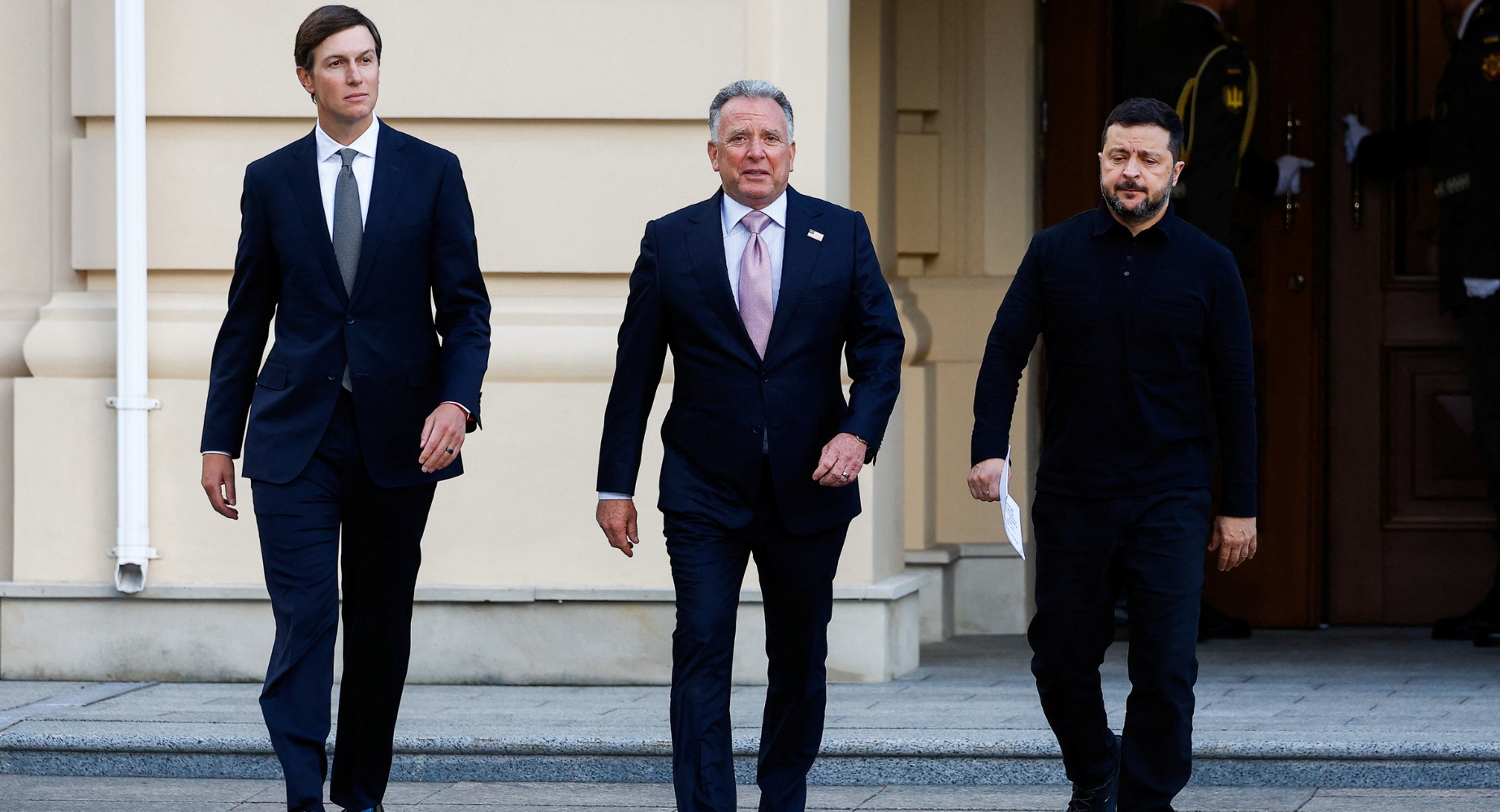
There is a compelling reason to take the present American initiative seriously. Jared Kushner has already demonstrated that Montesquieu’s insight can be translated into modern diplomacy.
The Abraham Accords did not ask societies separated by decades of conflict, religious sensitivity and political mistrust to forget their history or resolve every grievance before speaking to one another. They began with a different question: what future could these nations build together that none could build alone?
Trade, investment, technology, tourism and security cooperation were not treated merely as rewards to follow reconciliation. They became instruments of reconciliation. Common interests opened political doors that decades of conventional diplomacy had left closed.
The Abraham Accords did not resolve every conflict in the Middle East. But they proved that hostility inherited from the past does not have to determine the future.
This is what Kushner brings to the Ukrainian conflict: not a Middle Eastern formula that can simply be transferred to Europe, but a demonstrated ability to challenge diplomatic fatalism and search beyond hardened public positions for interests upon which a new relationship can be built.
Steve Witkoff now joins him in the mission entrusted to them by President Trump. It is too early to judge their initiative or predict its outcome. It deserves neither blind confidence nor premature dismissal. It deserves the political space and international support necessary to determine whether an honorable and enforceable settlement is possible.
Europe—including Britain, must help shape this effort. If the initiative fails without a credible alternative, the result will not be a better peace. It will be more deaths, deeper destruction and a growing risk of confrontation between Russia and NATO.
Peace will not endure because former enemies suddenly trust each other. It will endure when security makes renewed conflict dangerous and shared prosperity makes cooperation more valuable than war.
Montesquieu understood this in 1748. Kushner helped demonstrate its modern relevance through the Abraham Accords. American diplomacy can now offer a path out of another seemingly intractable conflict—but it cannot make the final choice for Russia and Ukraine.
That responsibility belongs to Presidents Vladimir Putin and Volodymyr Zelenskyy. Both have repeatedly invoked their devotion to their nations. History will judge them not only by the determination with which they pursued this war, but by the courage they show in ending it.
They now have an opportunity to choose a peace that neither denies their national interests nor condemns another generation to inherit this war—a peace protected by strength, sustained by shared interests and worthy of the people in whose name they lead.
They must not waste it.
