Beijing trades growth for control and unification for deterrence, while its energy depends on waters guarded by its rival.
China’s leaders face a dilemma that is political before it is economic. Every system Beijing opens to the outside world loosens the party’s hold on something it considers essential: money, information, or territory it claims. Every system it keeps closed preserves that hold, but at a price paid elsewhere. The party has made its choice. It prefers control to openness, and it is prepared to accept the costs. Three arenas show how that choice works and where it reaches its limits: the domestic system of money and data, the Taiwan Strait, and the Strait of Hormuz.
The Logic of Control
Capital controls and state-owned banks are first of all instruments of political authority. Beijing can restrict cross-border transfers, direct credit to favored sectors, and decide which institutions survive a crisis. It has removed many formal ownership caps on foreign financial institutions while retaining authority over shareholder approvals, governance, data transfers, and capital movements. Foreign banks, insurers, and asset managers may participate, but they cannot take over the institutions that direct Chinese savings and credit. That is how China permits selective foreign investment without surrendering the commanding heights of its system.
Beijing applies the same logic to artificial intelligence. AI in China is not only a commercial industry. It is part of the party’s effort to control information, strengthen domestic technology, and reduce dependence on foreign suppliers. Public-facing generative AI services operate under Chinese filing and regulatory requirements, which give the state influence over which services reach the public and how Chinese technology travels abroad. If Washington wants access to China’s AI market, it is asking Beijing to loosen its grip on data, cloud infrastructure, and the platforms through which Chinese citizens receive information. Those are not commercial concessions. They touch the foundations of party control, which is why China may buy selected American products and cooperate on narrow questions such as AI safety, but will not let American companies shape the information environment of its citizens.
The cost of this model is slower growth and weaker productivity. For the party, that is an acceptable price. A prolonged slowdown is politically manageable. A loss of control over money and information is not.
Preventing Independence, Not Forcing Unification
Taiwan is where this logic meets its most sensitive test, and where it is most often misread. Two different strategies are frequently treated as one. Forcing unification would require Beijing to change Taiwan’s status, by persuasion or by war. Preventing independence requires only that Taiwan’s status not change in the direction Beijing rejects. China’s operational strategy is the second.
The evidence lies in what Beijing actually asks for. According to China’s official readout of the November 19 meeting in Shenzhen, the American side stated that the United States does not support Taiwan independence. Beijing presented this as an achievement, yet the wording is Washington’s long-standing formula, not the stronger “opposes” that Beijing has sought. American diplomacy did not move, and the White House issued no readout. What Beijing seeks from Washington is a barrier against independence, not support for unification.
China’s own law points the same way. The Anti-Secession Law of 2005 states in its first article that its purpose is opposing and checking Taiwan’s secession. Its Article 8 ties the use of non-peaceful means first to secession and to major incidents entailing secession. The legal trigger for force is a move toward independence, not the passage of time without unification.
On the American side, policy on the ground has not moved. Washington continues to arm Taiwan. Last December, the State Department approved $11.1 billion in arms sales to Taiwan, one of the largest packages ever offered to the island, including HIMARS rocket systems, howitzers, anti-tank missiles, and drones. Older commitments are still arriving. Of the 66 F-16V Block 70 fighters Taiwan ordered in 2019, only five have been delivered: the first two in October and, as Focus Taiwan reported, three more this month. The pace is slow, but the direction is unchanged. Washington’s words decline to support independence, while its weapons ensure that unification cannot be imposed by force. Both capitals are managing the status quo rather than resolving it.
The distinction follows from the logic of control. Preventing independence is a defensive objective that Beijing can sustain for decades at a manageable cost, through diplomatic pressure, military signaling, and the steady exclusion of Taiwan from international institutions. Forcing unification would require war, and war would put at risk the domestic stability the party works so hard to preserve. A leadership that prefers a slow decline to a sudden crisis at home has every reason to prefer a frozen strait to an invasion.
Military activity around Taiwan serves this strategy. Drills and patrols put pressure on Taipei and Washington, and they show the domestic audience that the party is defending the nation and will not tolerate separatism or foreign interference. Here lies a trap. The more nationalist credibility Beijing invests in Taiwan, the harder it becomes to retreat from a confrontation. If Taiwan moves toward what Beijing considers independence, or if Washington appears to support that move, the party may feel compelled to respond forcefully, even though war is not its preferred strategy.
The strongest objection deserves an answer. Xi Jinping presents reunification as part of national rejuvenation, and the Anti-Secession Law also permits force if the possibilities for peaceful reunification are completely exhausted. Unification is therefore the stated horizon. But a horizon is not a strategy. That third condition is deliberately undefined, a reserve clause rather than a timetable, and Beijing has spent two decades without invoking it. Its conduct consistently aims at blocking independence while postponing the question of unification.
Hormuz: The Limit of Control
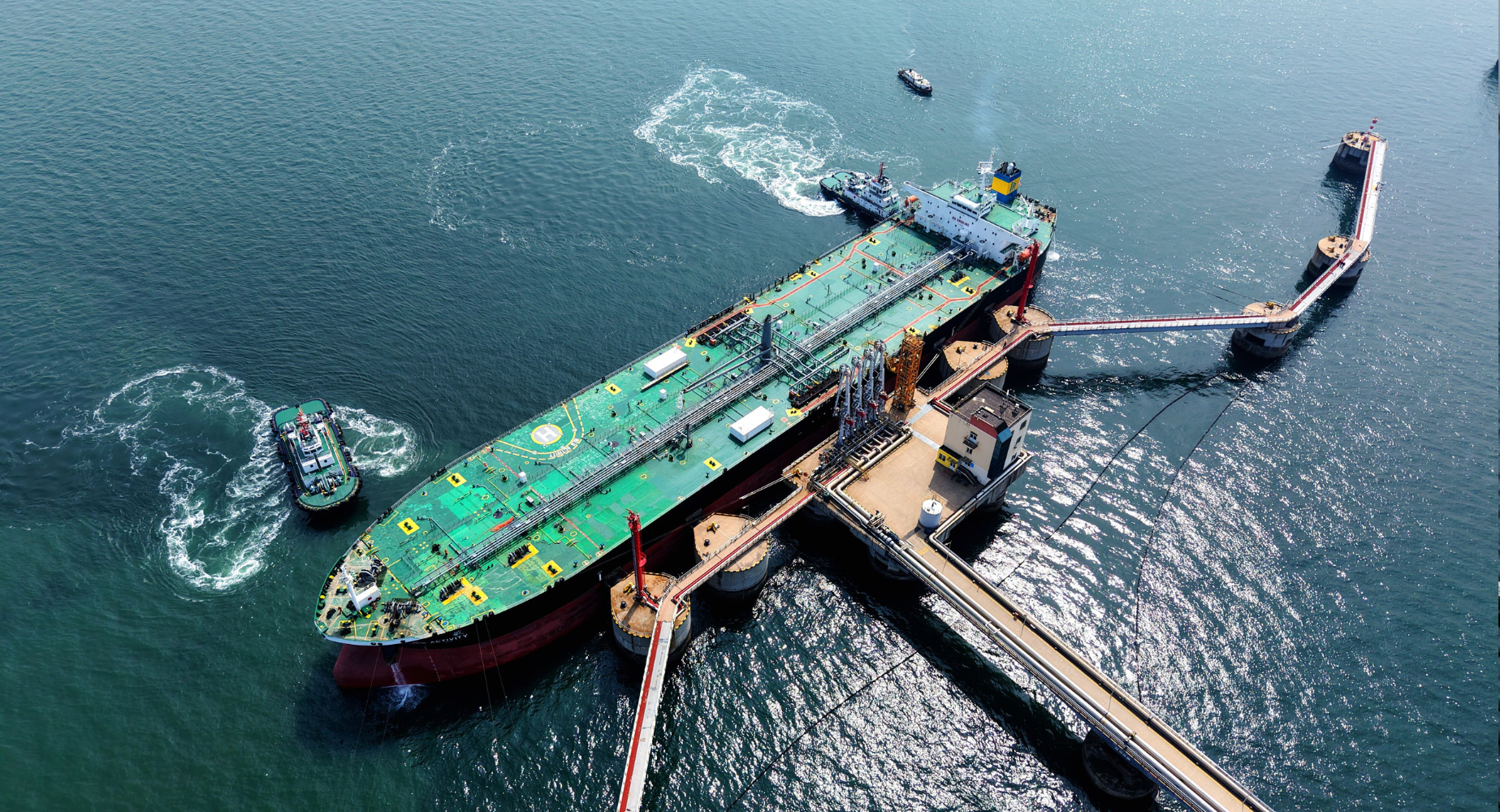
The Strait of Hormuz shows where the logic of control ends. Beijing can direct its banks, filter its information, and calibrate pressure on Taiwan. It cannot secure the sea lane on which its energy depends. Around half of China’s crude imports pass through the strait, giving Beijing a vital interest in a waterway it does not control.
That waterway is now the most dangerous chokepoint in world trade. Iranian attacks on commercial shipping continue, and much of the tanker traffic that still moves through the strait does so under American naval facilitation. For China, the loss runs in both directions. The Gulf is not only a source of energy but a market for Chinese goods, from vehicles and machinery to renewable-energy equipment, and those exports must pass through the same waters. When transits fall, Chinese energy imports and Chinese exports are cut together. Every cargo that does move pays more: by July, insurance rates through Hormuz had reached four times their five-year average, and container lines have imposed war-risk surcharges on cargo to and from the Gulf. China pays twice, as buyer and as seller.
The political meaning is plain. The country that Beijing treats as its principal strategic rival is the guarantor of the route that feeds its economy. China competes with the United States over Taiwan, technology, and influence, while relying on American naval power to keep its tankers moving. Every disruption in Hormuz raises energy prices across Asia and Europe and reminds Beijing that its model of control stops at its own borders.
This dependence also shapes China’s conduct elsewhere. A leadership that cannot protect its energy supply at sea has strong reasons to avoid a war in the Taiwan Strait, where the same American navy would stand on the other side. Hormuz does not decide China’s Taiwan strategy, but it reinforces the preference for pressure over invasion.
That is the Red Dragon’s political futures market. China is not simply choosing between growth and control. It is trying to hold power at home, deter independence across the strait, and keep its energy flowing through waters it cannot command. The party can control what lies inside its borders. Its future will be decided by how well it manages what lies beyond them.
